
61
170
-1
1530
30
Blog
Current Attractions
Each month, NTB highlights tech briefs related to a particular area of technology in a special section known as Technology Focus. Here's an Insider look at the April focus on Sensors.
Wearable Environmental and Physiological Sensing Unit
Developed at NASA™s Ames Research Center, the wearable environmental and physiological...
Blog
Technologies of the Week
A multilayer plastic film is available that meets the specifications required for flexible food packaging. View this technology here.
Blog
Fancar Aircraft
Engineers at Urban Aeronautics (Yavne, Israel) are developing the prototype X-Hawk Fancraft(TM), a Vertical Take-Off and Landing (VTOL) vehicle whose rotors, unlike a helicopter, are contained in the body of the craft. Originally envisioned as a medical evacuation vehicle, X-Hawk’s modular cargo bay allows for tailor-made,...
Blog: Nanotechnology
Nano 50 Deadline
Nominations for Nanotech Briefs' third annual Nano 50 awards competition are being accepted through 11:59 PM today, April 2. The awards honor the top 50 innovators, products, and technological advancements that demonstrate the greatest potential toward developing the commercialization of nanotechnology. Previous winners include...
Blog: Medical
Technology Business Briefs
A Fiber Optic-Based Integration System (FOBIS) has been developed that may be capable of in-situ, real-time biological monitoring, and is based on a single fiber optic system. A compact, multi-functional device, the FOBIS incorporates three working units (a Micro-Flow Cytometer, a Micro-Photometer, and a Micro-Sensor)...
Blog: Physical Sciences
Chain-mail Fabric
University of Illinois scientists have fabricated the world's smallest chain-mail fabric that consists of a network of small rings about 500 microns in diameter and even smaller links about 400 microns long. The rings and links are built upon a planar substrate and then released to create a flexible sheet that can bend along two...
Blog
White Papers
Thousands of engineers and scientists rely on National Instruments' LabVIEW for a variety of applications. This paper focuses on the capabilities that make LabVIEW the right tool for data and measurement analysis.
Blog
New Coating
Materials engineers at Purdue University have created a new type of coating that attracts water yet beads oils, promising potential applications such as "self-cleaning" eyeglasses and antifogging car windshields and ski goggles.
The coating consists of a single-molecule-thick layer of a material called polyethylene glycol, where each...
Blog
Tech Needs of the Week
Technical assistance is needed for the manufacture of serrated, scalloped (concave), and wavy (convex) bandknife blades. Of interest are 14 and 16 TPI (teeth per inch) by blanking for the serrated edge. Blanking has been achieved for the scalloped edge, but the resulting shape is not satisfactory. Blanking was not achieved...
Blog
NASA News
The "Research Opportunities in Aeronautics" announcement from NASA's Aeronautics Research Mission Directorate seeks research in several new topic areas for the Next Generation Air Transportation System Air Traffic Management Airspace Project and the Subsonic Fixed Wing Project.
Blog: Energy
Sugar Battery
Researchers at Saint Louis University (St. Louis, MO) have developed a biodegradable fuel cell battery that runs on virtually any sugar source, from soft drinks to tree sap, and has the potential to operate three to four times longer on a single charge than conventional lithium ion batteries. If the battery continues to show promise...
Blog: Electronics & Computers
Technologies of the Week
A low-cost fingerprint detector, using off-the-shelf components integrated into a compact, portable unit, is available. The fingertip is moved relative to a skin-resistance-sensing array to produce a 'reference trajectory signal' that is stored in memory. The fingertip is moved again to produce a 'sample trajectory signal.'...
Blog: Automotive
Air Car
Engineers at Moteur Developpment International (MDI, Luxembourg City, Luxembourg) have designed a prototype car that is powered by compressed air. The vehicle has a tubular chassis that is glued together, a fiberglass body, and uses wireless communication between its components. The engine weighs less than half that of a standard car....
Blog: Manned Systems
Saturn Movies
Astronomers have woven NASA Hubble Space Telescope images of Saturn, its rings, and several of its moons into three movies. Each movie highlights unique times in the planet's 30-year waltz around the Sun. Hubble snapped only about a dozen images during each of these three events, so astronomers created software to extend the photos...
Blog: Nanotechnology
Nano 50 Awards
Nanotech Briefs® magazine is accepting nominations for its third annual Nano 50 awards competition. The Nano 50 recognizes the top 50 technologies, innovators, and products with the greatest potential to advance the commercialization of nanotechnology.
Blog: Photonics/Optics
Chemical Weapons Sensor
Using lasers and tuning forks, researchers at Pacific Northwest National Laboratory have developed a chemical weapon agent sensing technique called Quartz Laser Photo-Acoustic Sensing (QPAS) that promises to meet or exceed current and emerging defense and homeland security chemical detection requirements.
The instrument is...
Blog: Materials
Tech Needs of the Week
A coating that is hard and has a high modulus of elasticity is needed for application to polyvinyl alcohol (PVA) optical films. Excellent coating adhesion and optical transparency are mandatory. The coating must withstand a force greater than 13,000 MpA, and offer a pencil hardness of B or over.To respond to this Tech Need...
Blog: Aerospace
Supply Chain Software
By 2020, NASA plans to establish a long-term human presence on the Moon. To make this possible, a reliable stream of consumables such as fuel, food and oxygen, spare parts, and exploration equipment would have to make its way from the Earth to the Moon as predictably as any Earth-based delivery system. To figure out how to do...
Blog: Electronics & Computers
New on the Market
BI Technologies Electronic Components Division (Fullerton, CA) introduced the EN line of rotary mechanical encoders. The two-bit gray code incremental encoders are housed in 11, 12, and 16 mm packages, and feature detents and push-on switch options. For more information, visit: http://link.abpi.net/l.php?20070321A6
Danaher Motion...
Blog: Mechanical & Fluid Systems
Current Attractions
Developed at NASA’s Marshall Space Flight Center (Huntsville, AL), a micro-commanding rotational-position-control system offers the advantage of less mechanical complexity, susceptibility to mechanical resonances, power demand, bulk, weight, and lower cost, relative to prior rotational-position-control systems based on...
Blog: Unmanned Systems
Fish Sensor
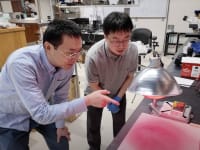
A research team led by Chang Liu at the University of Illinois at Urbana-Champaign (UIUC, Champaign, IL) has built a sensor for underwater vehicles equivalent to a sensory organ found on fish called the lateral line. In fish, the lateral line provides guidance for synchronized swimming, obstacle avoidance, and prey/predator detection...
Blog: Motion Control
Pneumatic Step Motor
Medical scientists at Johns Hopkins University (Baltimore, MD) have constructed the "PneuStep," a prototype pneumatic step motor that is the first of its kind. The motor was developed as part of a project for a robot that could operate precisely within the closed bore of high-intensity MRI equipment. The pneumatic nature of the...
Blog: Physical Sciences
Diagnostic Hydrogel
Researchers at Massachusetts Institute of Technology (MIT) have created customizable hydrogel microparticles capable of identifying different biomolecules, disease monitoring, drug discovery, or genetic profiling. Each particle is equipped with a bar-coded ID and one or more probe regions that turn fluorescent when they detect...
Blog: Robotics, Automation & Control
Robot Chair
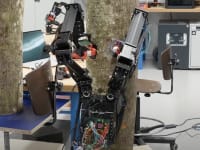
Engineers at the Humanoid Robot Research Center (Taejon, S. Korea) have constructed the prototype HUBO-FX1, a human-riding "robotic chair" capable of carrying a person or a load of 100 kg. The user sits in a chair structure mounted on two robot legs, and controls ambulatory motion by way of a joystick. The HUBO-FX1 can walk forward,...
Blog: Energy
Technologies of the Week
A self-biased solar cell is available that provides improved conversion efficiency. Loss of carriers at the back surface of the battery is decreased, and open circuit voltage and quantum efficiency near a long wavelength are increased.
View this technology here.
Blog: Green Design & Manufacturing
PCB Bacteria
Researchers at Rensselaer Polytechnic Institute have discovered a tiny anaerobic bacterium that could one day transform how polychlorinated biphenyls (PCBs) are removed from the environment. The organism could be the key to developing methods that help detoxify commercial PCB compounds on site -- without the need for dredging.
In order...
Blog: Medical
Holographic Images
The response of tumors to anticancer drugs has been observed in real-time, 3D images using technology developed at Purdue University. The new digital holographic imaging system uses a laser and a charged couple device (CCD) to see inside tumor cells. The instrument also may have applications in drug development and medical...
Blog: Energy
Technology Business Briefs
Lightweight, High-Performance Propeller/Rotor/Wind Turbine Blade
The turbine blade features a much lighter, more efficient, less expensive, and entirely new structural design. Other advantages offered bythis technology include increased performance, lower noise, decreased maintenance time and expense, and optimized...
Blog: Sensors/Data Acquisition
NASA Spinoff
A technology for monitoring protein growth -- developed in part through NASA Small Business Innovation Research (SBIR) funding from Marshall Space Flight Center -- is noninvasive, nondestructive, rapid, and more cost effective than x-ray analysis. The partner for this SBIR, Photon-X, Inc. (Huntsville, AL), developed spatial-phase...
Top Stories
 Blog: Design

Aerial Microrobots That Can Match a Bumblebee's Speed
 Blog: Energy

My Opinion: We Need More Power Soon — Is Nuclear the Answer?
 Blog: Electronics & Computers

Turning Edible Fungi into Organic Memristors
 Blog: Semiconductors & ICs

Revolutionizing the Production of Semiconductor Chips
 Blog: Robotics, Automation & Control

Microscopic Swimming Machines that Can Sense, Respond to Surroundings
 Quiz: Energy

Webcasts
 Upcoming Webinars: Power

Hydrogen Engines Are Heating Up for Heavy Duty
 Upcoming Webinars: Transportation

Advantages of Smart Power Distribution Unit Design for Automotive...
 Upcoming Webinars: Unmanned Systems

Quiet, Please: NVH Improvement Opportunities in the Early Design...
 Upcoming Webinars: Power

A FREE Two-Day Event Dedicated to Connected Mobility
 On-Demand Webinars: Automotive

E/E Architecture Redefined: Building Smarter, Safer, and Scalable Vehicles
 Podcasts: Unmanned Systems

How Sift's Unified Observability Platform Accelerates Drone Innovation