-1
1500
30
Blog: Materials
What's the best aluminum for extrusion? A Tech Briefs reader asks our expert.

Question of the Week: Robotics, Automation & Control
Would You Own a Robot Pet?
At the CES Unveiled kickoff event last week, Sony demonstrated Aibo, a social robotic pet. The technology, which will make the trip to CES 2020 in Las Vegas, makes dog noises, responds to commands, and uses cameras to recognize specific owners and their patterns. Take a look at Aibo on our Tech Briefs Instagram.
INSIDER: Materials
A team led by scientists at the University of Washington has designed and tested a 3D-printed metamaterial that can manipulate light with nanoscale precision. As...

INSIDER: Power
Researchers at the U.S. Department of Energy’s (DOE) Argonne National Laboratory have reported a new mechanism to speed up the charging of lithium-ion batteries for...

INSIDER: Sensors/Data Acquisition
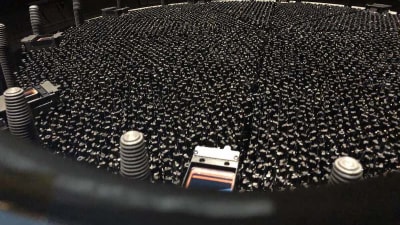
A new instrument mounted on a telescope in Arizona aimed its robotic array of 5,000 fiber-optic “eyes” at the night sky on Oct. 22 to capture the first images...
Blog: Mechanical & Fluid Systems
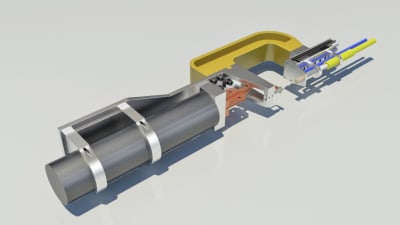
A team in Germany has a quicker, cleaner approach to welding metal to plastic: The HPCI® Joining Gun.
Question of the Week: Aerospace
Will Entire Planes Be Built By 'Assembler Robots?'
Commercial aircraft are typically manufactured in sections, often in different locations, and then flown to a central plant for final assembly. Researchers at MIT are hoping to change that.
Blog: Software
Livox uses machine learning to ease communication.

INSIDER: Motion Control
MIT researchers have compiled a dataset that captures the detailed behavior of a robotic system physically pushing hundreds of different objects. Using the dataset, robots “learn” pushing...
Blog: Aerospace
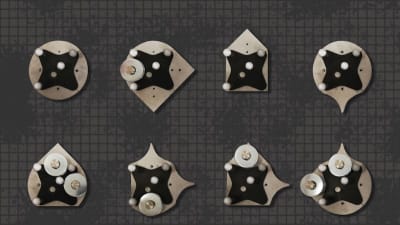
A minimal, map-less approach to drone navigation takes after the bee.

Blog: Manufacturing & Prototyping
The 'Biode' saves power by eliminating the need for AC/DC conversion.

Question of the Week: Electronics & Computers
Will ‘Print-in-Place’ Electronics Become a Mainstream Medical Tool?
The Duke University team says its “print-in-place” advancement could lead to embedded electronic tattoos and custom bandages with patient-specific biosensors.
Blog: Mechanical & Fluid Systems
The ULiSSES device preserves organs, without the ice chest.
News: Electronics & Computers
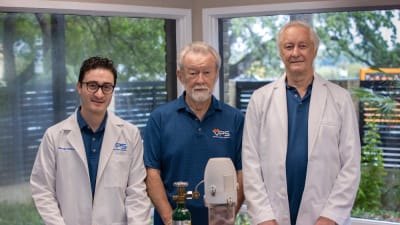
Ben Sharfi, CEO of General Micro Systems (GMS), says he has the Product of the Year. Do you agree?
Blog: Energy
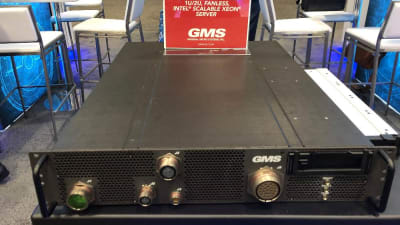
It just wouldn’t be a military technology show without a few drones on display.

News: Defense
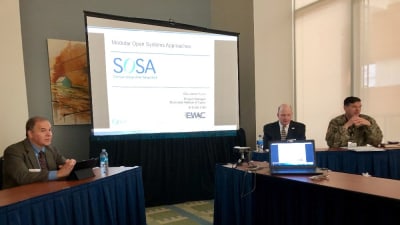
SOSA, the Sensor Open Systems Architecture Consortium, held a press conference on Monday afternoon at AUSA 2019.
Question of the Week: Aerospace
Will NASA’s New Wing Bring Greater Flexibility to Aircraft Design?
Researchers at NASA Ames Research Center and MIT have a radically new idea for an aircraft wing: hundreds of tiny subassemblied bolted together to form a constantly deformable lattice.
Blog: Transportation
Editor Bruce A. Bennett offers a look at the Association of the United States Army's 2019 Annual Meeting.

Blog: Sensors/Data Acquisition
A Tech Briefs reader asks: What's next with military motion control?

Blog: Aerospace
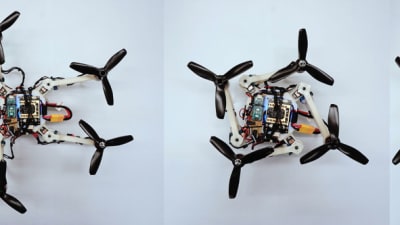
A new drone “folds” itself into configurations that suit a given environment.
Question of the Week: Mechanical & Fluid Systems
Will Wave-Powered Desalination Catch On?
Today's lead INSIDER story demonstrated how ocean waves can be used to turn seawater into freshwater.
Blog: Mechanical & Fluid Systems
Inventor Olivier Ceberio found a new way to turn ocean waves into fresh water.

Blog: Sensors/Data Acquisition
Copper cables send data around today's vehicles. "Why not fiber optics?" asks a reader.

INSIDER: Sensors/Data Acquisition
To investigate the vastly unexplored oceans covering most of our planet, researchers aim to build a submerged network of interconnected sensors that send data to the surface — an underwater...

INSIDER: Internet of Things
Combining new classes of nanomembrane electrodes with flexible electronics and a deep learning algorithm could help disabled people wirelessly control an...
INSIDER: Robotics, Automation & Control
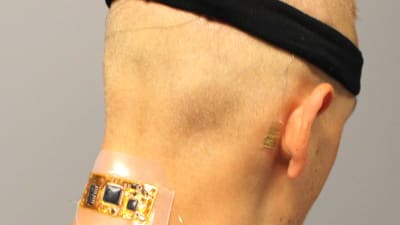
Medical implants of the future may feature reconfigurable electronic platforms that can morph in shape and size dynamically as bodies change or even transform to...

INSIDER: Sensors/Data Acquisition
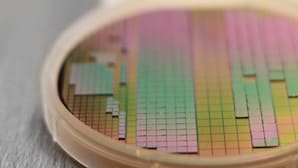
UCLA researchers at the Center for Heterogeneous Integration and Performance Scaling (CHIPS) say that computers powered by traditional integrated circuit chips are reaching their limits and a...
Question of the Week: Mechanical & Fluid Systems
Are You Encouraged by the Increasingly Sophisticated Capabilities of Today’s Robots?
Researchers from Boston Dynamics have stuck the landing and created a robot that can perform a full gymnastics routine. Watch the performance on Tech Briefs TV.
Blog: Manufacturing & Prototyping
Learn more about ULiSSES, a life-saving device for organ and limb transport.

Top Stories
 Blog: Lighting

A Stretchable OLED that Can Maintain Most of Its Luminescence
 Blog: Energy

Batteries that Can Withstand the Cold
 INSIDER: Energy

Advancing All-Solid-State Batteries
 Blog: Power

My Opinion: We Need More Power Soon — Is Nuclear the Answer?
 Quiz: Power

 Blog: Data Acquisition

Webcasts
 Upcoming Webinars: Test & Measurement

From Spreadsheets to Insights: Fast Data Analysis Without Complex...
 Upcoming Webinars: Aerospace

Cooling a New Generation of Aerospace and Defense Embedded...
 Upcoming Webinars: Sensors/Data Acquisition

Beyond AI-Copy-Paste Engineering: Advanced AI-Integration Success...
 Upcoming Webinars: Energy

Battery Abuse Testing: Pushing to Failure
 Upcoming Webinars: Power

A FREE Two-Day Event Dedicated to Connected Mobility
 Upcoming Webinars: RF & Microwave Electronics

Choosing the Right N-Port Strategy: Multiport VNAs vs. Switch...