-1
2040
30
INSIDER: Robotics, Automation & Control
Using an off-the-shelf camera flash, researchers at Jilin University, China, turned an ordinary sheet of graphene oxide into a material that bends when exposed to moisture. They then used this material...

Question of the Week: Energy
In today's lead INSIDER story, researcher Kourosh Kalantar-zadeh said of his "solar paint": "It will be widespread. It is a technology that can shift the energy economy to a hydrogen economy. This disruptive concept...
INSIDER: Materials
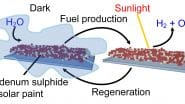
A team from Australia’s RMIT University created a “solar paint” that generates its own energy. The sunlight-absorbing substance absorbs and splits water atoms, resulting in hydrogen that...
News: Aerospace
Survey: Aerospace Engineers Seek Clarity on Cadmium
A survey of more than two hundred aerospace manufacturing professionals demonstrated a lack of understanding about cadmium, a highly toxic metal that is still being used frequently in the U.S. aerospace industry.
Question of the Week: Energy
A new story on TechBriefs.com this week featured an interview with Purdue University's John Cushman. The professor's "ifbattery" system may someday allow drivers to recharge their cars as quickly and easily as...

News: Materials
A new compressed form of glassy carbon opens up possibilities for applications requiring low weight and high strength — from aerospace parts to football helmets.

INSIDER: Energy
A new battery system may someday allow drivers to recharge their cars as quickly and easily as filling up a gas tank.

News: Information Technology
What’s New on Tech Briefs: Can You Answer Our Readers’ Big Questions?
New web-exclusive stories this month highlight soft robots, bio-printing successes, and opportunities to answer readers' questions.
Question of the Week: Energy
Can the Desolenator provide a solution for the global water crisis?
A new Tech Briefs Q&A highlighted an innovative water-purification system called the "Desolenator." Using only solar energy, the device provides clean water from any source. What do you think? Can the Desolenator provide a solution for the global water crisis?
INSIDER: Sensors/Data Acquisition
Researchers have developed a sensor package that monitors multiple phenomena in a room using machine-learning techniques. The prototype contained 19 different sensor channels, including sensors that...

INSIDER: Medical
A team from Northwestern University created bioprosthetic ovaries that ultimately led to the restoration of hormone production and fertility in mice.

INSIDER: Energy
According to the Centers for Disease Control and Prevention, 780 million people do not have access to clean water sources. The inventor of a water-purification technology hopes...

INSIDER: Sensors/Data Acquisition
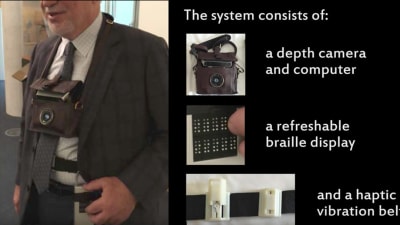
A new wearable system from the Massachusetts Institute of Technology will help blind users navigate through indoor environments.
INSIDER: Motion Control
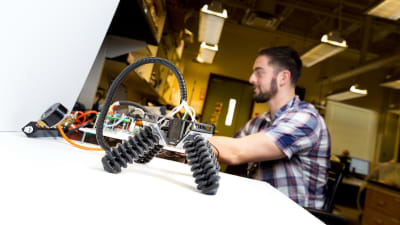
Researchers from the Robotics Research Centre at the International Institute of Technology – Hyderabad (IIIT-H), have developed a stair and obstacle climbing robot that can...

INSIDER: Motion Control
In an effort to make digital smartwatches more convenient for users, researchers at Dartmouth College and the University of Waterloo have produced a prototype watch face named Cito that moves in...

INSIDER: Mechanical & Fluid Systems
Extreme temperatures can severely strain a mechanical component because its material may have trouble enduring the heat without degrading. To address the problem, researchers at MIT developed...

Question of the Week: Robotics, Automation & Control
Will Soft Robots Improve Search-and-Rescue Operations?
University of California, San Diego researchers have demonstrated a soft robot that lifts its legs over obstacles and operates on a variety of terrains. What do you think? Will the 3D-printed quadrupedal technologies someday support search-and-rescue missions?
INSIDER: Manufacturing & Prototyping
Traditional robots often feature isolated mechanical joints. These discrete components limit a rover’s ability to traverse sand, stone, and other challenging environments.
A team at the...
INSIDER: Robotics, Automation & Control
To support human-robot interaction, designers are taking a page from philosophy and studying how we work together with one another.

INSIDER: Manufacturing & Prototyping
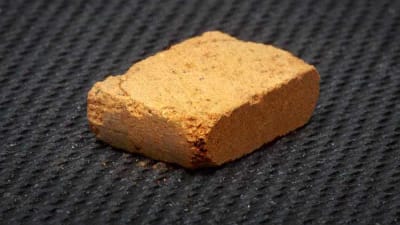
What's New on Tech Briefs: Brickmaking on Mars a 'Smashing' Success
With support from Congress and the President, NASA aims to send a manned mission to Mars by 2040. Establishing a human presence on the Red Planet, however, will require permanent shelters.
And lugging a pile of bricks on the nine-month, 35-million-mile trip is out of the...
INSIDER: Photonics/Optics
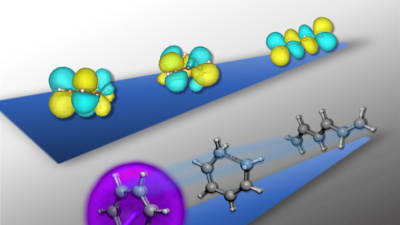
The ephemeral electron movements in a transient state of a reaction important in biochemical and optoelectronic processes have been captured and, for the first time, directly...
INSIDER: Photonics/Optics
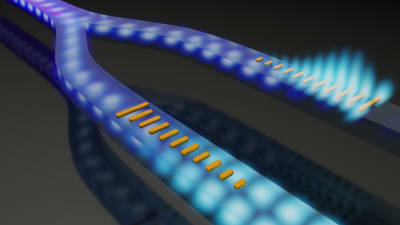
A team of Columbia Engineering researchers, led by Applied Physics Assistant Professor Nanfang Yu, has invented a method to control light propagating in confined pathways,...
INSIDER: Imaging
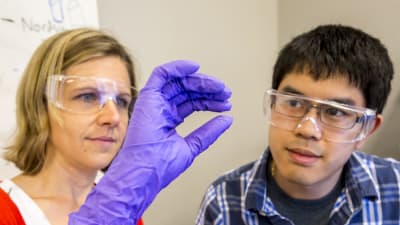
Lawrence Livermore National Laboratory scientists and academic collaborators from the University of Minnesota and Oklahoma State University have demonstrated the synthesis of transparent glass through 3D printing, a...
Question of the Week: Imaging
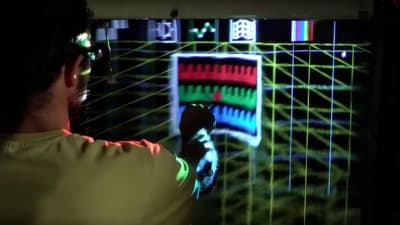
Today’s lead INSIDER story addressed a new kind of 3D visualization: a shape-shifting fog display. Researcher and co-creator Diego Martinez said the technology enables new ways to collaborate, but...
INSIDER: Imaging
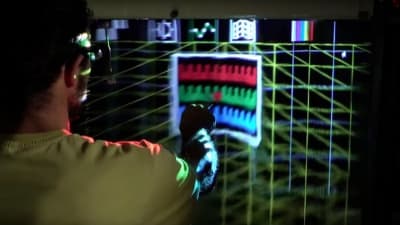
Researchers from the University of Sussex are the first to combine two cutting-edge visualization technologies in one: a fog screen and a shape-shifting display. The “MistForm” system, according to...
INSIDER: Energy
Researchers from the University of Antwerp and KU Leuven have built a proof-of-concept device that performs two noble functions simultaneously: purifying polluted air and generating power. Read...

INSIDER: Sensors/Data Acquisition
A 3D scanner, with a resolution of one million pixels and real-time data processing, operates using measuring technology that works in a similar way to human vision. To detect an object,...

Question of the Week: Materials
This week’s Question: Today’s lead INSIDER story described a potentially new way of building Mars habitats. What do you think? Will Mars habitats be built from Martian soil?
INSIDER: Energy
Internet of Things sensors will have to operate at very low powers to extend battery life for months, or make do with energy harvested from the environment. But that means that...

Top Stories
 Blog: Lighting

A Stretchable OLED that Can Maintain Most of Its Luminescence
 Blog: Energy

Batteries that Can Withstand the Cold
 INSIDER: Energy

Advancing All-Solid-State Batteries
 Blog: Power

My Opinion: We Need More Power Soon — Is Nuclear the Answer?
 Quiz: Power

 Blog: Data Acquisition

Webcasts
 Upcoming Webinars: Test & Measurement

From Spreadsheets to Insights: Fast Data Analysis Without Complex...
 Upcoming Webinars: Aerospace

Cooling a New Generation of Aerospace and Defense Embedded...
 Upcoming Webinars: Sensors/Data Acquisition

Beyond AI-Copy-Paste Engineering: Advanced AI-Integration Success...
 Upcoming Webinars: Energy

Battery Abuse Testing: Pushing to Failure
 Upcoming Webinars: Power

A FREE Two-Day Event Dedicated to Connected Mobility
 Upcoming Webinars: RF & Microwave Electronics

Choosing the Right N-Port Strategy: Multiport VNAs vs. Switch...