-1
2100
30
Question of the Week
This week's Question: San Francisco-based startup Apis Cor recently used its giant 3D printer to build a small home — in under 24 hours, according to the company. The mobile technology printed out...

INSIDER: Imaging
NASA Satellite Data Supports Global Maps of Volcanic Emissions
Volcanoes around the world continuously exhale ash and water vapor laced with heavy metals, carbon dioxide, hydrogen sulfide, and sulfur dioxide. Researchers from Michigan Technological University created the first, truly global inventory for volcanic sulfur dioxide emissions.
INSIDER: Sensors/Data Acquisition
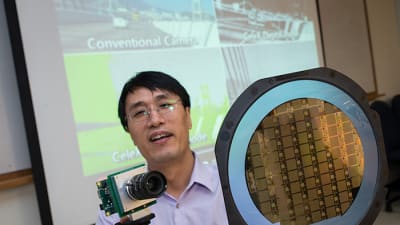
Scientists from Nanyang Technological University in Singapore developed an ultrafast high-contrast camera that could help self-driving cars and drones see better in...
INSIDER: Sensors/Data Acquisition
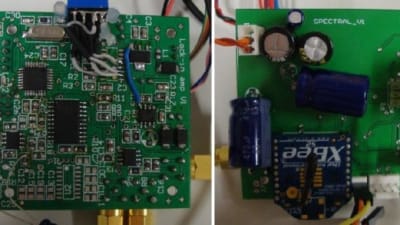
Researchers have developed a simple device that can detect an oil spill in water and then pinpoint the type of oil present on the surface. The device is designed to float on the water, where it...
INSIDER: Robotics, Automation & Control
Algorithm Improves Robots' Ability to Fetch Objects
An algorithm developed at Brown University will improve robots' ability to ask clarifying questions and more effectively retrieve objects, an important task for future robotic assistants.
Question of the Week: Sensors/Data Acquisition
Will robotic voice assistants improve children's ability to learn?
This week's Question: Toymaker Mattel recently announced the introduction of a smart baby monitor; The voice-controlled "Aristotle" uses artificial intelligence (AI) to automate functions like changing lights, playing lullabies, or triggering white noise. With an estimated 25...
INSIDER: Materials
'Tougher-than-Metal' Hydrogels Support New Biomaterials
Scientists from Japan's Hokkaido University have created tough hydrogels combined with woven fiber fabric. The "fiber-reinforced soft composite" fabrics are highly flexible, stronger than metals, and can support a number of potential applications, including artificial ligaments and tendons...
Question of the Week: Software
Can augmented reality reduce "road rage?"
This week’s Question: A new "CarNote" app from the Eindhoven University of Technology in the Netherlands aims to use augmented reality to improve the driving experience and reduce "road rage." CarNote's driver-facing periscope lens and transparent display projects information from a smartphone, allowing...
INSIDER: Motion Control
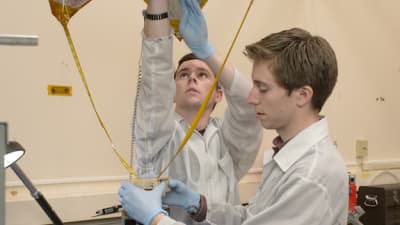
Engineers at NASA’s Ames Research Center in Moffett Field, CA have been testing its Exo-Brake technology as a simple design that promises to help bring small payloads...
INSIDER: Motion Control
Five-axis machine tools are computer-numerically controlled (CNC) machines that can move, cut, or mill a part on five different axes at the same time. Because of inherent...
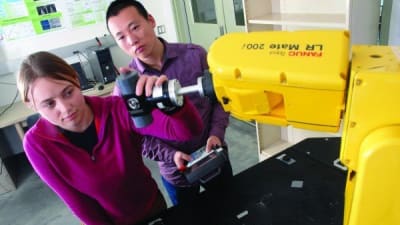
INSIDER: Motion Control
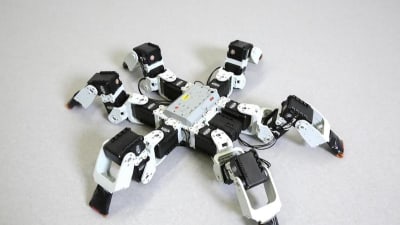
Researchers in Lausanne, Switzerland have determined that a bipod gait is the fastest and most efficient way for six-legged robots to move on flat ground, provided they don’t have the adhesive...
INSIDER: Materials
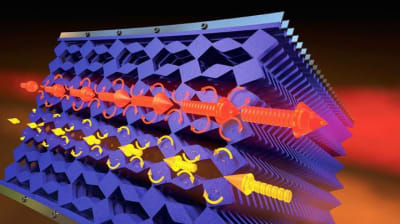
Engineers and scientists at the University of Texas at Austin and the AMOLF institute in the Netherlands have invented mechanical metamaterials that transfer motion in one direction...
INSIDER: Energy
Researchers Advance Printable Solar Cell Possibilities
By finding a new way to manufacture low-cost perovskite solar cells, a team at the University of Toronto believes that making solar cells could someday be as easy and inexpensive as printing a newspaper. The researchers' alternative solar technology supports the development of low-cost,...
Question of the Week: Aerospace
This week's Question: Amazon recently filed a patent for parachute-aided delivery of packages. The proposed idea imagines drones releasing parcels from the sky, deploying parachutes to slow...

INSIDER: Energy
Long-Lasting Flow Battery Advances Renewable Energy Efforts
A new flow battery from the Harvard John A. Paulson School of Engineering and Applied Sciences (SEAS) stores energy in organic molecules dissolved in neutral pH water. Losing only one percent of its capacity per 1000 cycles, the non-toxic, non-corrosive device offers the potential to...
Question of the Week: Energy
Will "$100-per-killowatt-hours" batteries boost wind and solar energy efforts?
This week’s Question: The Department of Energy (DOE) has set a goal of building a battery that stores energy for less than $100 per kilowatt-hour, making stored wind and solar energy competitive with energy produced from traditional power plants. Today’s lead INSIDER...
INSIDER: Energy
Iowa State University scientists have built a device that mimics the branches and leaves of a cottonwood tree and generates electricity when its artificial leaves sway in the wind. The device is derived...
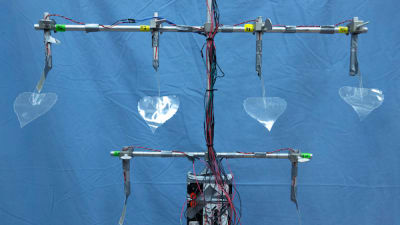
INSIDER: Electronics & Computers
Engineers at the University of California, Riverside have taken inspiration from biological evolution and the energy savings garnered by birds flying in formation to improve...
INSIDER: Materials
Light-Absorbent Material Keeps Buildings Cool
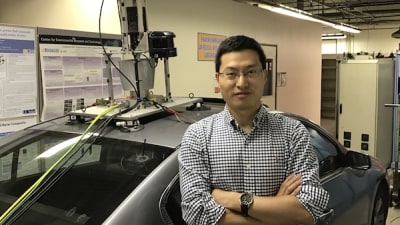
Engineers at the University of California San Diego have created a thin, flexible, light-absorbing material that absorbs more than 87 percent of near-infrared light. The technology could someday support the development of solar cells; transparent window coatings to keep cars and buildings cool; and...
INSIDER: Test & Measurement
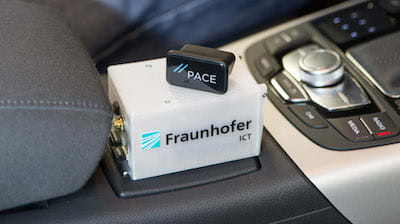
A new data logger developed by Fraunhofer researchers simultaneously collects data from vehicles with combustion engines, electric drives, external sensors, and location data, and permits the...
INSIDER: Sensors/Data Acquisition
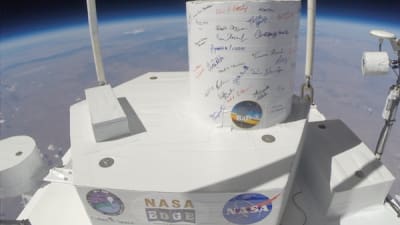
Imagine you’re sitting on an airplane cruising at 36,000 feet. Just above you, high-energy particles, called cosmic rays, are zooming in from outer space. While we are largely...
Question of the Week: Robotics, Automation & Control
Will telepresence drones take off?
This week’s Question: According to a recent application made public last week, Google is hoping to patent a "mobile telepresence system." The proposed drone is designed for collaboration with colleagues from remote locations. The technology will fly indoors and move from room to room, adjusting to unpredictable...
INSIDER: Green Design & Manufacturing
Researchers Build Solar-Powered Water Purifier
Using low-cost materials, academics from the University of Buffalo developed a solar-powered water purifier. The device could help to address global drinking water shortages, especially in developing areas and regions affected by natural disasters.
INSIDER: Materials
Researchers Create Metallic Hydrogen
Nearly a century after it was theorized, scientists from Harvard University have created the first-ever sample of one of the rarest materials on the planet: metallic hydrogen. The atomic metallic hydrogen has a potentially wide range of applications, including as a room-temperature superconductor.
Question of the Week: Materials
Will metallic hydrogen improve transportation?
This week's Question: Today's lead INSIDER story featured the development of metallic hydrogen, a technology that has a range of potential applications, from advanced rocket propellants to room-temperature superconductors. According to the Harvard University researchers, the material could support the...
INSIDER: Motion Control
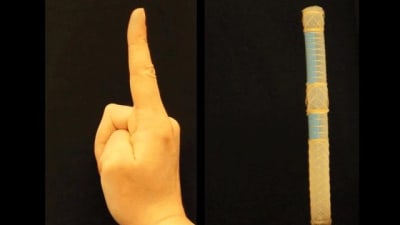
Designing a soft robot to move organically — to bend like a finger or twist like a wrist — has always been a process of trial and error. Now, researchers from the Harvard John A. Paulson...
INSIDER: Motion Control
A team of researchers from the Polytechnic University of Bari, Italy, is working to improve how industrial electric drives operate. They propose a new control scheme that will not only...
INSIDER: Materials
Researchers Awaken Graphene's Hidden Superconductivity
Since its discovery in 2004, scientists have believed that graphene contained an innate ability to superconduct. Now researchers from the University of Cambridge have found a way to activate that previously dormant potential, enabling the material to carry an electrical current with zero...
Question of the Week: Automotive
This week's Question: With backup cameras now mandatory in today's vehicles, screens in cars are increasingly becoming a standard feature. At the Consumer Electronics Show in Las Vegas this month,...

Top Stories
 Blog: Lighting

A Stretchable OLED that Can Maintain Most of Its Luminescence
 Blog: Energy

Batteries that Can Withstand the Cold
 INSIDER: Energy

Advancing All-Solid-State Batteries
 Blog: Power

My Opinion: We Need More Power Soon — Is Nuclear the Answer?
 Quiz: Power

 Blog: Data Acquisition

Webcasts
 Upcoming Webinars: Test & Measurement

From Spreadsheets to Insights: Fast Data Analysis Without Complex...
 Upcoming Webinars: Aerospace

Cooling a New Generation of Aerospace and Defense Embedded...
 Upcoming Webinars: Sensors/Data Acquisition

Beyond AI-Copy-Paste Engineering: Advanced AI-Integration Success...
 Upcoming Webinars: Energy

Battery Abuse Testing: Pushing to Failure
 Upcoming Webinars: Power

A FREE Two-Day Event Dedicated to Connected Mobility
 Upcoming Webinars: RF & Microwave Electronics

Choosing the Right N-Port Strategy: Multiport VNAs vs. Switch...