-1
2490
30
INSIDER: Lighting
A team of scientists from the National University of Singapore (NUS) has found that blue light emitting diodes (LEDs) have strong antibacterial effects on major foodborne...

INSIDER: Materials
Self-Healing Spacecraft Material Plugs Holes in Seconds
Although shields and sophisticated maneuvers could help protect space structures, scientists have to prepare for the possibility that debris could pierce a vessel. NASA and a team from the University of Michigan developed a new material that heals itself within seconds and could prevent...
INSIDER: Robotics, Automation & Control
Micro-Tentacles Help Robots Handle Delicate Objects
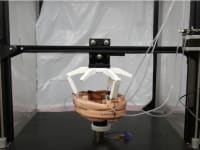
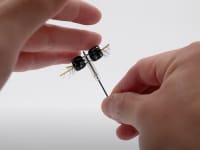
Engineers from Iowa State University developed micro-tentacles that enable robots to handle delicate objects.
“Most robots use two fingers. To pick things up, they have to squeeze,” said Jaeyoun (Jay) Kim, an Iowa State University associate professor of electrical and computer engineering and...
Question of the Week
Will we colonize Mars by 2039?
This week's Question: Buzz Aldrin, the second man to walk on the moon, is teaming up with the Florida Institute of Technology to develop a "master plan" to colonize Mars within 25 years. Aldrin envisions using Mars’ moons, Phobos and Deimos, as preliminary stepping stones for astronauts. The program would culminate...
INSIDER: Mechanical & Fluid Systems
'Snap' Design Mimics Venus Flytrap
A team led by physicist Christian Santangelo at the University of Massachusetts Amherst uses curved creases to give thin shells a fast, programmable snapping motion. The technique – inspired by the natural "snapping systems" like Venus flytrap leaves and hummingbird beaks – avoids the need for complicated...
Question of the Week
Will elevators take us to the edge of space?
This week's Question: Last month, the Canada-based company Thoth Technology received a US patent for its 12-mile space elevator design. The elevator, enclosed in a tunnel, includes a landing pad on its roof. Spacecraft would refuel and take on passengers and cargo from the pad. Some of the elements of...
INSIDER: Sensors/Data Acquisition
Depth-Sensing Camera Works in Bright Light and Darkness
A new imaging technology from Carnegie Mellon University and the University of Toronto operates in both bright sunlight and darkness. A mathematical model programs the device so that the camera and its light source work together efficiently, eliminating extraneous light, or “noise,” that...
News: Electronics & Computers
A hybrid technology mixes traditional electronics with flexible, high-performance electronics and new 3D printing technologies. The system takes a razor-thin silicon integrated...

INSIDER: Mechanical & Fluid Systems
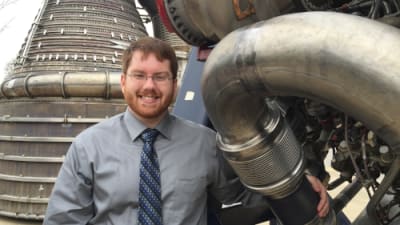
Researchers at the University of Georgia are helping NASA determine if a key rocket component can withstand the rigors of the next generation of spaceflight. The bellows...
INSIDER: Robotics, Automation & Control
3D Projection Improves Robot-to-Human Communication
Researchers at the Georgia Institute of Technology have developed a way for robots to project their next action into the 3D world and onto any moving object, such as car parts on an assembly line. The achievement will help to improve human and robot safety in manufacturing scenarios.
News: Robotics, Automation & Control
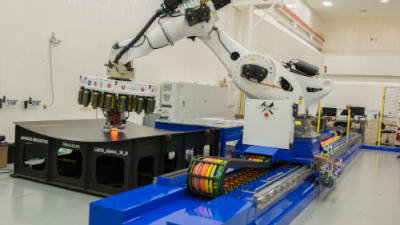
One of the largest composites manufacturing robots created in America will help NASA build the biggest lightweight composite parts ever made for space vehicles. The robot will build...
Question of the Week
Are Internet-connected cars worth the risk?
This week's Question: Last week, researchers from the University of California - San Diego discovered a vulnerability that allowed a 2013 Corvette to be hacked. The security flaw was found in dashboard hardware commonly used by insurance firms and transportation companies to monitor location, speed, and...
INSIDER: Electronics & Computers
Fujitsu has developed a new smartphone with iris recognition, and a Clarkson University professor says she expects the technology to be available in the United States in the near future....

INSIDER: Electronics & Computers
The heat that builds up in the shuttling of current in electronics is an important obstacle to packing more computing power into ever-smaller devices; excess heat can cause them to...

INSIDER: Electronics & Computers
As scientists continue to hunt for a material that will make it possible to pack more transistors on a chip, new research from McGill University and Université de Montréal adds to evidence that...

News: Test & Measurement
Smart Building Responds to all Climate Conditions
A grid of sensors embedded into an innovative building insulation activates specific façade components to optimize energy savings while improving aesthetics. This high-tech kind of retrofitting approach uses several types of modules that allow real-time monitoring. The multifunctional modular...
News: Test & Measurement
Vibration machines are crucial to test the forces that make things fall apart in the bumpy real world, from small components to complete systems like airplanes or nuclear weapons. Large,...

News: Aerospace
NASA's New Horizons probe performed the first-ever flyby of Pluto, zooming within 7,800 miles of its frigid surface. The close encounter is giving researchers their first up-close looks at...

INSIDER: Photonics/Optics
'Electron Camera' Reveals Nature's Fastest Processes
Using a method known as ultrafast electron diffraction (UED), a scientific instrument from the Department of Energy’s SLAC National Accelerator Laboratory reveals nature's fastest processes, including the rapid motions of atoms and molecules.
Question of the Week
Can an app improve your mood?
This week's Question: Smartwatches allow users to track exercise, heart rate, and other health factors, but what about mood? The design studio Ustwo has a new app that aims for a more approachable model of delivering psychological therapy. The technology, called Moodnotes, acts as a basic journaling app. The user...
INSIDER: Electronics & Computers
Simulations Reveal Material with Record-Setting Melting Point
Using advanced computers and a computational technique to simulate physical processes at the atomic level, researchers at Brown University have predicted that a material made from hafnium, nitrogen, and carbon would have the highest known melting point: 4,400 kelvins (7,460 degrees...
Question of the Week
Will Google Glass make a comeback in the workplace?
This week's Question: According to The Wall Street Journal, Google has been distributing a new version of its smart eyewear, Google Glass, to companies, engineered specifically for professionals in workplaces like health care, manufacturing, and energy. The new version will have improved battery...
INSIDER: Photonics/Optics
It’s often said that necessity is the mother of invention. Such was the case for Ames Laboratory physicist Adam Kaminski who took a challenge he was facing and turned it...
INSIDER: Photonics/Optics
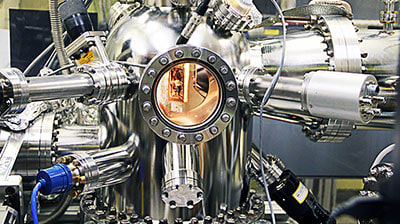
A research team has realized one of the long-standing theoretical predictions in nonlinear optical metamaterials: creation of a nonlinear material that has opposite refractive...
INSIDER: Imaging
MIT has been investigating techniques for amplifying movements captured by video, but indiscernible to the human eye. The algorithms can make the human pulse visible and even recover...

INSIDER: Motion Control
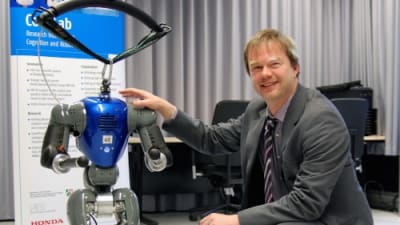
When robots and humans have to work together, it often leads to problems. Researchers on the CogIMon project want to teach robots to understand the forces during the movement of an...
INSIDER: Test & Measurement
When modern football helmets were introduced, they all but eliminated traumatic skull fractures caused by blunt force impacts. Mounting evidence, however, suggests that...

INSIDER: Materials
Simulations Reveal Near-Frictionless Material
Scientists from Argonne National Laboratory used simulations to identify and improve a new mechanism for reducing friction. The resulting hybrid material exhibited superlubricity at the macroscale.
Question of the Week
Is long-term Mars living possible?
This week's Question: A recent study created by the Arizona-based Paragon Space Development Corporation says its life support system could help humans survive on Mars. The proposed Environmental Control and Life Support System, the company says, could extract water from Mars’ rocky material and convert some of...
Top Stories
 Blog: Lighting

A Stretchable OLED that Can Maintain Most of Its Luminescence
 Blog: Energy

Batteries that Can Withstand the Cold
 INSIDER: Energy

Advancing All-Solid-State Batteries
 Blog: Power

My Opinion: We Need More Power Soon — Is Nuclear the Answer?
 Quiz: Power

 Blog: Data Acquisition

Webcasts
 Upcoming Webinars: Test & Measurement

From Spreadsheets to Insights: Fast Data Analysis Without Complex...
 Upcoming Webinars: Aerospace

Cooling a New Generation of Aerospace and Defense Embedded...
 Upcoming Webinars: Sensors/Data Acquisition

Beyond AI-Copy-Paste Engineering: Advanced AI-Integration Success...
 Upcoming Webinars: Energy

Battery Abuse Testing: Pushing to Failure
 Upcoming Webinars: Power

A FREE Two-Day Event Dedicated to Connected Mobility
 Upcoming Webinars: RF & Microwave Electronics

Choosing the Right N-Port Strategy: Multiport VNAs vs. Switch...