-1
1830
30
Question of the Week: Manufacturing & Prototyping
What are your Biggest Manufacturing Challenges?
What parts of the design process are the most difficult? What information are you looking for now to help you with your job? Is there a specific technology area that can be challenging to find out the latest solutions for?
Blog: Energy
Researchers from Purdue University demonstrated that thermoacoustics properties could theoretically occur in solids as well as liquids.

Blog: Sensors/Data Acquisition
‘FingerPing’ Recognizes Micro Motions, Soundly
A new system from the Georgia Institute of Technology has a sound approach to recognizing tiny gestures of the hand.
Question of the Week: Green Design & Manufacturing
Can a 'Cool' Strategy Improve Water-Purification Efforts?
Researchers from the University of Buffalo found a counter-intuitive way of improving the water-purification process: keeping things cool.
Blog: Materials
A stretchy material, modeled after squid skin, achieves thermal invisibility by reflecting heat.
Blog: Energy
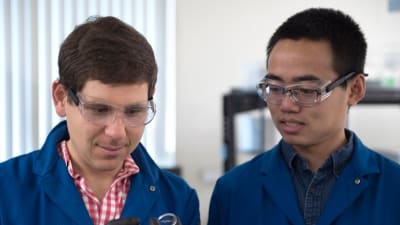
A new microchip allows sensor nodes to run uninterruptedly, even when the battery runs out.

Blog: Data Acquisition
A “MapLite” framework from MIT allows self-driving cars to navigate roads – with just GPS and sensors as a guide.

Blog: Green Design & Manufacturing
Researchers at the University of Buffalo have found a counter-intuitive way of improving the water-purification process: keeping things cool.
Question of the Week: Electronics & Computers
Would You Wear a 'Mind-Reading' Headset?
A Tech Briefs TV video this week featured AlterEgo, a “mind-reading” wearable headset from MIT's Media Lab.The technology allows a user to silently converse with a computing device, AI assistant, or application without any audible voice or discernible movements. The wearable device captures electrical...
INSIDER: Photonics/Optics
Holography, like photography, is a way to record the world around us. Both use light to make recordings, but instead of two-dimensional photos, holograms reproduce...

INSIDER: Imaging
MIT researchers have developed a system that can produce images of objects shrouded by fog so thick that human vision can’t penetrate it. It can also gauge the objects’ distance.

INSIDER: Imaging
To catch chemistry in action, scientists at the Department of Energy’s SLAC National Accelerator Laboratory use the shortest possible flashes of X-ray light to create “molecular movies”...

Blog: Automotive
Answering Your Questions: Will Reducing Nitrogen Oxide (NOx) Lead to Increased Particulate?
Does less nitrogen oxide mean more particulate emissions? A reader asks our expert.
Blog: Medical
Will 3D Printing Get Past the Plastic?
If you think there’s too much hype surrounding 3D printing, perhaps that’s because you’re only thinking about plastic parts.
Question of the Week: Materials
Will sponges effectively soak up oil spills?
This week’s lead INSIDER story highlights the Oleo sponge – a reusable material that may someday support oil-spill remediation efforts.
Blog: Electronics & Computers
Answering Your Questions: Is This the End of VME?
A reader asked our expert: What technology will spell the beginning of the end for the VME embedded computing platform?
Blog: Materials
A reusable sponge from the U.S. Department of Energy’s Argonne National Laboratory cleans up spills – not in the kitchen, but on the coast.

Question of the Week: Electronics & Computers
Will All-Liquid 3D-Printing lead to ‘Liquid Electronics’?
A recent video on Tech Briefs TV featured an achievement from Berkeley Lab scientists who have developed a way to print all-liquid 3D structures.
Blog: Robotics, Automation & Control
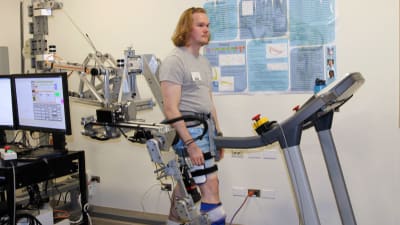
Robotics are increasingly find a role in patient rehabilitation. But are the technologies safe?
Blog: Materials
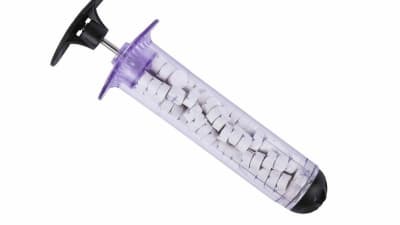
With a syringe-like applicator, the XSTAT hemostatic tool injects small, rapidly-expanding sponges into a wound cavity.
Question of the Week: Aerospace
Can a Harpoon Help with Space Clean-Up?
Once released from the International Space Station, the "RemoveDEBRIS" spacecraft will facilitate four demonstrations. One of the ideas: A harpoon. During the scheduled RemoveDEBRIS demo, the spear will be aimed at a target plate made of representative satellite materials.
Question of the Week: Robotics, Automation & Control
Will 'jet-powered' feet support search-and-rescue applications?
Tech Briefs TV this week featured research from the Guangdong University of Technology in China: A team of engineers developed a ducted-fan propulsion system that drives the legs of a bipedal robot. Watch the video, and let us know what you think.
Blog: Automotive
How to Control Vehicle Emissions: Selective Catalytic Reduction (SCR) or Exhaust Gas Recirculation (EGR)?
What's the best platform for controlling vehicle emissions? "It depends!" says one engine expert.
Blog: Electronics & Computers
Larry Curtiss answers reader questions about a new kind of lithium-air battery.

Blog: Aerospace
A “RemoveDEBRIS” satellite set to launch today will demonstrate new ideas for clearing out space junk near the International Space Station.

Question of the Week: Aerospace
Can a 'HAMMER' Protect Us from Asteroids?
Today's lead story featured a theoretical 'HAMMER' spacecraft designed to serve as a kind of asteroid "battering ram," delivering an impact at 22,000 miles per hour.
Blog: Manufacturing & Prototyping
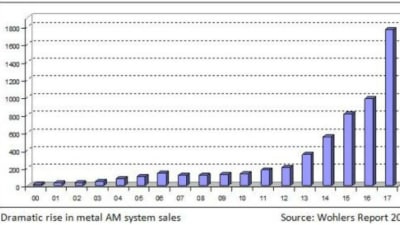
A report released this week revealed a spike in the adoption of metal additive-manufacturing systems – an increase due largely to a growing number of new companies.
Blog: Transportation
A reader asks our expert: "How do road conditions impact vehicle-to-vehicle responses?"

Blog: Semiconductors & ICs
Physical chemists at the Georgia Institute of Technology discovered an emerging class of semiconductors with some unexpected moves.

Top Stories
 Blog: Lighting

A Stretchable OLED that Can Maintain Most of Its Luminescence
 Blog: Energy

Batteries that Can Withstand the Cold
 INSIDER: Energy

Advancing All-Solid-State Batteries
 Blog: Power

My Opinion: We Need More Power Soon — Is Nuclear the Answer?
 Quiz: Power

 Blog: Data Acquisition

Webcasts
 Upcoming Webinars: Test & Measurement

From Spreadsheets to Insights: Fast Data Analysis Without Complex...
 Upcoming Webinars: Aerospace

Cooling a New Generation of Aerospace and Defense Embedded...
 Upcoming Webinars: Sensors/Data Acquisition

Beyond AI-Copy-Paste Engineering: Advanced AI-Integration Success...
 Upcoming Webinars: Energy

Battery Abuse Testing: Pushing to Failure
 Upcoming Webinars: Power

A FREE Two-Day Event Dedicated to Connected Mobility
 Upcoming Webinars: RF & Microwave Electronics

Choosing the Right N-Port Strategy: Multiport VNAs vs. Switch...