-1
2520
30
INSIDER: Nanotechnology
New Nanowires Absorb Light
Harvard University scientists have created nanowires with new useful properties. The wire not only absorbs light at specific wavelengths, but also light from other parts of the spectrum. The technology could have applications in areas ranging from consumer electronics to solar panels.
Question of the Week
Will robots be suitable emotional companions?
This week's Question: In June, Softbank sold its first 1,000 Pepper robots in less than a minute. Using cameras, touch sensors, an accelerometer, and other sensors in its neural network, Pepper has the ability to read (and develop its own) emotions. According to the company's Web site, the social...
INSIDER: Energy
Nanogenerator Harvests Power from Rolling Tires
A group of University of Wisconsin-Madison engineers and a collaborator from China have developed a nanogenerator that harvests energy from a car's rolling tire friction. The technology ultimately could provide automobile manufacturers with a new way to reuse energy and provide greater vehicle...
INSIDER: Electronics & Computers
Researchers at Rice University have discovered a new way to make ultrasensitive conductivity measurements at optical frequencies on high-speed nanoscale electronic components. The...

INSIDER: Medical
An advanced driving simulator will be used to test a patient’s driving ability after cataract surgery. The trial will help determine if a newly developed artificial lens will be...

INSIDER: Test & Measurement
The first of five instruments for a spacecraft that will collect a sample from an asteroid and bring it back to Earth has arrived at Lockheed Martin for installation onto NASA’s Origins Spectral...

Question of the Week
Will robo-cabs lower gas emissions?
This week's Question: In last week's Nature Climate Change journal, Lawrence Berkeley National Laboratory researchers reported that, by 2030, traveling by driverless electric taxi could lower greenhouse gas emissions by as much as 90% compared with the same length ride in a privately owned gas-powered car today....
News: Materials
Diamond-Like Coating Application Improves Engine Components
Applying carbon coatings to engine components, such as piston rings and pins, reduces friction and lowers fuel consumption. Using a new laser-based method, researchers at Fraunhofer-Gesellschaft, Munich, Germany, say they can now produce layers of carbon that are almost as hard as...
News: Energy
Researchers Prevent Fires in Next-Gen Lithium Batteries
New research from SLAC National Accelerator Laboratory, Menlo Park, CA, could help remove a major barrier to developing lithium-sulfur and lithium-air batteries. The SLAC engineering team discovered that adding two chemicals to a lithium metal battery's electrolyte prevents the formation of...
INSIDER: Energy
New System Stores Solar Energy at Night
Common solar energy systems today are unable to use the generated energy at night or in cloudy conditions. A University of Texas at Arlington materials science and engineering team has developed a new energy cell that stores large-scale solar energy even when it is dark.
Question of the Week
Will remote-controlled passenger flights take off in the next 5 years?
This week's Question: Last month, the Manassas, VA-based Aurora Flight Sciences Corp. tested its 4100-pound twin-propeller experimental airplane. The Centaur flew without a pilot and within airspace also being used by commercial aircraft. John Langford, the CEO of Aurora, is...
INSIDER: Mechanical & Fluid Systems
The high cost to manufacture nanofibers has relegated them to just a few niche industries. MIT researchers developed a new technique for producing nanofibers that increases the rate...
INSIDER: Manufacturing & Prototyping
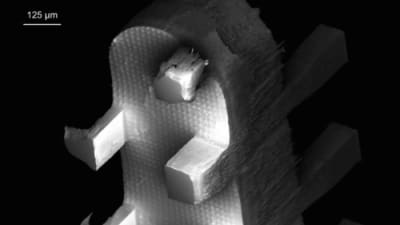
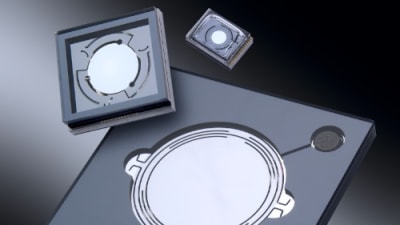
Silicon micromirrors can guide laser beams at extremely high speeds, allowing operators to dose heat input to workpieces with absolute precision. But to date, they have not been robust enough to be...
INSIDER: Manufacturing & Prototyping
A new type of graphene aerogel will make for better energy storage, sensors, nanoelectronics, catalysis, and separations. Lawrence Livermore National Laboratory made graphene aerogel microlattices with...

INSIDER: Semiconductors & ICs
Tiny Origami Robot Folds Itself Up
MIT researchers have developed a printable origami-inspired robot that, when heated, folds itself up from a flat sheet of plastic. The robot weighs a third of a gram and measures about a centimeter from front to back.
News: Aerospace
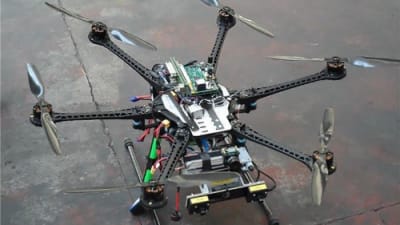
Drones, say goodbye to pilots. With the goal of achieving autonomous flight of these aerial vehicles, researchers developed a vision and learning system to control and navigate them...
Question of the Week
Will seaplanes take flight?
This week's Question: As global air traffic increases and airports expand, researchers from Imperial College London's Department of Aeronautics have developed a design concept for a medium to long-range seaplane. The proposed design, the Imperial College team says, may reduce the pressure on inland airports, lower noise...
INSIDER: Energy
More American homes could be powered by the Earth's natural underground heat with a new, nontoxic, and potentially recyclable liquid that is expected to use half as much water as other fluids used to tap...

INSIDER: Electronics & Computers
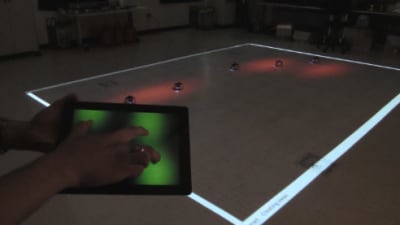
Using a tablet and a red beam of light, researchers at Georgia Tech have created a system that controls a fleet of robots with the swipe of a finger. A person taps the tablet to control where the beam...
INSIDER: Motion Control
What if handheld tools knew what needs to be done and were even able to guide and help inexperienced users to complete jobs that require skill? Researchers at the University of Bristol (UK)...

INSIDER: Electronics & Computers
University of Utah engineers have taken a step forward in creating the next generation of computers and mobile devices capable of speeds millions of times faster than current machines. The Utah engineers have...

INSIDER: Electronics & Computers
Portable electronics — typically made of non-renewable, non-biodegradable and potentially toxic materials — are discarded at an alarming rate in consumers' pursuit of the next best...

INSIDER: Electronics & Computers
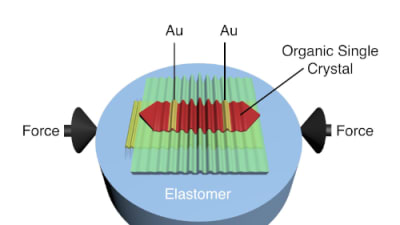
A revolution is coming in flexible electronic technologies as cheaper, more flexible, organic transistors come on the scene to replace expensive, rigid, silicone-based...
INSIDER: Energy
Engineer Creates Origami Battery
A Binghamton engineer, Seokheun "Sean" Choi, developed an inexpensive, bacteria-powered battery made from paper. Using a drop of bacteria-containing liquid, the battery generates power from microbial respiration and delivers enough energy to run a paper-based biosensor.
Question of the Week
Would you implant a technology under your skin?
This week's Question: During a speech at last week's Sensors Expo in Long Beach, California, keynote speaker and NewDealDesign technology designer Gadi Amit explained a new concept that he believes could be the next step in wearable technology. The idea, Project Underskin, is an implantable device...
INSIDER: Electronics & Computers
New Computer Operates on Water Droplets
A synchronous computer from Stanford University operates using the unique physics of moving water droplets. The work combines the manipulation of droplet fluid dynamics with a fundamental element of computer science – an operating clock.
INSIDER: Medical
A new study shows that the recently developed Compact Light Source (CLS) – a commercial X-ray source with roots in research and development efforts at the Department of Energy’s SLAC National...

INSIDER: Lighting
Flexible optoelectronic devices that can be produced roll-to-roll – much like newspapers are printed – are a highly promising path to cheaper devices such as solar cells...

INSIDER: Mechanical & Fluid Systems
New Etching Method Boosts Nanofiber Production
A new technique from MIT researchers boosts production of nanofibers fourfold, while cutting energy consumption by more than 90 percent. Potential nanofiber applications include solar cells, water filtration, and fuel cells.
Top Stories
 Blog: Lighting

A Stretchable OLED that Can Maintain Most of Its Luminescence
 Blog: Energy

Batteries that Can Withstand the Cold
 INSIDER: Energy

Advancing All-Solid-State Batteries
 Blog: Power

My Opinion: We Need More Power Soon — Is Nuclear the Answer?
 Quiz: Power

 Blog: Data Acquisition

Webcasts
 Upcoming Webinars: Test & Measurement

From Spreadsheets to Insights: Fast Data Analysis Without Complex...
 Upcoming Webinars: Aerospace

Cooling a New Generation of Aerospace and Defense Embedded...
 Upcoming Webinars: Sensors/Data Acquisition

Beyond AI-Copy-Paste Engineering: Advanced AI-Integration Success...
 Upcoming Webinars: Energy

Battery Abuse Testing: Pushing to Failure
 Upcoming Webinars: Power

A FREE Two-Day Event Dedicated to Connected Mobility
 Upcoming Webinars: RF & Microwave Electronics

Choosing the Right N-Port Strategy: Multiport VNAs vs. Switch...