33
-1
360
30
Briefs: Manufacturing & Prototyping
A nanostructure design lends extraordinary strength to a promising storage ingredient.

Briefs: Sensors/Data Acquisition
A metal-organic framework does not contain cost-intensive raw materials and can be produced in bulk.

Briefs: Sensors/Data Acquisition
This method could benefit next-generation electronics.

Briefs: Power
The new battery technology could improve electric vertical takeoff and landing aircraft and supercharge safe, long-range electric cars.

Briefs: RF & Microwave Electronics
These non-reciprocal devices on a compact chip pave the way for applications from two-way wireless to quantum computing.

Briefs: Electronics & Computers
Fully integrated flexible electronics made of magnetic sensors and organic circuits open the path towards the development of electronic skin.

Briefs: Wearables
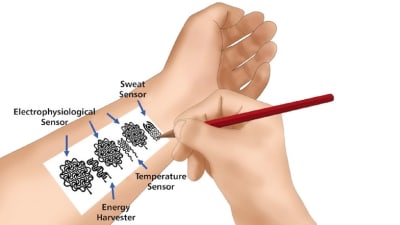
People could monitor their own health conditions by picking up a pencil and drawing a bioelectronic device on their skin.
Briefs: Materials
This approach could engineer quantum materials atom-by-atom for new electronic, magnetic, and sensing applications.

Briefs: Electronics & Computers
The algorithm provides an extra layer of safety and security against hackers of electronic devices.

Briefs: Energy
This battery would enable a 10-minute electrical vehicle recharge.

Briefs: Photonics/Optics
The tiny unit is significant for the miniaturization of optoelectronic systems.
Briefs: Electronics & Computers
“EasyPass” would enable smart warehouses, automated factories, and more to operate without delays.

Briefs: Energy
Perovskites could be the active ingredient that makes the next generation of low-cost, efficient, lightweight, and flexible solar cells.
Briefs: Electronics & Computers
To make electronic components smaller, semiconductor 2D materials are combined with new types of insulator materials.

Briefs: Electronics & Computers
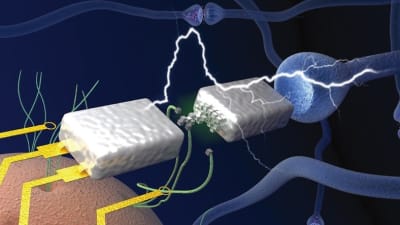
Neuromorphic computing uses memristors that could function and operate like real brain synapses.
Briefs: Software
Open source microcontroller technologies in industrially hardened form factors address critical applications.

Briefs: Electronics & Computers
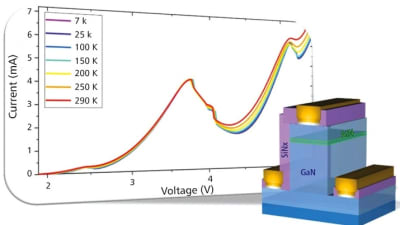
Applications include high-speed communications, networking, and sensing.
Briefs: Photonics/Optics
Flat-panel technology could transform antennas, wireless, and cellphone communications.

Briefs: Sensors/Data Acquisition
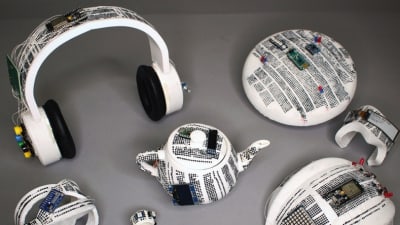
In place of flat breadboards, 3D-printed CurveBoards enable easier testing of circuit design on electronics products.
Briefs: Semiconductors & ICs
A new encapsulation technique protects electronic properties of sensitive materials.

Briefs: Nanotechnology
Pop-up miniature electronics based on the Japanese art of kirigami can be repeatedly compressed.

Briefs: Electronics & Computers
Aerogels based on cellulose nanofibers can effectively shield electromagnetic radiation over a wide frequency range.

Briefs: Communications
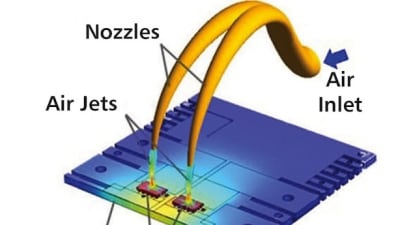
Additive manufacturing creates cooling solutions with sizes and shapes not previously possible.
Briefs: Electronics & Computers
This method provides a key step toward quantum computers, sensors, and distributed quantum information.

Briefs: Software
This high-strength material could be used to improve safety and reduce the cost of producing cars.
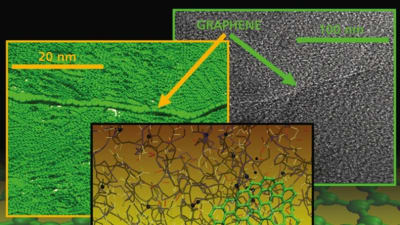
Briefs: Wearables
This neurostimulator could deliver fine-tuned treatments to patients with diseases such as epilepsy and Parkinson’s.
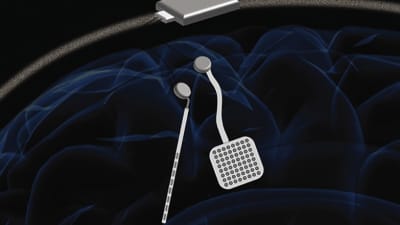
Briefs: Imaging
The material was designed specifically for biomedical or wearable technologies, since sweat and volatile organic compounds evaporate away from the skin.

Briefs: Materials
Bioactive inks printed on wearable textiles can map conditions over the entire surface of the body.

Briefs: Electronics & Computers
The ultra-light robotic insect can be folded or crushed, yet continues to move.
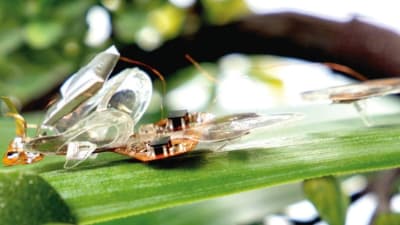
Top Stories
 Blog: Lighting

A Stretchable OLED that Can Maintain Most of Its Luminescence
 Blog: Energy

Batteries that Can Withstand the Cold
 INSIDER: Energy

Advancing All-Solid-State Batteries
 Blog: Power

My Opinion: We Need More Power Soon — Is Nuclear the Answer?
 Quiz: Power

 Blog: Data Acquisition

Webcasts
 Upcoming Webinars: Test & Measurement

From Spreadsheets to Insights: Fast Data Analysis Without Complex...
 Upcoming Webinars: Defense

Cooling a New Generation of Aerospace and Defense Embedded...
 Upcoming Webinars: AR/AI

Beyond AI-Copy-Paste Engineering: Advanced AI-Integration Success...
 Upcoming Webinars: Automotive

Battery Abuse Testing: Pushing to Failure
 Upcoming Webinars: Connectivity

A FREE Two-Day Event Dedicated to Connected Mobility
 Upcoming Webinars: RF & Microwave Electronics

Choosing the Right N-Port Strategy: Multiport VNAs vs. Switch...