44
-1
240
30
Briefs: Energy
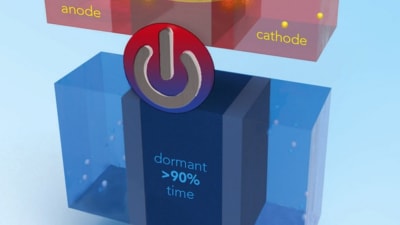
Micro-supercapacitors could revolutionize the way we use batteries by increasing their lifespan and enabling extremely fast charging. Now, researchers at Chalmers University of Technology have...

Briefs: Energy
National Institute for Materials Science (NIMS) and Softbank Corp. have developed a lithium-air battery with an energy density over 500Wh/ kg - significantly higher than currently lithium-ion batteries....

Briefs: Power
In steep mountain regions, the potential for generating electricity from a small stream of water is high, however, the hydropower potential of these regions remains untapped as it...

Briefs: Materials
Researchers from the University of Waterloo, Canada, who are members of the Joint Center for Energy Storage Research (JCESR), headquartered at the U.S. Department of Energy's (DOE) Argonne...
Briefs: Energy
Living materials made by housing biological cells within a nonliving matrix have gained popularity as scientists recognize that often the most robust materials are those that...

Briefs: Automotive
All solid materials, including glass, have a property called elastic stiffness — also known as elastic modulus. It's a measure of how much force per unit area is needed to make...
Briefs: Lighting
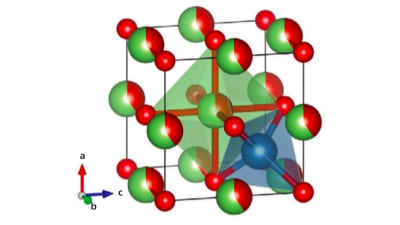
Researchers have developed technology to produce next-generation composite glass for lighting LEDs and smartphone, television, and computer screens. The technology was a step forward in perovskite...

Briefs: Energy
Decreasing Anode Corrosion in Metal-Air Batteries
Metal-air batteries can be used in a variety of applications ranging from range extenders for electric vehicles to emergency power systems. Metal-sea-water batteries are primarily used for underwater applications ranging from torpedoes to underwater unmanned vehicles. A team of researchers at the...
Briefs: Energy
Electrification of the transportation sector is critical to future energy and environmental resilience and will require high-power fuel cells (either standalone or in conjunction with batteries) to...
Briefs: Power
Electric vehicle batteries typically require a tradeoff between safety and energy density. If the battery has high energy and power density — required for uphill driving or merging on the...
Briefs: Power
Wearable electronic components incorporated directly into fabrics have been developed that could be used for flexible circuits, healthcare monitoring, energy conversion, and other applications. Graphene...

Briefs: Energy
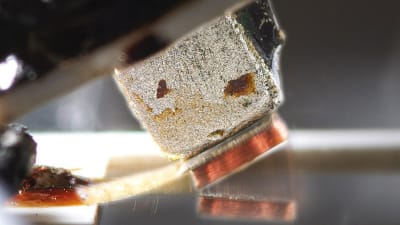
Many technical processes only use part of the energy consumed. The remaining fraction leaves the system in the form of waste heat. Frequently, this heat is released into the...
Briefs: Nanotechnology
A hybrid method enables 3D printing of self-powered wearable devices.

Briefs: Energy
The method enhances the battery's safety while it is being used, without opening the battery cell.

Briefs: Energy
Pyroelectric energy generates energy from heat that would otherwise be wasted in a catalytic chemical reaction.

Briefs: Manufacturing & Prototyping
The battery is smaller than a traditional lithium-ion battery due to the elimination of dendrites.

Briefs: Manufacturing & Prototyping
The material enables lithium-ion batteries to be safely recharged within minutes for thousands of cycles.
Briefs: Energy
The flexible, washable microgrid uses the human body to sustainably power small electronics.

Briefs: Materials
The material improves connectivity while maintaining recyclability and low cost.

Briefs: Energy
The device combines with body power to treat tendon disease and damage, and sports injuries.

Briefs: Sensors/Data Acquisition
Researchers successfully demonstrated the use of the human body as a medium for transmitting and harvesting energy to power wearables.

Briefs: Sensors/Data Acquisition
Applications include power and energy, communications, and sensors.

Briefs: Energy
In-wall capacitors power lights, phones, and laptops without wires.

Briefs: Electronics & Computers
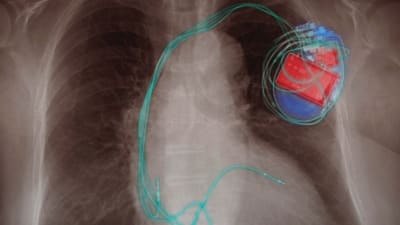
The nanothin material could advance self-powered electronics, wearable technologies, and even deliver pacemakers powered by heartbeats.
Briefs: Nanotechnology
Invisibly small nanotubes aligned as fibers and sewn into fabrics can turn heat from the Sun or other sources into energy.

Briefs: Materials
This process could improve large touchscreens, LED light panels, and window-mounted infrared solar cells.

Briefs: Manned Systems
This scalable power processing unit (PPU) is for use with low-power Hall effect thrusters.

Briefs: Green Design & Manufacturing
A new catalyst and microchannel reactors improve efficiency and cost of the process.

Briefs: Energy
The system could allow for flight speeds of Mach 6 to 17 and would have applications in air and space travel.

Top Stories
 Blog: Lighting

A Stretchable OLED that Can Maintain Most of Its Luminescence
 Blog: Energy

Batteries that Can Withstand the Cold
 INSIDER: Energy

Advancing All-Solid-State Batteries
 Quiz: Energy

 Blog: Physical Sciences

 Blog: Materials

Webcasts
 Upcoming Webinars: Test & Measurement

From Spreadsheets to Insights: Fast Data Analysis Without Complex...
 Upcoming Webinars: Electronics & Computers

Cooling a New Generation of Aerospace and Defense Embedded...
 Upcoming Webinars: Test & Measurement

Beyond AI-Copy-Paste Engineering: Advanced AI-Integration Success...
 Upcoming Webinars: Automotive

Battery Abuse Testing: Pushing to Failure
 Upcoming Webinars: Internet of Things

A FREE Two-Day Event Dedicated to Connected Mobility
 Upcoming Webinars: Test & Measurement

Choosing the Right N-Port Strategy: Multiport VNAs vs. Switch...