42
-1
60
30
Briefs: Software
MIT researchers have developed a quantum computing architecture that aims to enable extensible, high-fidelity communication between superconducting quantum processors.

Briefs: Electronics & Computers
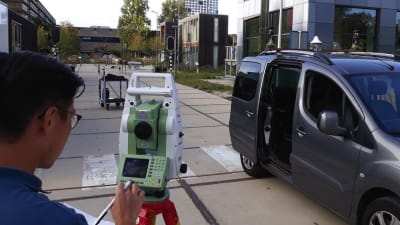
This new technology — developed by engineers at Delft University of Technology, Vrije Universiteit Amsterdam, and VSL, and which can achieve an accuracy of 10 centimeters — is important for the implementation of a range of location-based applications, such as automated vehicles, quantum communication, and next-generation mobile communication systems.
Briefs: Unmanned Systems
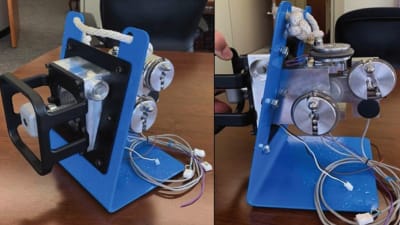
Innovators at NASA’s Johnson Space Center have designed a circumferential scissor spring mechanism, that when incorporated into a hand controller, improves the restorative force to a control stick’s neutral position. The design also provides for operation on a more linear portion of the spring’s force deflection curve, yielding better feedback to the user.
Briefs: Data Acquisition
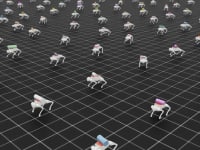
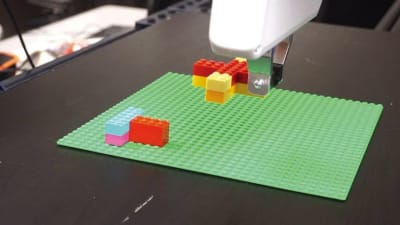
MIT researchers developed a machine-learning technique called Diffusion-CCSP. Diffusion models learn to generate new data samples that resemble samples in a training dataset by iteratively refining their output.

Briefs: Manufacturing & Prototyping
Inventors at the NASA Langley Research Center have developed a novel method to model and ingest point-wise process data to evaluate an additive manufacturing build and its file for issues by highlighting potential anomalies or other areas where the build may have issues with fusion of the material.

Briefs: AR/AI
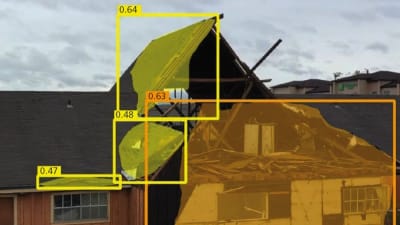
By using artificial intelligence, researchers are developing a system that can automatically identify buildings after disasters and make an initial determination of whether they are damaged and how serious that damage might be.
Briefs: Electronics & Computers
Researchers from MIT, the MIT-IBM Watson AI Lab, and elsewhere have developed a technique that enables deep-learning models to efficiently adapt to new sensor data directly on an edge device. Their on-device training method, Pock-Engine, determines which parts of a huge machine-learning model need to be updated to improve accuracy, and only stores and computes with those specific pieces.

Briefs: Materials
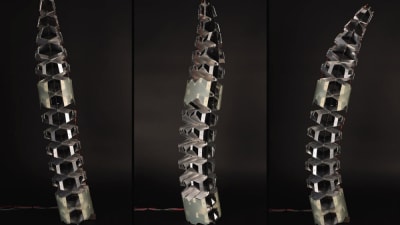
Using kirigami, the ancient Japanese art of folding and cutting paper, MIT researchers have now manufactured a type of high-performance architected material known as a plate lattice, on a much larger scale than scientists have previously been able to achieve by additive fabrication.
Briefs: Robotics, Automation & Control
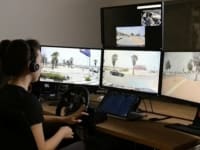
Researchers at The Ohio State University have developed new software to aid in the development, evaluation, and demonstration of safer autonomous, or driverless, vehicles. Called the Vehicle-in-Virtual-Environment (VVE) method, it allows the testing of driverless cars in a perfectly safe environment.

Briefs: Robotics, Automation & Control
A Software Model Makes Transport Robots Smarter
Imagine a team of humans and robots working together to process online orders — real-life workers strategically positioned among their automated coworkers who are moving intelligently back and forth in a warehouse space. This could become a reality sooner than later, thanks to researchers at the University of Missouri.
Briefs: Energy
Launched by Purdue University postgraduate students, Aerovy Mobility commercializes cloud-based software solutions to plan and operate infrastructure that charges electric aircraft with renewable energy.

Briefs: Electronics & Computers
New research in quantum computing at Sandia National Laboratories is moving science closer to being able to overcome supply-chain challenges and restore global security during future periods of unrest.

Briefs: Automotive
Researchers have developed the first ethical algorithm to fairly distribute the levels of risk rather than operating on an either/or principle.

Briefs: Robotics, Automation & Control
The technology could be useful in manufacturing and assembly plants for sorting packages, or in any environment where humans and robots collaborate.
Briefs: Robotics, Automation & Control
Robotic vision has come a long way, reaching a level of sophistication with applications in complex and demanding tasks, such as autonomous driving and object manipulation.

Briefs: Robotics, Automation & Control
Interactive program aids motion planning for environments with obstacles.

Briefs: Software
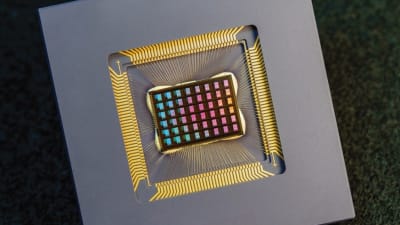
A team has designed and built a chip that runs computations directly in memory and can run a wide variety of AI applications.
Briefs: Electronics & Computers
The researchers plan to apply the design to edge computing devices.

Briefs: Software
A new area of artificial intelligence called analog deep learning promises faster computation with a fraction of the energy usage.

Briefs: Robotics, Automation & Control
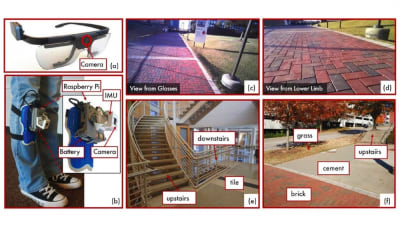
The software can be integrated with existing hardware to aid people using robotic prosthetics or exoskeletons.
Briefs: Power
NASA’s System-Wide Safety (SWS) project is developing innovative data solutions to assure safe, rapid, and repeatable access to a transformed National Airspace System.

Briefs: Imaging
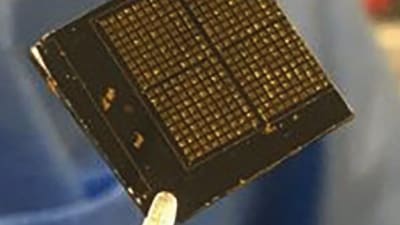
Researchers at University of Central Florida have developed an artificial intelligence device that mimics the retina of the eye.
Briefs: Transportation
Statistical Audibility Prediction Algorithm
Predicting the extent that one sound is heard over another is difficult, yet could help engineers to better design for sound management.
Briefs: Medical
Companies in many industries are completely revamping the way in which their manufacturing arms are designing, building, producing, and servicing their goods.

Briefs: Design
The new method could slash the energy cost of AI.

Briefs: Data Acquisition
MMS was developed as an add-on to NASA Ames-patented Inductive Monitoring System (IMS), which estimates deviation from normal system operations.

Briefs: Software
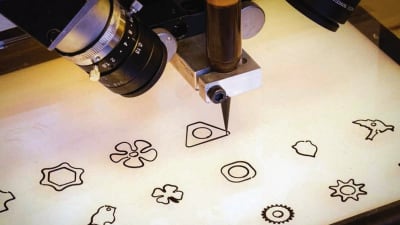
Simulations teach a neural network how to adjust printing parameters to minimize error, and then apply that controller to a real 3D printer. The system printed objects more accurately than all the other 3D-printing controllers they compared it to.
Briefs: Imaging
The models allow users to optimize X-ray radiography setups, for the detection of crack and crack-like flaws, to penetrate various materials to show internal structures of parts.

Briefs: Medical
The team compared its AI approach, known as virtual native enhancement, with contrast-enhanced CMR scans now used to monitor hypertrophic cardiomyopathy, the most common genetic heart condition.

Top Stories
 Blog: Power

My Opinion: We Need More Power Soon — Is Nuclear the Answer?
 Blog: AR/AI
Aerial Microrobots That Can Match a Bumblebee's Speed
 News: Energy

 Blog: Electronics & Computers

Turning Edible Fungi into Organic Memristors
 Blog: Robotics, Automation & Control

Microscopic Swimming Machines that Can Sense, Respond to Surroundings
 INSIDER: Sensors/Data Acquisition
Webcasts
 Upcoming Webinars: Power

Hydrogen Engines Are Heating Up for Heavy Duty
 Upcoming Webinars: Electronics & Computers

Advantages of Smart Power Distribution Unit Design for Automotive...
 Upcoming Webinars: Transportation

Quiet, Please: NVH Improvement Opportunities in the Early Design...
 Upcoming Webinars: Sensors/Data Acquisition

From Spreadsheets to Insights: Fast Data Analysis Without Complex...
 Upcoming Webinars: Energy

Battery Abuse Testing: Pushing to Failure
 Upcoming Webinars: AR/AI