39
-1
930
30
Briefs: Mechanical & Fluid Systems
Military and aerospace industries use Mil-Spec type electrical connections on bulkhead panels that require inline access for mate and demate operations. These connectors are usually in tight...

Briefs: Mechanical & Fluid Systems
A specially configured seal system (see figure) has been developed and produced that provides a barrier to gas leakage between a pressurized module and its external...

Briefs: Mechanical & Fluid Systems
Locking Nut With Stress-Distributing Insert
An improved locking nut comprises (1) an internally threaded shell, partly resembling a conventional nut, that can be engaged by a wrench or other tool, and (2) an internally and externally threaded insert that engages the threads of the shell and a bolt. Whereas some prior locking nuts are plated over...
Briefs: Mechanical & Fluid Systems
Adaptable Holders for Arc-Jet Screening Candidate Thermal Protection System Repair Materials
Reusable holders have been devised for evaluating high-temperature, plasma-resistant re-entry materials, especially fabrics. Typical material samples tested support thermal-protection-system damage repair requiring evaluation prior to re-entry into...
Briefs: Mechanical & Fluid Systems
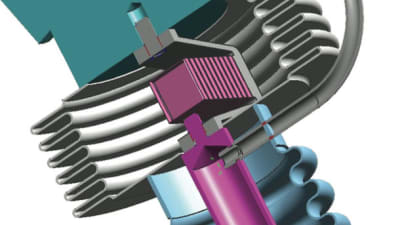
Recent experiments with a flextensional piezoelectric actuator have led to the development of a sampler with a bit that is designed to produce and capture a full set of sample forms...
Briefs: Mechanical & Fluid Systems
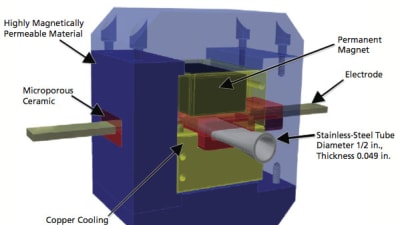
A proposed direct-current electromagnetic pump for circulating a molten alkali metal alloy would be smaller and lighter and would demand less input power, relative to currently...
Briefs: Mechanical & Fluid Systems
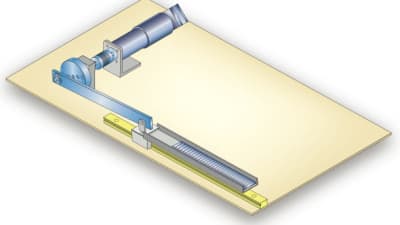
There is a need for effective sample handling tools to deliver and sort particles for analytical instruments that are planned for use in future NASA missions....
Briefs: Mechanical & Fluid Systems
Durable Tactile Glove for Human or Robot Hand
A glove containing force sensors has been built as a prototype of tactile sensor arrays to be worn on human hands and anthropomorphic robot hands. Whereas the force sensors of a prior force-sensing glove are mounted on the outside, the force sensors of this glove are mounted inside, in protective...
Briefs: Mechanical & Fluid Systems
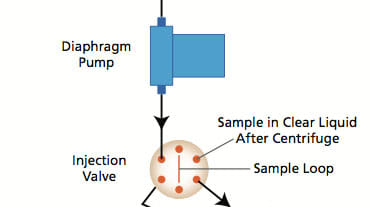
Because salt and metals can mask the signature of a variety of organic molecules (like amino acids) in any given sample, an automated system to purify complex field samples has been created for the analytical...
Briefs: Mechanical & Fluid Systems
Dedicated Deployable Aerobraking Structure
A dedicated deployable aerobraking structure concept was developed that significantly increases the effective area of a spacecraft during aerobraking by up to a factor of 5 or more (depending on spacecraft size) without substantially increasing total spacecraft mass. Increasing the effective aerobraking...
Briefs: Mechanical & Fluid Systems
Ultrasonic/sonic rotary-hammer drill (USRoHD) is a recent addition to the collection of apparatuses based on ultrasonic/sonic drill corer (USDC). As described below, the USRoHD has several features, not...

Briefs: Mechanical & Fluid Systems
Lunar Soil Particle Separator
The Lunar Soil Particle Separator (LSPS) beneficiates soil prior to in situ resource utilization (ISRU). It can improve ISRU oxygen yield by boosting the concentration of ilmenite, or other iron-oxide-bearing materials found in lunar soils, which can substantially reduce hydrogen reduction reactor size, as well as...
Briefs: Mechanical & Fluid Systems
The planned Mars Science Laboratory mission requires inlet funnels for channeling unconsolidated powdered samples from the sampling and sieving...

Briefs: Mechanical & Fluid Systems
The Picosat and Uninhabited Aerial Vehicle Systems Engineering (PAUSE) project is developing balloon-borne instrumentation systems as aerobots for scientific exploration of remote planets and for...

Briefs: Mechanical & Fluid Systems
Hybrid Heat Exchangers
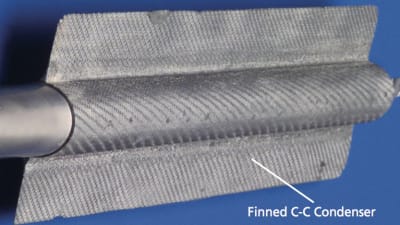
A hybrid light-weight heat exchanger concept has been developed that uses high-conductivity carbon-carbon (C–C) composites as the heat-transfer fins and uses conventional high-temperature metals, such as Inconel, nickel, and titanium as the parting sheets to meet leakage and structural requirements.
Briefs: Mechanical & Fluid Systems
Orbital Winch for High-Strength, Space-Survivable Tethers
An Orbital Winch mechanism enables high-load, multi-line tethers to be deployed and retracted without rotating the spool on which the tether is wound. To minimize damage to the tether and the wound package during retraction or deployment under load, it can incorporate a Tension Management...
Briefs: Mechanical & Fluid Systems
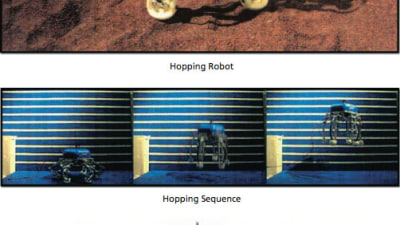
The figure depicts selected aspects of a six-legged robot that moves by hopping and that can be steered in the sense that it can be launched into a hop in a controllable direction. This is a prototype of...
Briefs: Mechanical & Fluid Systems
A proposed robotic system for scientific exploration of rough terrain would include a stationary or infrequently moving larger base robot, to which would be tethered a smaller hopping robot of the type...

Briefs: Mechanical & Fluid Systems
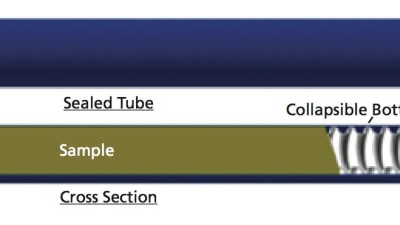
A system is proposed for packaging material samples on a remote planet (especially Mars) in sealed sample tubes in preparation for later return to Earth. The sample tubes (Figure 1)...
Briefs: Mechanical & Fluid Systems
Offset Compound Gear Drive
The Offset Compound Gear Drive is an in-line, discrete, two-speed device utilizing a special offset compound gear that has both an internal tooth configuration on the input end and external tooth configuration on the output end, thus allowing it to mesh in series, simultaneously, with both a smaller external tooth input...
Briefs: Mechanical & Fluid Systems
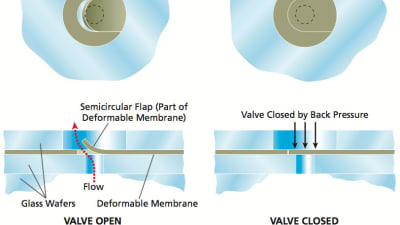
A simple design concept for check valves has been adopted for microfluidic devices that consist mostly of (1) deformable fluorocarbon polymer membranes sandwiched between (2) borosilicate float glass...
Briefs: Mechanical & Fluid Systems
Low-Dead-Volume Inlet for Vacuum Chamber
Gas introduction from near-ambient pressures to high vacuum traditionally is accomplished either by multi-stage differential pumping that allows for very rapid response, or by a capillary method that allows for a simple, single-stage introduction, but which often has a delayed response. Another means to...
Briefs: Mechanical & Fluid Systems
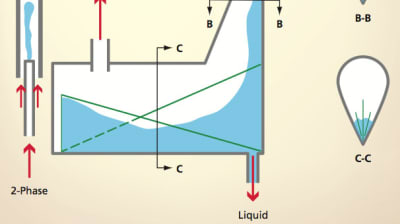
The invention, a static phase separator (SPS), uses airflow and capillary wetting characteristics to passively separate a two-phase (liquid and air) flow. The...
Briefs: Mechanical & Fluid Systems
Lightweight Heat Pipes Made From Magnesium
Magnesium has shown promise as a lighter-weight alternative to the aluminum alloys now used to make the main structural components of axially grooved heat pipes that contain ammonia as the working fluid. Magnesium heat-pipe structures can be fabricated by conventional processes that include extrusion,...
Briefs: Mechanical & Fluid Systems
This elemental space radiator heat pipe is designed to operate in the 700 to 875 K temperature range. It consists of a C–C (carbon-carbon) shell made from poly-acrylonitride fibers...
Briefs: Mechanical & Fluid Systems
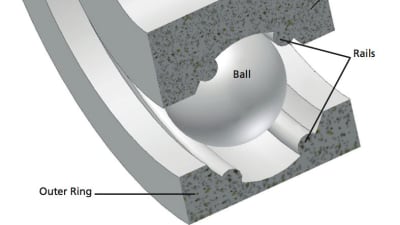
Non-lubricated ball bearings featuring rail races have been proposed for use in mechanisms that are required to function in the presence of mineral dust particles in very low-pressure, dry environments with...
Briefs: Mechanical & Fluid Systems
Gimballing Spacecraft Thruster
A gimballing spacecraft reaction-control-system thruster was developed that consists of a small hydrogen/oxygen-burning rocket engine integrated with a Canfield joint. (Named after its inventor, a Canfield joint is a special gimbal mount that is strong and stable yet allows a wide range of motion.) One especially...
Briefs: Mechanical & Fluid Systems
Instrument for Analysis of Greenland’s Glacier Mills
A new instrument is used to study the inner workings of Greenland’s glacier mills by riding the currents inside a glacier’s moulin. The West Greenland Moulin Explorer instrument was deployed into a tubular shaft to autonomously record temperature, pressure, 3D acceleration, and location. It...
Briefs: Mechanical & Fluid Systems
Low-Friction, Low-Profile, High-Moment Two-Axis Joint
The two-axis joint is a mechanical device that provides two-degrees-of-freedom motion between connected components. A compact, moment-resistant, twoaxis joint is used to connect an electromechanical actuator to its driven structural members. Due to the requirements of the overall mechanism, the...
Top Stories
 Blog: Power

My Opinion: We Need More Power Soon — Is Nuclear the Answer?
 Blog: AR/AI

Aerial Microrobots That Can Match a Bumblebee's Speed
 News: Energy

 Blog: Electronics & Computers

Turning Edible Fungi into Organic Memristors
 Blog: Robotics, Automation & Control

Microscopic Swimming Machines that Can Sense, Respond to Surroundings
 INSIDER: Sensors/Data Acquisition

Webcasts
 Upcoming Webinars: Power

Hydrogen Engines Are Heating Up for Heavy Duty
 Upcoming Webinars: Electronics & Computers

Advantages of Smart Power Distribution Unit Design for Automotive...
 Upcoming Webinars: Transportation

Quiet, Please: NVH Improvement Opportunities in the Early Design...
 Upcoming Webinars: Sensors/Data Acquisition

From Spreadsheets to Insights: Fast Data Analysis Without Complex...
 Upcoming Webinars: Energy

Battery Abuse Testing: Pushing to Failure
 Upcoming Webinars: AR/AI