
Stories
44
0
1170
30
INSIDER: Energy
Although perovskites are a promising alternative to silicon for solar cells, new manufacturing processes are needed to make them practical for commercial production. To help fill...

INSIDER: Electronics & Computers
Researchers from Rensselaer Polytechnic Institute have demonstrated how to overcome a persistent challenge to potassium metal batteries — dendrites. Their new battery...

INSIDER: Power
Solid state batteries are of great interest to the electric vehicle industry. New technology developed by scientists at Chalmers University of Technology, Sweden and Xi'an...

INSIDER: Robotics, Automation & Control
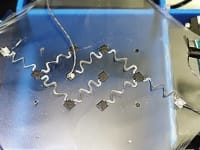
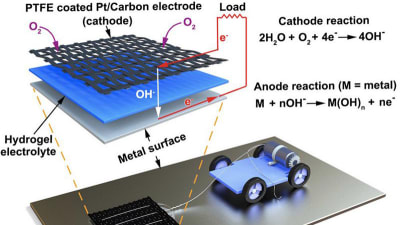
A new metal-air scavenger works like a battery, in that it provides power by repeatedly breaking and forming a series of chemical bonds. But it also works like a harvester, in...
Blog: Green Design & Manufacturing
"Who knows? Maybe one day we will have roofs covered with humidity panels together with solar panels," TAU professor Colin Price told Tech Briefs.

Question of the Week: Energy
Will On-Demand Octane Improve Fuel Economy?
A video on Tech Briefs TV this month demonstrated a Pacific Northwest National Laboratory technology that enables on-demand octane by portioning ethanol from gasoline. PNNL researchers believe their invention could increase fuel economy and lower greenhouse gas emissions. Do you agree? Watch the video on...
Briefs: Energy
The rainproof, stainproof technology turns clothing into self-powered remotes while turning away bacteria.

Briefs: Energy
These composites could improve how unmanned vehicles dissipate energy.

Briefs: Energy
This green process produces pristine graphene in bulk using waste food, plastic, and other materials.
Briefs: Manufacturing & Prototyping
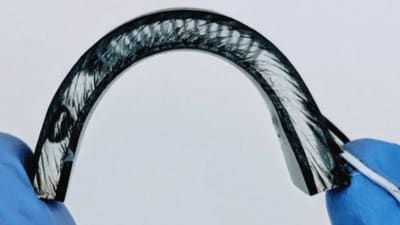
The flexible device harvests heat energy from the body to monitor health.
Briefs: Manufacturing & Prototyping
This method of producing clean syngas could be used to develop a sustainable liquid fuel alternative to gasoline.

Articles: Electronics & Computers
Nature-Inspired Energy Tech, Superelastic Tires, Wearable Supercapacitors, and more...

Facility Focus: Energy
Rensselaer Engineering focuses on solving the “grand challenges” facing humanity.

Technology Leaders: Sensors/Data Acquisition
Low-power radio design is enabling new connected IoT products for consumer, commercial, industrial, and medical markets.

Technology Leaders: Wearables
Bio-interfacing and biodegradable flexible hybrid electronics (FHE) devices can help tackle some of the world’s great challenges including environmental degradation and food scarcity.

Briefs: Materials
This type of energy source could be the basis for robots that seek out and “eat” metal, breaking down its chemical bonds for energy like humans do with food.

Blog: Materials
The Los Angeles, CA-based company Nanotech Energy is using graphene to prevent thermal runaway and create a non-flammable battery.

Briefs: Software
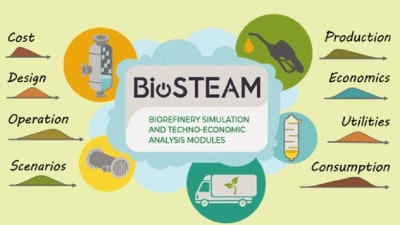
This fast, flexible tool allows researchers to quickly compare and prioritize strategies for converting biomass to fuels and products.
Briefs: Aerospace
This new design could conserve energy used for defrosting airplanes, appliances, and more.

Briefs: Materials
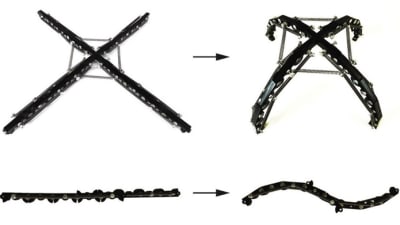
The domino effect is used to design deployable systems that expand quickly with a small push and are stable and locked into place after deployment.
Briefs: Automotive
The method slashes battery testing times — a key barrier to longer-lasting, faster-charging batteries for electric vehicles.

Briefs: Energy
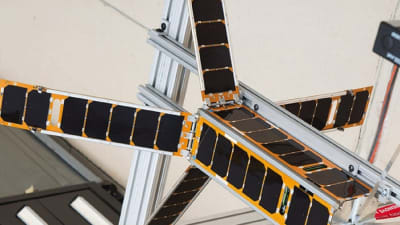
This lightweight and efficient mechanism enables retention, release, and deployment of solar arrays and antennas.
Briefs: Electronics & Computers
A liquid crystal elastomer can be programmed to exhibit controllable, dynamic behavior without the need for complex electronic components.

Briefs: Electronics & Computers
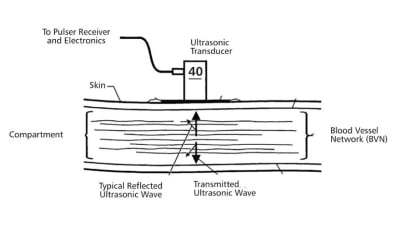
Applications include emergency medicine, combat casualty care, and sports injuries.
Briefs: Lighting
The AI system can help shorten the time required for 2D material-based electronics to be ready for consumer devices.

Briefs: Electronics & Computers
The capacitor could enable a new generation of electronics that will require less power and generate less heat.

Question of the Week: Transportation
Will 'Metal-Air Scavengers' Power Vehicles and Robots?
Penn Engineering researchers have introduced a "metal-air scavenger" vehicle, which gets energy not from a battery, but from breaking chemical bonds in the aluminum surface it travels over. The technology, which works like both a battery and an energy harvester, has 13 times more energy density...
Blog: Automotive
A team at Northwestern University is developing a material so porous that if you were able to unfold a gram of it, you could go farther than a football field.

Blog: Test & Measurement
A Berkeley Lab system provides a much more sensitive probe of the chemical state of battery electrodes, especially when the battery is operated under high capacity mode.
Top Stories
 Blog: Robotics, Automation & Control

Aerial Microrobots That Can Match a Bumblebee's Speed
 Blog: Electronics & Computers

Turning Edible Fungi into Organic Memristors
 Blog: Manufacturing & Prototyping

Revolutionizing the Production of Semiconductor Chips
 News: Energy

 INSIDER: Electronics & Computers

World’s Smallest Programmable, Autonomous Robots
 INSIDER: Manufacturing & Prototyping

Webcasts
 On-Demand Webinars: Power

E/E Architecture Redefined: Building Smarter, Safer, and Scalable Vehicles
 Upcoming Webinars: Energy

Hydrogen Engines Are Heating Up for Heavy Duty
 Upcoming Webinars: Electronics & Computers

Advantages of Smart Power Distribution Unit Design for Automotive...
 Upcoming Webinars: Automotive

Quiet, Please: NVH Improvement Opportunities in the Early Design...
 Upcoming Webinars: Power

A FREE Two-Day Event Dedicated to Connected Mobility
 Podcasts: Defense

How Sift's Unified Observability Platform Accelerates Drone Innovation