Stories
36
928
0
600
30
Products: Electronics & Computers
Laser Sensors
The optoNCDT 1750 laser sensors from Micro-Epsilon, Raleigh, NC, feature measuring ranges of 500 and 750 mm for fast, high-precision measurement tasks that require large measuring ranges. They are...

Q&A: Sensors/Data Acquisition
Researchers at Oregon State University’s College of Engineering have taken an important step toward the rapid manufacture of stretchable electronic devices,...

Application Briefs: Manufacturing & Prototyping
Stratasys Ltd.Eden Prairie, MNwww.stratasys.com
Orion is NASA’s spacecraft that will send astronauts to the Moon and beyond. Orion’s next test flight, dubbed Exploration Mission-1 (EM-1), will...

Blog: Manufacturing & Prototyping
If digital transformation is a boardroom priority, why are companies so slow to transform product development? A reader asks our experts.

Blog: Transportation
Answering Your Questions: Beyond Prototyping, How is 3D Metal Printing Being Used in the Automotive Industry?
Can metal 3D printing help automakers with more than just prototyping? It can, and it has, says our engineering expert.
Question of the Week: Manufacturing & Prototyping
What are your Biggest Manufacturing Challenges?
What parts of the design process are the most difficult? What information are you looking for now to help you with your job? Is there a specific technology area that can be challenging to find out the latest solutions for?
Blog: Manufacturing & Prototyping
Will 3D Printing Get Past the Plastic?
If you think there’s too much hype surrounding 3D printing, perhaps that’s because you’re only thinking about plastic parts.
Briefs: Propulsion
Large-scale liquid rocket engines with regeneratively cooled nozzles will enable reliable and reduced-cost access to space. The coolant that circulates through the internal...

Briefs: Robotics, Automation & Control
Soft robots inspired by nature can crawl, swim, grasp delicate objects, and even assist a beating heart, but none of them has been able to sense and respond to the...

Briefs: Test & Measurement
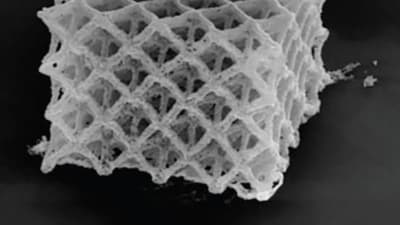
Two-photon lithography (TPL), a high-resolution 3D printing technique, is capable of producing nanoscale features smaller than 1/100 the width of a human hair. The technique could enable X-ray...

Briefs: Medical
A “4D printing” method was developed for a smart gel that could lead to the development of living structures in human organs and tissues, soft robots, and targeted drug delivery.

Articles: Automotive
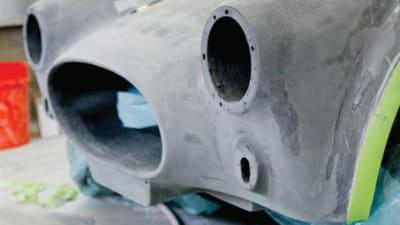
Next-generation manufacturing takes on a 50-year-old icon as ORNL researchers transform the classic Shelby Cobra sports car into a 3D-printed laboratory on wheels. Additive manufacturing enables the seamless integration...
Question of the Week: Electronics & Computers
Will All-Liquid 3D-Printing lead to ‘Liquid Electronics’?
A recent video on Tech Briefs TV featured an achievement from Berkeley Lab scientists who have developed a way to print all-liquid 3D structures.
Briefs: Mechanical & Fluid Systems
Every complex human tool has contained multiple materials wedged, tied, screwed, glued, or soldered together. But the next generation of tools, from autonomous squishy robots to flexible...

Briefs: Manufacturing & Prototyping
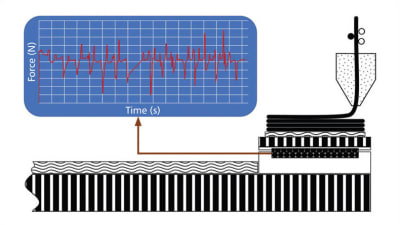
NASA Langley Research Center has developed a test station capable of in-situ testing of material deposition and layer adhesion in an extrusion additive manufacturing process. The technology addresses the problem of...
Briefs: Materials
In 3D printing — also known as additive manufacturing — an object is built layer-by-layer, allowing for the creation of structures that would be impossible to manufacture by...
Blog: Manufacturing & Prototyping
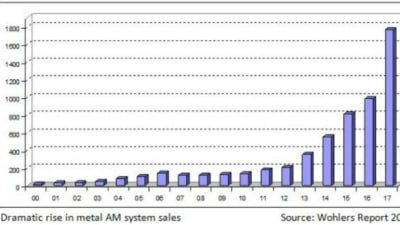
A report released this week revealed a spike in the adoption of metal additive-manufacturing systems – an increase due largely to a growing number of new companies.

Q&A: Communications
Researchers from NC State have developed a new technique for directly printing metal circuits, creating flexible, stretchable electronics. The technique can...

Briefs: Medical
Currently, most 3D-printed organ models are made using hard plastics or rubbers. This limits their application for accurate prediction and replication of the organ’s physical behavior...

Briefs: Materials
New graphene printing technology can produce electronic circuits that are low-cost, flexible, highly conductive, and water-repellent. Low-cost, inkjet-printed graphene can...

Briefs: Manufacturing & Prototyping
High-speed images of a common laser-based metal 3D printing process, coupled with newly updated computer models, have revealed the mechanisms behind material redistribution, a phenomenon that...

Application Briefs: Photonics/Optics
StratasysEden Prairie, MNwww.stratasys.com
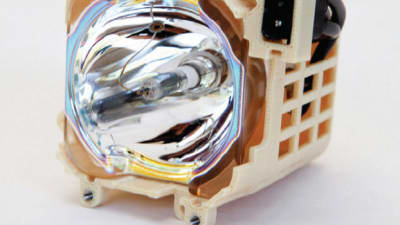
Christie Digital Systems manufactures advanced digital projectors and displays using an innovative prototyping program. The company serves...
Blog: Software
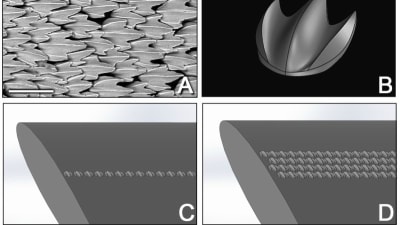
To improve a flying vehicle, sometimes you have to turn to a reliable model that has been operating for hundreds of millions of years.
Question of the Week: Manufacturing & Prototyping
Would you use color-changing 3D printables?
In today’s INSIDER, MIT researcher Professor Stefanie Mueller said that her laboratory’s color-changing 3D printables support new customizable objects and accessories, as well as opportunities for product designers showing off their prototypes.
INSIDER: Manufacturing & Prototyping
Professor Stefanie Mueller and fellow researchers from MIT’s Computer Science and Artificial Intelligence Laboratory (CSAIL) are exploring a more efficient way to cut down on print jobs: objects that change color.

Blog: Manufacturing & Prototyping
Shape-Morphing Materials Add 4th Dimension to 3D Printing
3D printing uses computer control to fuse layers of polymers or powders into a three-dimensional object. Rutgers University researchers found a way to add to a fourth dimension – time – to the manufacturing process.
Briefs: Mechanical & Fluid Systems
Algorithm Boosts Speed of 3D Printers
A major drawback to 3D printing is the slow pace of the process, which ensures details are reproduced accurately. The pace of 3D printing is one of the factors that has prevented the technology from finding a broader audience. A new algorithm was developed that boosts the speed at which the printers operate.
Briefs: Manufacturing & Prototyping
Additive Manufacturing Unique Serialization
Current methods of identifying a unique part involve adding a unique serial number to the part. There are many reasons that manufactured parts receive a serial number. They enable traceability of a part throughout its lifecycle, and ensure the part is not a counterfeit; however, labels and stamped codes...
Top Stories
 Blog: Lighting

A Stretchable OLED that Can Maintain Most of Its Luminescence
 News: Energy

 INSIDER: Energy

Advancing All-Solid-State Batteries
 Blog: Energy

My Opinion: We Need More Power Soon — Is Nuclear the Answer?
 Blog: Robotics, Automation & Control

Aerial Microrobots That Can Match a Bumblebee's Speed
 Blog: Communications

Microscopic Swimming Machines that Can Sense, Respond to Surroundings
Webcasts
 Upcoming Webinars: Automotive

Advantages of Smart Power Distribution Unit Design for Automotive...
 Upcoming Webinars: Unmanned Systems

Quiet, Please: NVH Improvement Opportunities in the Early Design...
 Upcoming Webinars: Sensors/Data Acquisition

From Spreadsheets to Insights: Fast Data Analysis Without Complex...
 Upcoming Webinars: Defense

Cooling a New Generation of Aerospace and Defense Embedded...
 Upcoming Webinars: Test & Measurement

Beyond AI-Copy-Paste Engineering: Advanced AI-Integration Success...
 Upcoming Webinars: Energy