
Stories
38
0
1290
30
Briefs: Energy
The material can be recycled, making renewable energy more sustainable while lowering costs in the process.
Briefs: Sensors/Data Acquisition
Sensors need to be flexible, stretchable, biodegradable, safe, and stable for use in the body.
Briefs: Test & Measurement
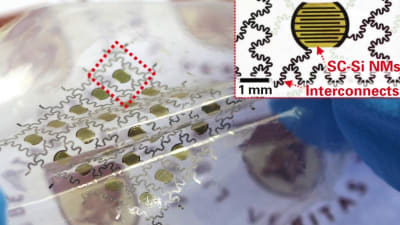
Real-time health monitoring and sensing abilities of robots require soft electronics, but a challenge of using such materials lies in their reliability.
Articles: Photonics/Optics
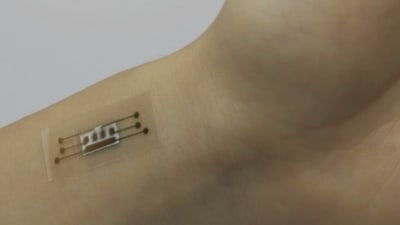
See what kinds of applications require high-precision laser glass with demanding dimensional tolerances and high-power laser coatings.
Articles: Nanotechnology
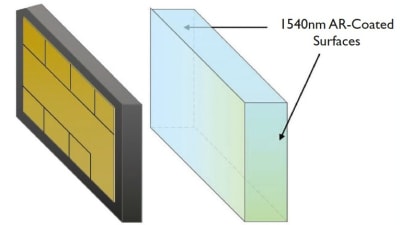
The virtual event offers a mix of live plenary talks, on-demand technical presentations and discussions, online networking and special events.
Articles: Automotive
The marking provides easy-to-see legends on plastic buttons under widely varying illumination conditions.

INSIDER: Photonics/Optics
When SpaceX’s Crew Dragon capsule splashed down off the Florida coast in August following its first crewed mission, the two astronauts inside could not exit the capsule immediately....
Blog: Materials
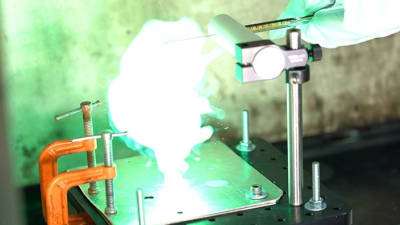
What can you do with a credit card sized pump? "Power clothing!" Prof. Jonathan Rossiter tells Tech Briefs?

INSIDER: Manufacturing & Prototyping
Scientists around the world are working to develop electronic skins that attach to the body and monitor vital signs. These E-skins need to be comfortable, breathable, and flexible for everyday...

INSIDER: Sensors/Data Acquisition
A research team from National University of Singapore (NUS) has taken a first step towards improving the safety and precision of industrial robotic arms by developing a new range of...

Articles: Packaging & Sterilization
Next-generation solar panels, 3D-printed composites from NASA, and a new way to sterilize medical devices.

Application Briefs: Mechanical & Fluid Systems
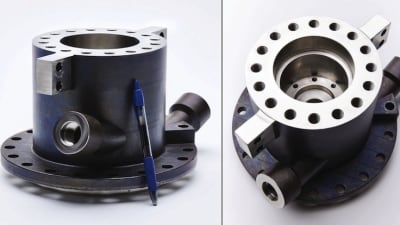
See why Mohawk Innovative Technology, Inc. is excited for the potential of additive manufacturing.
Briefs: Wearables
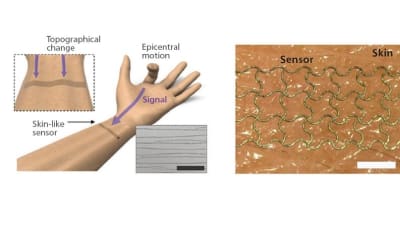
This system can track the motion of the entire body with a small sensory network.
Briefs: Materials
A technique enables manufacturing of minuscule robots by interlocking multiple materials in a complex way.

Briefs: Imaging
The material could enable cheaper and more environmentally friendly displays and large-area lighting.
Briefs: Sensors/Data Acquisition
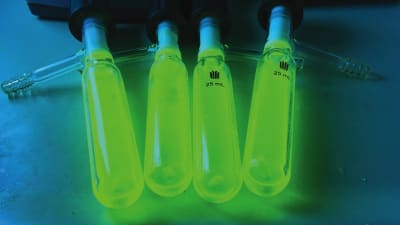
Applications include detection of explosives, navigation, and aerospace altitude sensing.

Briefs: Test & Measurement
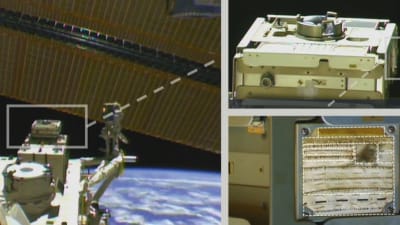
A smart fiber being tested on the International Space Station could be used to develop space dust telescopes and allow astronauts to feel through their pressurized suits.
Briefs: Nanotechnology
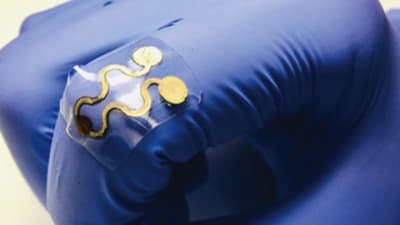
The stretchable sensor has applications in environmental monitoring and healthcare.
Application Briefs: Aerospace
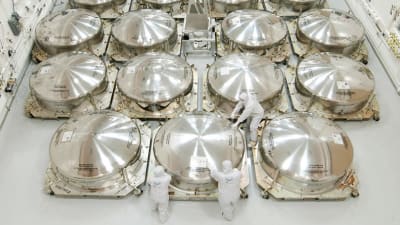
“The disruption promised by Industry 4.0 has already begun,” says Jason Melcher from the aerospace manufacturing company Ingersoll.

Briefs: Manufacturing & Prototyping
A new method of linking materials with unique mechanical properties could enable robots made of robots.

Briefs: Test & Measurement
This system treats light-responsive disorders or deficits such as eating disorders, sleep problems, hormone-sensitive cancers, and cardiovascular disorders.

Briefs: Wearables
Material for Wearable Biosensors
Electrospinning is used to make porous silicone that allows sweat to evaporate.
5 Ws: Energy
The battery can be used in flexible, stretchable electronics for wearables as well as soft robotics.

Briefs: Photonics/Optics
This rapid and cost-effective technique yields a uniform etched surface with 99.5 percent emissivity.

Briefs: Aerospace
Applications include terahertz medical imaging and communications.
Briefs: Robotics, Automation & Control
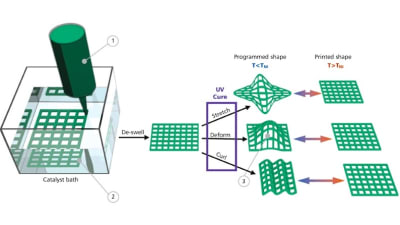
A new method manufactures complex shapeshifters for soft robots and biomedical implants.
Briefs: Materials
The polyimide composites have uses in aerospace, automotive, construction, electronics, mechanical systems, and industrial machinery.

Briefs: Robotics, Automation & Control
These nanomaterial strain sensors are ten times more sensitive when measuring minute movements compared to existing technology.

Briefs: Imaging
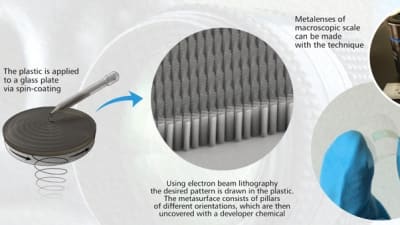
Ultra-thin and flexible metalenses could replace traditional camera lenses.
Top Stories
 Blog: Robotics, Automation & Control

Aerial Microrobots That Can Match a Bumblebee's Speed
 Blog: Electronics & Computers

Turning Edible Fungi into Organic Memristors
 Blog: Manufacturing & Prototyping

Revolutionizing the Production of Semiconductor Chips
 News: Energy

 INSIDER: Electronics & Computers

World’s Smallest Programmable, Autonomous Robots
 INSIDER: Manufacturing & Prototyping
Webcasts
 On-Demand Webinars: Power

E/E Architecture Redefined: Building Smarter, Safer, and Scalable Vehicles
 Upcoming Webinars: Energy

Hydrogen Engines Are Heating Up for Heavy Duty
 Upcoming Webinars: Electronics & Computers

Advantages of Smart Power Distribution Unit Design for Automotive...
 Upcoming Webinars: Automotive

Quiet, Please: NVH Improvement Opportunities in the Early Design...
 Upcoming Webinars: Power

A FREE Two-Day Event Dedicated to Connected Mobility
 Podcasts: Defense

How Sift's Unified Observability Platform Accelerates Drone Innovation