Stories
51
0
1260
30
Question of the Week: Robotics, Automation & Control
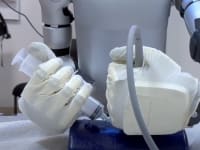
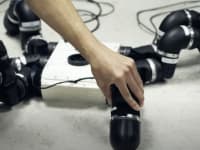
Will Entire Planes Be Built By 'Assembler Robots?'
Commercial aircraft are typically manufactured in sections, often in different locations, and then flown to a central plant for final assembly. Researchers at MIT are hoping to change that.
Special Reports: Robotics, Automation & Control
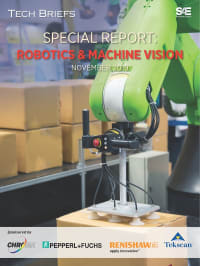
Robotics & Machine Vision - November 2019
Advances in robotics and machine vision are transforming the factory floor. To help you keep pace with the latest developments in industrial automation, we present this compendium of recent articles...Briefs: Imaging
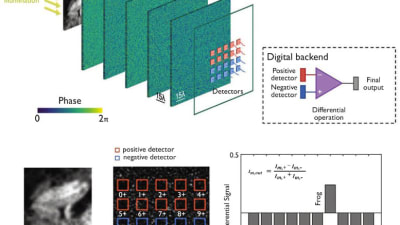
UCLA engineers have made major improvements on their design of an optical neural network — a device inspired by how the human brain works — that can identify objects or process...
Briefs: Robotics, Automation & Control
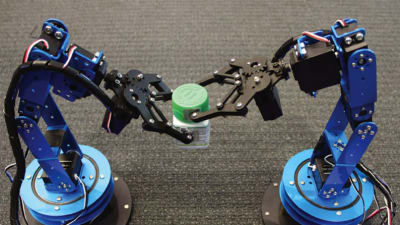
A system was developed that uses radio-frequency identification (RFID) tags to help robots target moving objects with unprecedented speed and accuracy. The system could enable greater...
Briefs: Test & Measurement
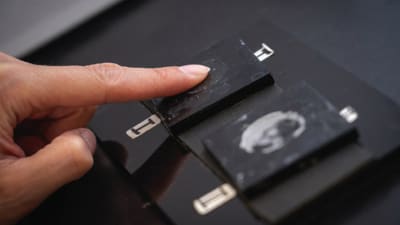
Researchers have developed a formula that enables them to recreate different levels of perceived softness. Based on the results from their experiments, they created equations that can calculate how soft...
Briefs: Manufacturing & Prototyping
Smart Electronic Skin for Robots and Prosthetics
Humans use the sense of touch to accomplish almost every daily task such as picking up a cup of coffee or shaking someone’s hand. Without it, humans can even lose their sense of balance when walking. Similarly, robots need to have a sense of touch in order to interact better with humans but robots...
Articles: Mechanical & Fluid Systems
A team of inventors found a fast way to join plastic to metal.

Briefs: Materials
Researchers have developed a fiber that combines the elasticity of rubber with the strength of a metal, resulting in a tougher material. The fibers consist of a gallium metal core surrounded...

Facility Focus: Test & Measurement
In recent decades, NSF-funded researchers have discovered quite a bit, including many of the fundamental particles of matter.

Briefs: Aerospace
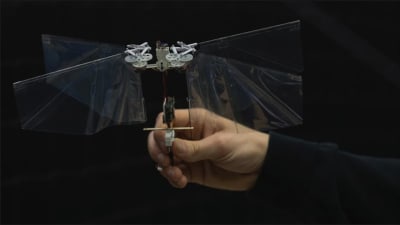
Flying animals both power and control flight by flapping their wings. This enables small natural flyers such as insects to hover close to a flower but also to rapidly escape danger. Animal flight has...
Briefs: Sensors/Data Acquisition
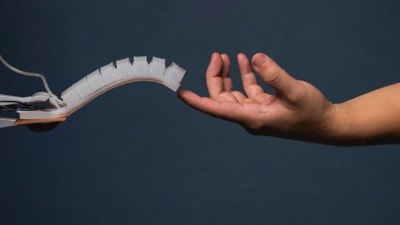
A perception system for soft robots was developed that is inspired by the way humans process information about their own bodies in space and in relation to other objects and people. The system includes a motion...
Briefs: RF & Microwave Electronics
A novel approach was developed to improve communications range and allow for covert behavior using a team of robots for future multi-domain operations. Specifically, researchers demonstrated...

Briefs: Robotics, Automation & Control
For decades, robots in controlled environments like assembly lines have been able to pick up the same object over and over again. More recently, breakthroughs in computer vision have enabled...

INSIDER: Motion Control
MIT researchers have compiled a dataset that captures the detailed behavior of a robotic system physically pushing hundreds of different objects. Using the dataset, robots “learn” pushing...

Blog: Aerospace
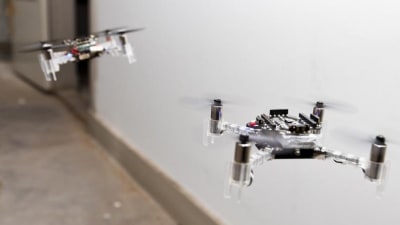
A minimal, map-less approach to drone navigation takes after the bee.
Blog: Aerospace
Editor Bruce A. Bennett offers a look at the Association of the United States Army's 2019 Annual Meeting.

News: Mechanical & Fluid Systems
A Tech Briefs reader asks: What's next with military motion control?

Blog: Sensors/Data Acquisition
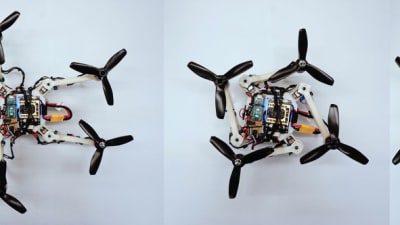
A new drone “folds” itself into configurations that suit a given environment.
INSIDER: Electronics & Computers
Medical implants of the future may feature reconfigurable electronic platforms that can morph in shape and size dynamically as bodies change or even transform to...

Products: Sensors/Data Acquisition
Toposens, Sunnyvale, CA, released the TS3, a 3D ultrasonic sensor suitable for autonomous systems including robotics, autonomous vehicles, and other positioning applications that require reliable object detection and...

Briefs: Mechanical & Fluid Systems
An automated system designs and 3D-prints complex robotic parts that are optimized according to an enormous number of specifications. The system fabricates actuators — devices that mechanically control...

Briefs: Mechanical & Fluid Systems
Soft robots have a distinct advantage over rigid robots: they can adapt to complex environments, handle fragile objects, and interact safely with humans. Made from silicone, rubber, or other stretchable polymers, they...

Briefs: Mechanical & Fluid Systems
A high-sensitivity and low-noise MEMS accelerometer was developed using multi-layer metal structures composed of multiple metal layers. The accelerometer achieves 1 μG level resolution that has...

Briefs: Manufacturing & Prototyping
A smartphone app was developed that allows a user to easily program any robot to perform a mundane activity such as picking up parts from one area and delivering them to another. The app, called VRa, uses...

Briefs: Manufacturing & Prototyping
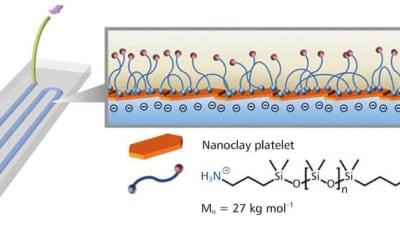
Researchers have 3D-printed an all-liquid device that, with the click of a button, can be repeatedly reconfigured on demand to serve a wide range of applications from making battery materials to screening drug...
Briefs: RF & Microwave Electronics
Technique Locates Robots and Humans in GPS-Challenged Environments
An algorithm enables localization of humans and robots in areas where GPS is unavailable. The Army needs to be able to localize agents operating in physically complex, unknown, and infrastructure-poor environments. This capability is critical to help find dismounted soldiers and for...
Briefs: Aerospace
A radically new kind of airplane wing, assembled from hundreds of tiny identical pieces, can change shape to control the plane’s flight, and could provide a significant boost in aircraft...

Briefs: Sensors/Data Acquisition
Between walking and running, human gaits can cover a wide range of speeds; for example, at low speeds, the metabolic rate of walking is lower than that of running in a slow jog. The...

Briefs: Semiconductors & ICs
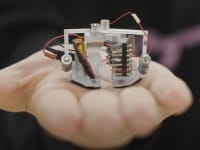
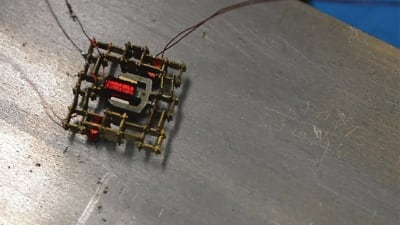
A set of five tiny fundamental parts can be assembled into a wide variety of functional devices including a tiny “walking” motor that can move back and forth across a surface or...
Top Stories
 Blog: Lighting

A Stretchable OLED that Can Maintain Most of Its Luminescence
 INSIDER: Energy

Advancing All-Solid-State Batteries
 Blog: Power

My Opinion: We Need More Power Soon — Is Nuclear the Answer?
 Quiz: Energy

 Blog: Lighting Technology

Microscopic Swimming Machines that Can Sense, Respond to Surroundings
 Blog: Data Acquisition

Webcasts
 Upcoming Webinars: Semiconductors & ICs

Advantages of Smart Power Distribution Unit Design for Automotive...
 Upcoming Webinars: Automotive

Quiet, Please: NVH Improvement Opportunities in the Early Design...
 Upcoming Webinars: Test & Measurement

From Spreadsheets to Insights: Fast Data Analysis Without Complex...
 Upcoming Webinars: Electronics & Computers

Cooling a New Generation of Aerospace and Defense Embedded...
 Upcoming Webinars: AR/AI

Beyond AI-Copy-Paste Engineering: Advanced AI-Integration Success...
 Upcoming Webinars: Test & Measurement