

Stories
35
66
0
60
30
Briefs: Data Acquisition
Purdue researchers have created technology aimed at replacing Morse code with colored “digital characters” to modernize optical storage. They are confident the advancement will help with the explosion of remote data storage during and after the COVID-19 pandemic. Read on to learn more.
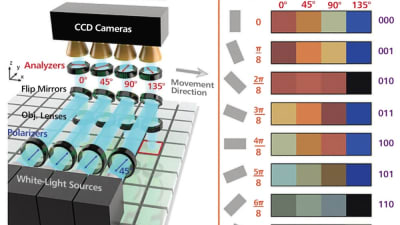
Briefs: Photonics/Optics
Researchers have created visible lasers of very pure colors from near-ultraviolet to near-infrared that fit on a fingertip. The colors of the lasers can be precisely tuned and extremely fast — up to 267 petahertz per second, which is critical for applications such as quantum optics. Read on to learn more.

Special Reports: RF & Microwave Electronics

Space Technology - January 2025
Engineering NASA's next great space telescope…how to build a better rocket…the groundbreaking material that could propel future space travel. Read about these and other exciting advances in this compendium of...Articles: Photonics/Optics
Watch this video to learn more about three new robotic technologies: A soft robot developed at NC State University; a pair of wearable robotic limbs developed by MIT engineers; and a camera inspired by the human eye developed at the University of Maryland.

INSIDER: Photonics/Optics
Seven early-stage startup companies have been selected to compete for a top prize of $10,000 at the 15th annual SPIE Startup Challenge at Photonics West Tuesday, January 28.

INSIDER: Lighting Technology
The SPIE Photonics West 2025 technical conference and exhibition returns to San Francisco's Moscone Center, January 25 to 30, providing attendees the opportunity to learn...

Blog: Photonics/Optics
Researchers have developed a new type of infrared photodiode that is 35 percent more responsive at 1.55 µm, the key wavelength for telecommunications, compared to other germanium-based components.

INSIDER: Medical
Cornell researchers in physics and engineering have created the smallest walking robot yet. Its mission: to be tiny enough to interact with waves of visible light and still move...
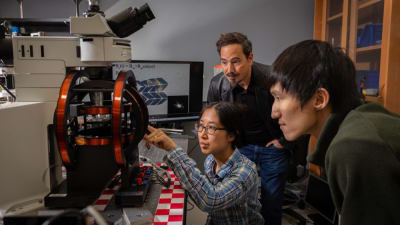
Technology & Society: Design
AiSee is a smart headphone equipped with an integrated camera, microphone, and an AI-powered software architecture. It “sees” what’s in front of the user, “hears” what the user says, and is able “speak” to the user.

Articles: Photonics/Optics
In optical manufacturing, precision polishing is vital to achieving the required flatness, surface quality, and angular precision that many applications demand. Traditionally, single-sided polishing has been the go-to method, particularly for complex components where one-sided control is critical. Read on to learn more about double-sided polishing.

Application Briefs: Physical Sciences
Defense applications, in particular, are always tasked with the balancing act that optimizes size, weight, power, and cost (SWaP-C) efficiencies when specifying new equipment. The challenge is how to balance beneficial trade-offs for optimal performance. Read on to learn more.

Application Briefs: Photonics/Optics
Today, companies are building small satellite constellations with tens to hundreds of units, far exceeding the scale of traditional space operations. Read on to learn more.

Articles: Photonics/Optics
When it launches no later than May 2027, the NASA Nancy Grace Roman Space Telescope will serve as a powerful eye on deep space, capturing images of billions of distant galaxies and exploring the mysteries of dark matter, supernovae and other cosmic phenomena. Read on to learn about what it takes to make it a success.
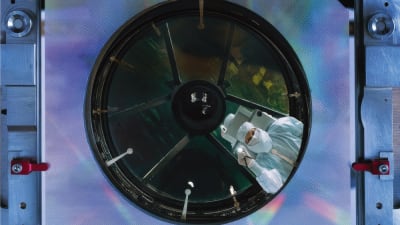
Briefs: Photonics/Optics
Researchers have made it possible to expand tissue twentyfold in a single step. This simple, inexpensive method could pave the way for nearly any biology lab to perform nanoscale imaging. Read on to learn more.
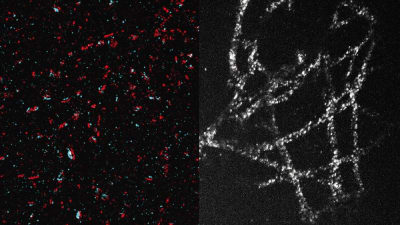
Briefs: Imaging
Researchers have developed an optical design technology that dramatically reduces the volume of cameras with a folded lens system utilizing “metasurfaces,” a next-generation nano-optical device. Read on to learn more.

Briefs: Lighting Technology
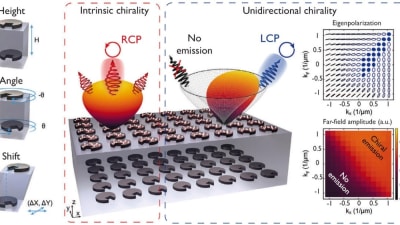
Researchers have designed a spiral ladder-inspired tool that allows precision control of light direction and polarization to control the direction of the emitted beam and the polarization of the light, while using a precisely engineered resonance of the structure. Read on to learn more.
Briefs: Photonics/Optics
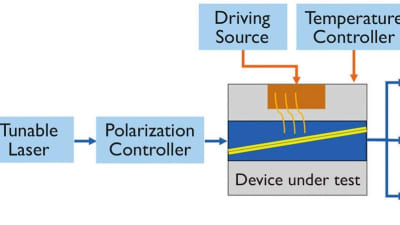
Researchers have successfully developed a wide-bandwidth, low-polarization semiconductor optical amplifier based on tensile-strained quantum wells. The study, published in the journal Sensors, presents a significant advancement in optical communication technology, addressing the growing demand for higher bandwidth and lower polarization sensitivity. Read on to learn more.
Products: Imaging
See the new products, including TRIOPTICS' compact and retrofittable solution for processing laser diodes on the ATS 100 alignment turning station; TRUMPF's VCSELs and photodiodes; Edmund Optics’ TECHSPEC® UV Fused Silica Plano-Convex (PCX) Lenses MgF2 Coated feature precision specifications; Imperx' two new Cheetah cameras: the CXP-C1941 and the SFP-C1941; and more.

Articles: Software
Scientists from MIT and elsewhere have demonstrated a fully integrated photonic processor that can perform all the key computations of a deep neural network optically on a chip. Read on to learn more about it.

Briefs: Imaging
A team led by University of Maryland computer scientists invented a camera mechanism that improves how robots see and react to the world around them. Inspired by how the human eye works, their innovative camera system mimics the tiny involuntary movements used by the eye to maintain clear and stable vision over time. Read on to learn more.

Briefs: RF & Microwave Electronics
In a paper published in the journal Nature Nanotechnology, a team of Caltech engineers reports building a metasurface patterned with miniscule tunable antennas capable of reflecting an incoming beam of optical light to create many sidebands, or channels, of different optical frequencies. Read on to learn more.

Briefs: Data Acquisition
Researchers have achieved data rates as high as 424Gbit/s across a 53-km turbulent free-space optical link using plasmonic modulators — devices that uses special light waves called surface plasmon polaritons to control and change optical signals. The new research lays the groundwork for high-speed optical communication links that transmit data over open air or space. Read on to learn more.

Application Briefs: Photonics/Optics
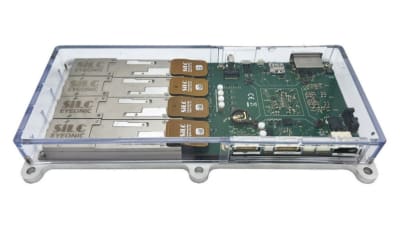
Photonics & Imaging Technology caught up with Dr. Mehdi Asghari, SiLC Technologies CEO, to discuss their approach to designing and manufacturing FMCW LiDAR technology. Read on for the entire interview.
Articles: AR/AI
Opto Generative Pretrained Transformer (OptoGPT), a decoder-only transformer, developed by University of Michigan engineers, harnesses the computer architecture underpinning ChatGPT to work backward from desired optical properties to the material structure that can provide them. Read on to learn more.
Articles: Photonics/Optics
The Department of Energy has given the green light for construction to begin on a high-energy upgrade that will further boost the performance of the Linac Coherent Light Source (LCLS), the world’s most powerful X-ray free-electron laser (XFEL) at the DOE’s SLAC National Accelerator Laboratory. Read on to learn more about it.

Briefs: Imaging
If the outside of clothing or a vehicle were covered with the coating, an infrared camera would have a harder time distinguishing what is underneath. Read on to learn what this means.

Briefs: Photonics/Optics
A team of scientists has developed an ultrafast imaging technique, called femtosecond laser sheet-compressed ultrafast photography, that can compile videos of incredibly transient details. Read on to learn more about it.
Briefs: Photonics/Optics
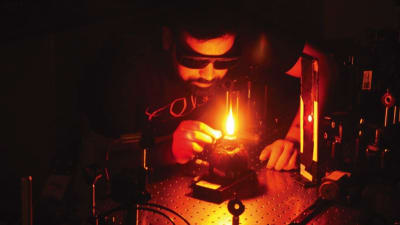
Butterflies can see more of the world than humans, including more colors and the field oscillation direction, or polarization, of light. Other species, like the mantis shrimp, can sense an even wider spectrum of light, as well as the circular polarization, or spinning states, of light waves. Inspired by these abilities in the animal kingdom, researchers have developed an ultrathin optical element known as a metasurface, which can attach to a conventional camera and encode the spectral and polarization data of images captured in a snapshot or video through tiny, antenna-like nano-structures that tailor light properties.
Briefs: Lighting Technology
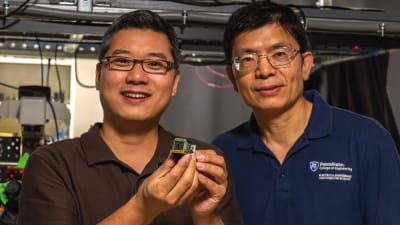
A new type of organic light emitting diode (OLED) could replace bulky night vision goggles with lightweight glasses, making them cheaper and more practical for prolonged use, according to University of Michigan researchers. Read on to learn more.
Top Stories
 Blog: Robotics, Automation & Control

Aerial Microrobots That Can Match a Bumblebee's Speed
 Blog: Electronics & Computers

Turning Edible Fungi into Organic Memristors
 Blog: Manufacturing & Prototyping

Revolutionizing the Production of Semiconductor Chips
 News: Energy

 INSIDER: Electronics & Computers
World’s Smallest Programmable, Autonomous Robots
 INSIDER: Manufacturing & Prototyping

Webcasts
 On-Demand Webinars: Power

E/E Architecture Redefined: Building Smarter, Safer, and Scalable Vehicles
 Upcoming Webinars: Energy

Hydrogen Engines Are Heating Up for Heavy Duty
 Upcoming Webinars: Electronics & Computers

Advantages of Smart Power Distribution Unit Design for Automotive...
 Upcoming Webinars: Automotive

Quiet, Please: NVH Improvement Opportunities in the Early Design...
 Upcoming Webinars: Power

A FREE Two-Day Event Dedicated to Connected Mobility
 Podcasts: Defense

How Sift's Unified Observability Platform Accelerates Drone Innovation