
Stories
35
66
0
30
30
Briefs: Energy
AI systems like ChatGPT are notorious for being power-hungry. To tackle this challenge, a team from the Centre for Optics, Photonics and Lasers has come up with an optical chip that can transfer massive amounts of data at ultra-high speed. As thin as a strand of hair, this technology offers unrivaled energy efficiency. Read on to learn more.
Briefs: Photonics/Optics
As fast as modern electronics have become, they could be much faster if their operations were based on light, rather than electricity. Fiber optic cables already transport information at the speed of light, but to do computations on that information without translating it back to electric signals will require a host of new optical components. Researchers have now developed such a device. Read on to learn more.
Briefs: Materials
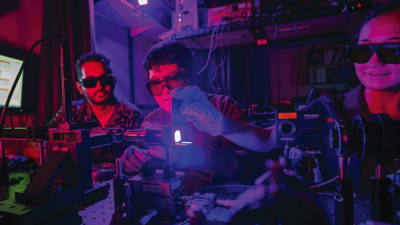
Engineers at the University of California San Diego have achieved a long-sought milestone in photonics: creating tiny optical devices that are both highly sensitive and durable — two qualities that have long been considered fundamentally incompatible. Read on to learn more.
Briefs: Photonics/Optics
Researchers have invented a new type of tunable semiconductor laser that combines the best attributes of today’s most advanced laser products, demonstrating smooth, reliable, wide-range wavelength tuning in a simple, chip-sized design. Read on to learn more about it.

Briefs: Photonics/Optics
Researchers have developed an on-chip twisted moiré photonic crystal sensor that uses MEMS technology to control the gap and angle between the crystal layers in real time. The sensor can detect and collect detailed polarization and wavelength information simultaneously. Read on to learn more.

Articles: Physical Sciences
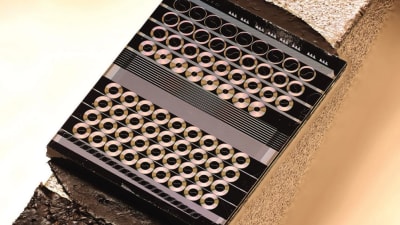
See the products of tomorrow, including a new tunable laser that uses a series of rings to smoothly emit many light wavelengths from a single chip; a smart capsule called PillTrek, which can measure pH, temperature, and a variety of different biomarkers; and more.

Special Reports: Sensors/Data Acquisition

Military & Maritime Unmanned/Autonomous Systems - August 2025
AI automates drone defense with high‐energy lasers…3D printing a game‐changer for ship and submarine part production…how TSN Ethernet will change the future of mil/aero...Briefs: Photonics/Optics
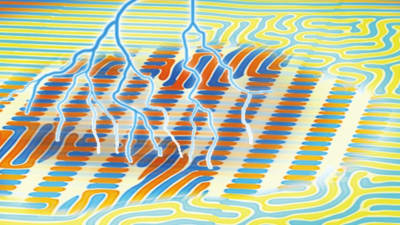
With this groundbreaking discovery of time-dependent changes in networked nanodomains, developers are on the path to building adaptive networks for information storage and processing. Read on to learn more.
Products: Photonics/Optics
See what's new on the market, including a solution for actuating choke and other valves in subsea applications; Sumida's new CEP1311F Flyback Transformers, designed for use with “no-opto” isolated flyback circuits; SPIROL's range of 2024 aluminum Press-In Inserts; Instron's AVE3, an advanced non-contacting video extensometer that delivers precise strain measurement with unparalleled, micron-level accuracy; and more.
Special Reports: Electronics & Computers

Rugged/Hi‐Rel Electronics - June 2025
How advanced packaging is transforming mission‐critical electronics…a new era of high‐speed data transmission in defense…fully rugged PCs provide a decisive edge on the battlefield. Read about...INSIDER: Nanotechnology
What if ultrafast pulses of light could operate computers at speeds a million times faster than today's best processors? A team of scientists, including researchers from...
Technology & Society: Software
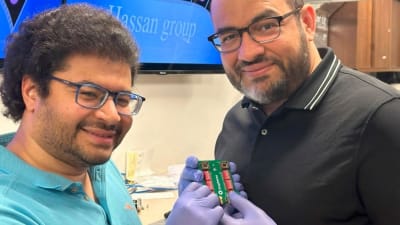
Desperately wanting to bridge the gap between the deaf and people who don't know sign language, a Florida Atlantic University team decided to use AI and computer engineering to build a smart, real-time ASL system.

Application Briefs: Lighting
Exploiting the “spatial” degree of freedom of light can mean many things. Read on to learn what they are and what the process can lead to.

Products: Photonics/Optics
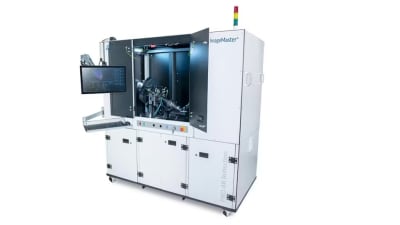
See the new products, including TRIOPTICS' ImageMaster® PRO AR Reflection waveguide testing solution; TOP-TICA’s Clock Laser System; Aerotech Inc.'s HexGen® HEX150-125HL Miniature Hexapod, a six degree-of-freedom precision positioning system; Teledyne e2v's Optimom™ 5D turnkey imaging module; Coherent Corp.'s set of pluggable optical transceivers optimized for use in data centers that incorporate optical circuit switches; and more.
Application Briefs: Photonics/Optics
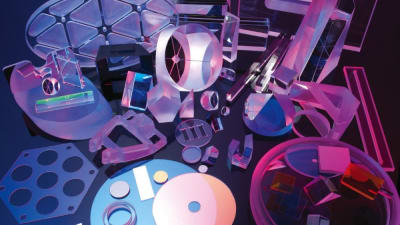
Machining metal has its challenges as many shops will attest, but machining glass is another matter – one that Dan Bukaty Jr., President of Precision Glass & Optics (PG&O) is well schooled in. Mr. Bukaty and his 35-person shop manufacture high-end precision glass optics for customers such as IMAX, Intuitive Surgical, Boeing and NASA, to name a few. Read on to learn about PG&O's use of a vision system.
Briefs: Medical
Metabolic imaging is a noninvasive method that enables clinicians and scientists to study living cells using laser light, which can help them assess disease progression and treatment responses. But light scatters when it shines into biological tissue, limiting how deeply it can penetrate and hampering the resolution of captured images. Now, MIT researchers have developed a new technique that more than doubles the usual depth limit of metabolic imaging. Read on to learn more.

Briefs: Photonics/Optics
Augmented reality has become a hot topic in the entertainment, fashion, and makeup industries. Though a few different technologies exist in these fields, dynamic facial projection mapping is among the most sophisticated and visually stunning ones. Read on to learn more about it.

Briefs: Photonics/Optics
Researchers have developed a photonic chip-based traveling wave parametric amplifier that achieves ultra-broadband signal amplification in an unprecedentedly compact form. Read on to learn more about it.
Briefs: Power
Innovators at NASA Johnson Space Center have developed a handheld digital microscope to fill the critical microscopy needs of human space exploration by providing flight crews in situ hematological diagnostic and tracking ability to assess and monitor crew health in the absence of gravity. Read on to learn more.

INSIDER: Photonics/Optics
Physicists in the Harvard John A. Paulson School of Engineering and Applied Sciences (SEAS) have created a compact laser that emits extremely bright, short pulses of light in a useful but...

INSIDER: Photonics/Optics
A beam of light doesn’t sound like a material that can create a knot. Until now.

Blog: Design
The work addresses the outfielder problem, which refers to the baseball player who stands in the outfield to catch the ball after it is hit. It is a classic challenge in physics and the neuroscience of movement, used to explore how humans and animals predict movements in a dynamic environment and how automated systems can be designed to mimic them.

Briefs: Imaging
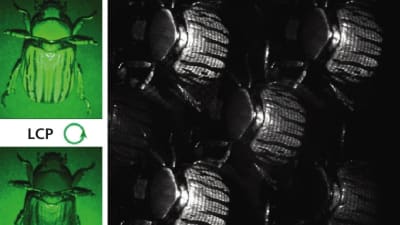
Researchers at the Harvard John A. Paulson School of Engineering and Applied Sciences have developed a compact, single-shot polarization imaging system that can provide a complete picture of polarization. Read on to learn more about it.
Briefs: Sensors/Data Acquisition
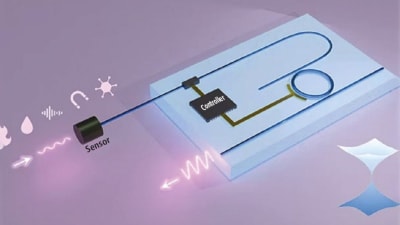
New research unlocks the power of exceptional points (EPs) for advanced optical sensing. In a study published in Science Advances , a team showed that these unique EPs — specific conditions in systems where extraordinary optical phenomena can occur — can be deployed on conventional sensors to achieve a striking sensitivity to environmental perturbations. Read on to learn more.
Special Reports: Defense

Test & Measurement - March 2025
Testing the “eyes” of NASA's next space telescope…mass‐manufacturing photonic sensors at the quantum limit…driving zero defects in today's intelligent vehicles. Read about these and other applications...Special Reports: Materials

Medical Manufacturing & Outsourcing - March 2025
Researchers achieve near‐void‐free 3D printing…how new laser joining technology is improving implantable device reliability…tips and techniques for adhesive bonding of plastics. Read...Articles: Sensors/Data Acquisition
See the products of tomorrow, including paper-thin optical lenses simple enough to mass produce like microchips; a compact cooling technology that can pump away heat continuously using layers of flexing thin films; and a multilayered chip design that doesn’t require any silicon wafer substrates and works at temperatures low enough to preserve the underlying layer’s circuitry.

Briefs: Nanotechnology
Researchers have designed a way to levitate and propel objects using only light by creating specific nanoscale patterning on the objects' surfaces. The work could be a step toward developing a spacecraft that could reach the nearest planet outside of our solar system in 20 years, powered and accelerated only by light. Read on to learn more.

Briefs: Photonics/Optics
Researchers in the emerging field of spatial computing have developed a prototype augmented reality headset that uses holographic imaging to overlay full-color, 3D moving images on the lenses of what would appear to be an ordinary pair of glasses. Read on to learn more about it.

Top Stories
 Blog: Robotics, Automation & Control
Aerial Microrobots That Can Match a Bumblebee's Speed
 Blog: Electronics & Computers

Turning Edible Fungi into Organic Memristors
 Blog: Manufacturing & Prototyping

Revolutionizing the Production of Semiconductor Chips
 News: Energy

 INSIDER: Electronics & Computers
World’s Smallest Programmable, Autonomous Robots
 INSIDER: Manufacturing & Prototyping

Webcasts
 On-Demand Webinars: Power

E/E Architecture Redefined: Building Smarter, Safer, and Scalable Vehicles
 Upcoming Webinars: Energy

Hydrogen Engines Are Heating Up for Heavy Duty
 Upcoming Webinars: Electronics & Computers

Advantages of Smart Power Distribution Unit Design for Automotive...
 Upcoming Webinars: Automotive

Quiet, Please: NVH Improvement Opportunities in the Early Design...
 Upcoming Webinars: Power

A FREE Two-Day Event Dedicated to Connected Mobility
 Podcasts: Defense

How Sift's Unified Observability Platform Accelerates Drone Innovation