
Stories
56
-1
360
30
Briefs: Nanotechnology
A new method uses ultraviolet light to control the flow of fluids by encouraging particles — from plastic microbeads, to bacterial spores, to pollutants — to gather...
INSIDER: Semiconductors & ICs
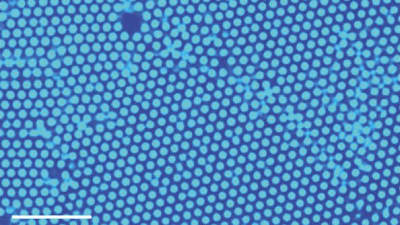
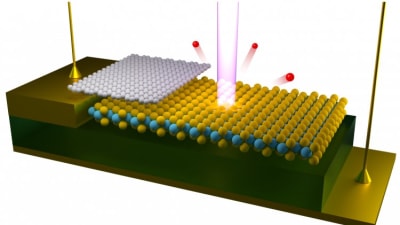
Scientists have visualized the electronic structure in a microelectronic device for the first time, opening up opportunities for finely tuned, high-performance...
Blog: Imaging
A team from the University of Pittsburgh looked to the butterfly to create a glass that is self-healing, liquid-repellant, and anti-fogging.

Facility Focus: Electronics & Computers
On September 1, 1961, NASA requested appropriations for initial land purchases on Merritt Island on Florida’s east coast to support the Apollo Lunar Landing Program. Designers quickly began developing...

Briefs: Electronics & Computers
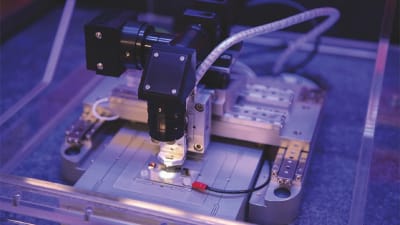
A process for fabricating atom-thin processors can be used to produce at the nanoscale for smaller and faster semiconductors.
Briefs: Materials
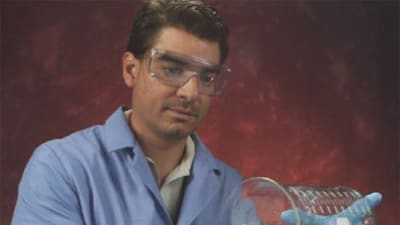
A system was developed that can remove radioactive cesium contamination from porous structures such as brick and concrete that are hard to clean, as well as contamination from metal...
Briefs: Lighting
3D Printing of Flexible Circuits
A process was developed for 3D printing that can be used to produce transparent and mechanically flexible electronic circuits. The electronics consist of a mesh of silver nanowires that can be printed in suspension and embedded in various flexible and transparent plastics (polymers). This technology can enable new...
Q&A: Software
Aydin Aysu, Ph.D., is Assistant Professor in the Electrical & Computer Engineering Department at North Carolina State University in Raleigh, where he helped develop a technique for...

Briefs: Automotive
Shear Assisted Processing and Extrusion (ShAPE™) allows creation of wire, bar, and tubular extrusions that show significant improvement in material properties; for example, magnesium extrusions have...

INSIDER: Energy
Wearable devices that harvest energy from movement are not a new idea, but a material created at Rice University may make them more practical.

INSIDER: Nanotechnology
Computers and similar electronic devices have gotten faster and smaller over the decades as computer-chip makers have learned how to shrink individual transistors. Scientists’...

Briefs: Test & Measurement
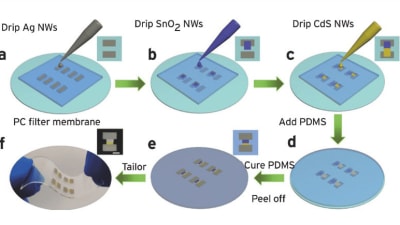
Stretchable electronics, which can be stretched, deformed and wrapped onto nonplanar curved surfaces, have attracted much attraction due to their...
Articles: Nanotechnology
We recently had a discussion with Sri Peruvemba, VP of Strategy at BeBop Sensors (Berkeley, CA), about the technology and applications for their two-dimensional fabric sensor material. I started by asking Sri...

Briefs: Energy
Wood-Based Technology Creates Electricity from Heat
Researchers have transformed a piece of wood into a flexible membrane that generates energy from the same type of electric current (ions) on which the human body runs. This energy is generated using charged channel walls and other unique properties of the wood’s natural nanostructures. With this...
Briefs: Medical
Flexible, Transparent, Wearable Bio-Patch
Silicon nanoneedle patches are currently placed between skin, muscles, or tissues where they deliver exact doses of biomolecules. Commercially available silicon nanoneedle patches are usually constructed on a rigid and opaque silicon wafer. The rigidity can cause discomfort and cannot be left in the body...
Briefs: Lighting
The combination of conductive polymers on nanostructures was demonstrated as suited to creating electronic displays as thin as paper. The “paper” is similar to the Kindle tablet. It does...

Briefs: Materials
Anyone who skis, wears glasses, uses a camera, or drives a car is familiar with the problem: Coming into a humid environment from the cold causes eyewear, camera lenses, or windshields to quickly...

Briefs: Imaging
A Northwestern University research team has developed tiny optical elements from metal nanoparticles and a polymer that one day could replace traditional refractive...

Q&A: Sensors/Data Acquisition
Dr. Sultana won funding to advance a nanomaterial-based detector platform that can sense environmental parameters from minute concentrations of target gases and vapors, to...
Briefs: Manufacturing & Prototyping
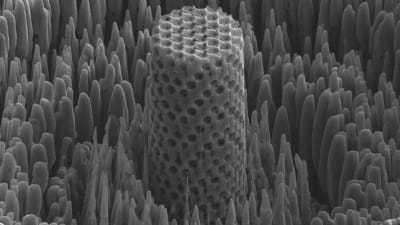
Existing techniques for creating nano-structures are limited in what they can accomplish. Etching patterns onto a surface with light can produce 2D nano-structures but doesn’t work for 3D structures. It...

Blog: Energy
A new 3D printed device turns snowfall into electricity.
Application Briefs: Photonics/Optics
In the middle of the Pacific Ocean, Hawaii Island is surrounded by thousands of miles of thermally stable seas. The 13,796-foot Maunakea mountain summit has no nearby ranges to roil the upper...

Briefs: Nanotechnology
Researchers, drawing inspiration from bacteria, have designed smart, bio-compatible microrobots that are highly flexible. Because these devices are able to swim through fluids and modify their shape when...

Briefs: Photonics/Optics
NASA Langley Research Center has developed new methods for fabricating hollow nanoparticles using dendrimer molecules. Dendrimers are used as templates to control the size, stability, and solubility of...

Briefs: Nanotechnology
A heat-rejecting film was developed that could be applied to a building’s windows to reflect up to 70 percent of the Sun’s incoming heat. The film remains highly transparent below...

Briefs: Motion Control
Fast-response, stiffness-tunable (FRST) soft actuators — or movable machine elements — were developed that could be used in soft robots.

Q&A: Nanotechnology
Texas A&M professor Jaime Grunlan and his team are developing a new flame-retardant coating using renewable, nontoxic materials readily found in nature that could...

Briefs: Manufacturing & Prototyping
Titanium is as strong as steel but about twice as light. These properties depend on the way a metal’s atoms are stacked but random defects that arise in the...
INSIDER: Materials
Intentionally “squashing”colloidal quantum dots during chemical synthesis creates dots capable of stable, “blink-free” light emission that is fully comparable with...

Top Stories
 Blog: Robotics, Automation & Control

Aerial Microrobots That Can Match a Bumblebee's Speed
 Blog: Electronics & Computers

Turning Edible Fungi into Organic Memristors
 Blog: Manufacturing & Prototyping

Revolutionizing the Production of Semiconductor Chips
 News: Energy

 INSIDER: Electronics & Computers
World’s Smallest Programmable, Autonomous Robots
 INSIDER: Manufacturing & Prototyping
Webcasts
 Upcoming Webinars: Software

E/E Architecture Redefined: Building Smarter, Safer, and Scalable...
 Upcoming Webinars: Automotive

Hydrogen Engines Are Heating Up for Heavy Duty
 Upcoming Webinars: Electronics & Computers

Advantages of Smart Power Distribution Unit Design for Automotive...
 Upcoming Webinars: Transportation

Quiet, Please: NVH Improvement Opportunities in the Early Design...
 Upcoming Webinars: AR/AI

A FREE Two-Day Event Dedicated to Connected Mobility
 Podcasts: Manufacturing & Prototyping

How Sift's Unified Observability Platform Accelerates Drone Innovation