
Stories
56
-1
420
30
Briefs: Sensors/Data Acquisition
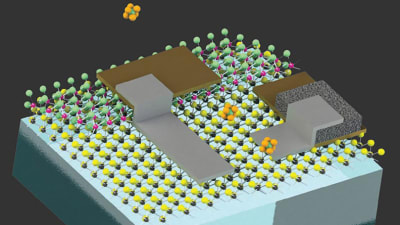
Colloids — insoluble particles or molecules anywhere from a billionth to a millionth of a meter across — are so small they can stay suspended indefinitely in a liquid or even in air. Robots about...
Briefs: Manufacturing & Prototyping
Current density is the amount of electrical current per cross-sectional area at a given point. As transistors in integrated circuits become smaller and smaller, they need higher and higher...

Articles: Semiconductors & ICs
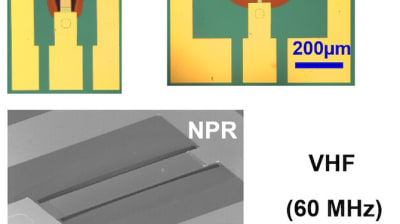
FUTURE ANTENNA MINIATURIZATION MECHANISM: MAGNETOELECTRIC ANTENNAS
Hwaider Lin and Nian-Xiang Sun, Northeastern University, Boston, MA USA
Antenna miniaturization...
Articles: Materials
INVISIBLE GLASS
Brookhaven National Laboratory’s Center for Functional Nanomaterials (CFN) has developed a method for creating surface nanotextures that effectively eliminates...

Articles: Sensors/Data Acquisition
AEROGELS FROM ENVIRONMENTAL WASTES FOR NOVEL ENGINEERING APPLICATIONS
Associate Prof. Hai Minh Duong and Prof. Nhan Phan-Thien, National University of Singapore...

Briefs: Photonics/Optics
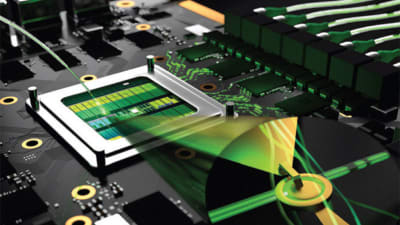
Photons, or units of light, are faster than electrons and could, therefore, process information faster from smaller chip structures. A switch was designed that bypasses a...
Briefs: Nanotechnology
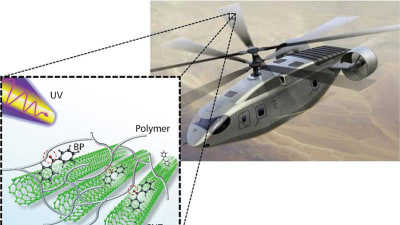
A technique that enables on-demand control of composite behavior could enable a variety of new capabilities for future rotorcraft design, performance, and maintenance. The focus of the research was on...
Briefs: Mechanical & Fluid Systems
Polymer Nanofiber-Based Reversible Nano-Switch/Sensor Schottky Diode (nanoSSSD) Device
Innovators at NASA's Glenn Research Center have developed a unique nano-structure device that operates as a nano-switch/sensor for detecting toxic gases and ultraviolet (UV) radiation. Conventional microsensors are limited by their short life, high cost and...
Briefs: Photonics/Optics
When hit with light, semiconductors (materials that have an electrical resistance in between that of metals and insulators) generate an electric current....

Blog: Manufacturing & Prototyping
A new approach to structural coloration is more freeform than you might expect.
Briefs: Mechanical & Fluid Systems
A device and method have been developed to conduct compression and tensile tests on soft materials such as flocculated sediments, biopolymers, biological materials, and food stuffs. The device...

Briefs: Sensors/Data Acquisition
The measurement of mechanical behavior in very small samples whose dimensions are on the order of microns and below can offer advantages over conventional macroscopic testing in many instances. Motivations for investigating...

Briefs: Government
Faster Photons Could Make Data Totally Secure
Transferring data using light passed along fiber optic cables has become increasingly common over the past decades, but each pulse currently contains millions of photons. That means that in principle, a portion of these could be intercepted without detection. Secure data is already encrypted, but if an...
Briefs: Photonics/Optics
The challenge of miniaturizing devices and systems is also achieving a broader dynamic range of detection for small signals such as sound, vibration, and radio waves.

Briefs: Medical
To further develop semiconductor technology, the field of molecular electronics is seeking to manufacture circuit components from individual molecules instead of silicon. Because of...
Briefs: Electronics & Computers
Faster, More Efficient Information Processing
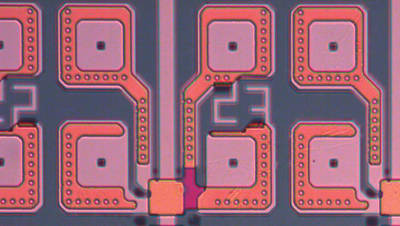
For decades, computer chips have been shrinking thanks to a steady stream of technological improvements in processing density. Experts have, however, been warning that we'll soon reach the end of the trend known as Moore's Law, in which the number of transistors per square inch on integrated circuits...
Briefs: Materials
High-Kinetic-Energy Penetrator Shielding and High-Wear-Resistance Materials Fabricated with Boron Nitride Nanotubes and BNNT Polymer Composites
In recent years, anti-penetration materials have been more widely used for armor, bulletproof vests, and micrometeoroid and orbital debris protection layers for space-suits, space vehicles, and structures....
Briefs: Materials
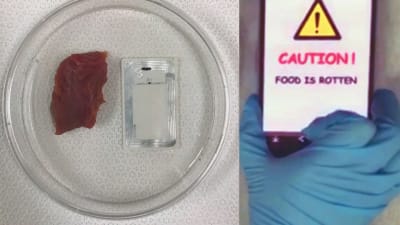
When it comes to the “smell test,” the nose isn't always the best judge of food quality. Now in a study appearing in ACS’ journal Nano Letters, scientists...
Briefs: Sensors/Data Acquisition
Infrared spectroscopy is the benchmark method for detecting and analyzing organic compounds. However, that requires complicated procedures and large, expensive instruments, making...

Briefs: Test & Measurement
A next-generation X-ray beamline now operating at the Department of Energy's Lawrence Berkeley National Laboratory (Berkeley Lab) brings together a unique set of capabilities to measure the...

INSIDER: Materials
Tiny Defects in Semiconductors Created ‘Speed Bumps’ or Electrons. UCLA Researchers Cleared the Path
UCLA scientists and engineers have developed a new process for assembling semiconductor devices. The advance could lead to much more...
Briefs: Nanotechnology
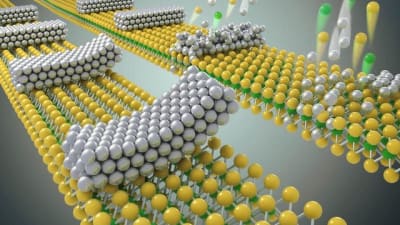
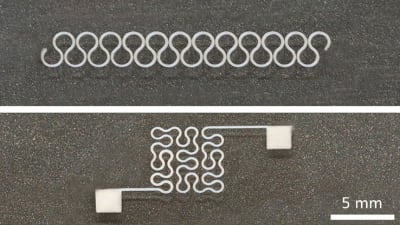
Silver nanowires have drawn significant interest in recent years for use in many applications ranging from prosthetic devices to wearable health sensors due to their flexibility,...
Briefs: Electronics & Computers
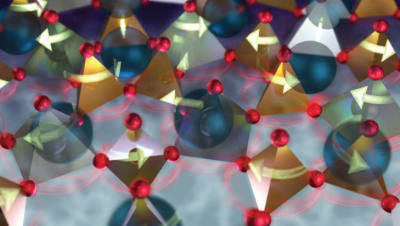
Researchers have observed waves of atomic rearrangements, known as phasons, propagating supersonically through a vibrating crystal lattice — a discovery that may dramatically...
NASA Spinoff: Green Design & Manufacturing
Spinoff is NASA's annual publication featuring successfully commercialized NASA technology. This commercialization has contributed to the development of products and services in the fields of health and...

Briefs: Aerospace
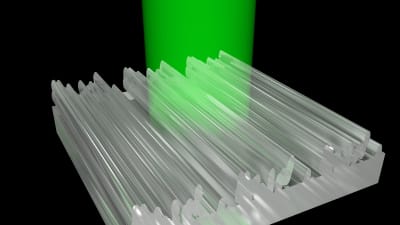
Water-Repellent Nanotextures Possess Anti-Fogging Capability
Some insect bodies have evolved the ability to repel water and oil, adhere to different surfaces, and eliminate light reflections. Scientists have been studying the physical mechanisms underlying these properties found in nature and mimicking them to design materials for use in everyday...
Blog: Test & Measurement
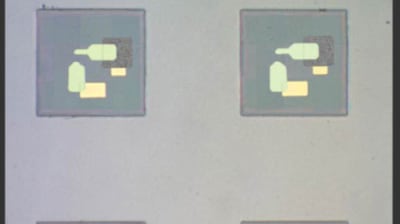
Researchers at MIT have created cell-sized robots that may someday be used to inspect and analyze hard-to-reach locations, from oil pipelines to the human body.
Facility Focus: Information Technology
Established in 1943, Los Alamos National Laboratory (LANL) in New Mexico was site Y of the Manhattan Project for a single purpose: to design and build an atomic bomb, which took just 27 months. The Los Alamos of...

Briefs: Photonics/Optics
Researchers at the University of Texas at Dallas have solved a longstanding problem that has been plaguing the scanning tunneling microscope for more than 35 years: How to prevent...

Briefs: Materials
Nanofibers are useful for any application that benefits from a high ratio of surface area to volume, such as solar cells that maximize exposure to sunlight, or fuel cell electrodes that catalyze...
Top Stories
 Blog: Robotics, Automation & Control

Aerial Microrobots That Can Match a Bumblebee's Speed
 Blog: Electronics & Computers

Turning Edible Fungi into Organic Memristors
 Blog: Manufacturing & Prototyping

Revolutionizing the Production of Semiconductor Chips
 News: Energy

 INSIDER: Electronics & Computers

World’s Smallest Programmable, Autonomous Robots
 INSIDER: Manufacturing & Prototyping
Webcasts
 Upcoming Webinars: Software

E/E Architecture Redefined: Building Smarter, Safer, and Scalable...
 Upcoming Webinars: Automotive

Hydrogen Engines Are Heating Up for Heavy Duty
 Upcoming Webinars: Electronics & Computers

Advantages of Smart Power Distribution Unit Design for Automotive...
 Upcoming Webinars: Transportation

Quiet, Please: NVH Improvement Opportunities in the Early Design...
 Upcoming Webinars: AR/AI

A FREE Two-Day Event Dedicated to Connected Mobility
 Podcasts: Manufacturing & Prototyping

How Sift's Unified Observability Platform Accelerates Drone Innovation