

Stories
56
-1
60
30
Briefs: Materials
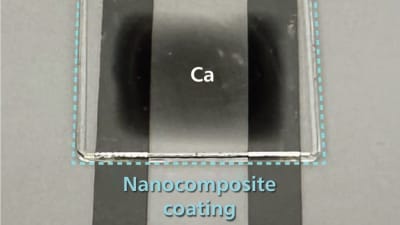
Developed by a team led by Lawrence Berkeley National Laboratory, a self-assembling nanosheet could significantly extend the shelf life of consumer products. And because the new material is recyclable, it could also enable a sustainable manufacturing approach that keeps single-use packaging and electronics out of landfills.
Briefs: Nanotechnology
A stretchable system that can harvest energy from human breathing and motion for use in wearable health-monitoring devices may be possible, according to an international team of researchers.

INSIDER: Materials
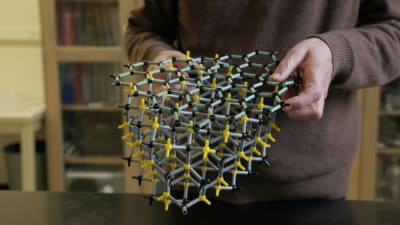
Researchers at the Georgia Institute of Technology have created the world’s first functional semiconductor made from graphene, a single sheet of carbon atoms held...
Briefs: Manufacturing & Prototyping
Macquarie University engineers have developed a new technique to make the manufacturing of nanosensors far less carbon-intensive, much cheaper, more efficient, and more versatile — substantially improving a key process in this trillion-dollar global industry.

INSIDER: Sensors/Data Acquisition
New research from Flinders University and UNSW Sydney, published in ACS Nano, explores switchable polarization in a new class of silicon compatible metal oxides...
INSIDER: Materials
The 'wonder material' graphene is well-known for its high electrical conductivity, mechanical strength, and flexibility. Stacking two layers of graphene...

INSIDER: Energy
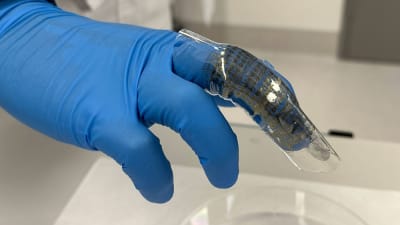
Researchers have invented an experimental wearable device that generates power from a user’s bending finger and can create and store memories, in a promising step...
Briefs: Electronics & Computers
An ultra-small actuator has nanometer-scale precision.

Briefs: Materials
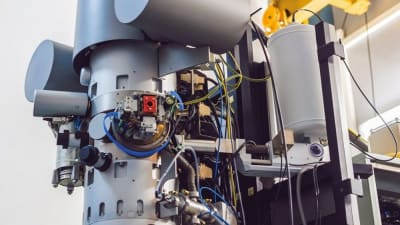
With a new microscopy technique that uses blue light to measure electrons in semiconductors and other nanoscale materials, a team of researchers is opening a new realm of possibilities in the study of these critical components, which can help power devices like mobile phones and laptops.
Briefs: Nanotechnology
Cage structures made with nanoparticles could be a step toward making organized nanostructures with mixed materials, and researchers at the University of Michigan have shown how to achieve this through computer simulations.

INSIDER: Electronics & Computers
Using lasers to accelerate electrons within a photonic nanostructure constitutes a microscopic alternative with the potential of generating significantly lower costs and making devices...

INSIDER: Electronics & Computers
Researchers at University of Rochester are developing photonic chips that could replace the gyroscopes currently used in unmanned aerial vehicles or drones, enabling them to fly where GPS...

INSIDER: Propulsion
An international team of scientists has recently developed a novel type of nano-engine made of DNA. It is driven by a clever mechanism that can perform pulsing movements. The researchers are now planning to fit it with a...

INSIDER: Data Acquisition
Continuous monitoring of sweat can reveal valuable information about human health, such as the body’s glucose levels. However, wearable sensors previously developed for this...

INSIDER: Design
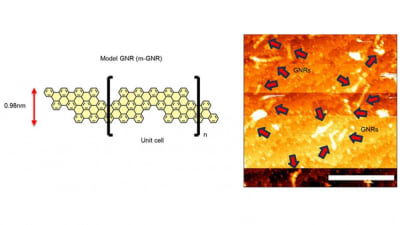
Researchers have developed a method of “wiring up” graphene nanoribbons (GNRs), a class of one-dimensional materials that are of interest in the scaling of microelectronic devices....
INSIDER: Sensors/Data Acquisition
The Big Data revolution has strained the capabilities of state-of-the-art electronic hardware, challenging engineers to rethink almost every aspect of the microchip. With ever...

INSIDER: Medical
A tiny transistor enables device to acquire and transmit neurophysiologic brain signals while simultaneously providing power to the implanted device.

Briefs: Nanotechnology
Bending 2D Nanomaterial Could Benefit Future Technologies
Rice University’s Boris Yakobson and collaborators uncovered a property of ferroelectric 2D materials that could be exploited as a feature in future devices.
Briefs: Materials
An international team of scientists is developing an inkable nanomaterial that they say could one day become a spray-on electronic component for ultra-thin, lightweight, and bendable displays and devices.
Briefs: Sensors/Data Acquisition
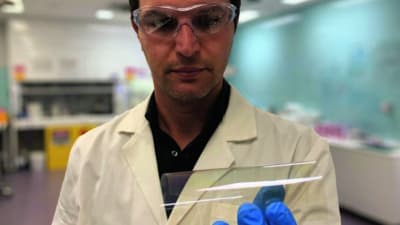
Researchers from the University of Technology Sydney (UTS) have developed biosensor technology that will allow you to operate devices, such as robots and machines, solely through thought-control.

Briefs: Materials
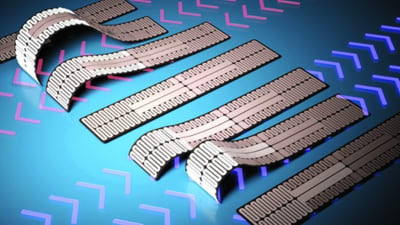
Researchers have demonstrated a caterpillar-like soft robot that can move forward, backward, and even dip under narrow spaces. Its movement is driven by a novel pattern of silver nanowires.
Briefs: Photonics/Optics
A novel nanostructure produces uniquely shaped light.

Briefs: Materials
3D nanometer-scale metamaterial structures hold promise for advanced optical isolators.

INSIDER: Motion Control
Scientists at the Department of Energy’s Oak Ridge National Laboratory have invented a coating that could dramatically reduce friction in common load-bearing systems with moving...

INSIDER: Sensors/Data Acquisition
Emerging AI applications, like chatbots that generate natural human language, demand denser, more powerful computer chips. But semiconductor chips are traditionally...
Briefs: Materials
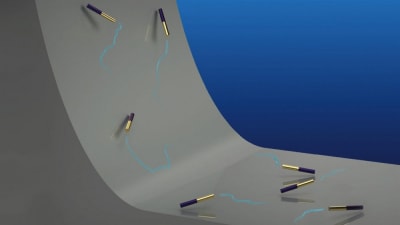
The tiny motors mimic how rock climbers navigate inclines.
Briefs: Materials
The cellulose nanofiber coating counters bending damage and retains electrode function under water.

Briefs: AR/AI
Magnets generate invisible fields that attract certain materials. Far more important to our everyday lives, magnets also can store data in computers. Exploiting the direction of the magnetic field, microscopic bar magnets each can store one bit of memory as a zero or a one — the language of computers.

INSIDER: Electronics & Computers
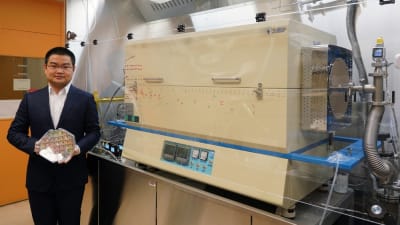
Purdue University engineers have developed a patent-pending tool to make the manufacture of ultrathin semiconductors more consistent, controllable, and...

Top Stories
 Blog: Robotics, Automation & Control

Aerial Microrobots That Can Match a Bumblebee's Speed
 Blog: Electronics & Computers

Turning Edible Fungi into Organic Memristors
 Blog: Manufacturing & Prototyping

Revolutionizing the Production of Semiconductor Chips
 News: Energy

 INSIDER: Electronics & Computers

World’s Smallest Programmable, Autonomous Robots
 INSIDER: Manufacturing & Prototyping

Webcasts
 Upcoming Webinars: Software

E/E Architecture Redefined: Building Smarter, Safer, and Scalable...
 Upcoming Webinars: Automotive

Hydrogen Engines Are Heating Up for Heavy Duty
 Upcoming Webinars: Electronics & Computers

Advantages of Smart Power Distribution Unit Design for Automotive...
 Upcoming Webinars: Transportation

Quiet, Please: NVH Improvement Opportunities in the Early Design...
 Upcoming Webinars: AR/AI

A FREE Two-Day Event Dedicated to Connected Mobility
 Podcasts: Manufacturing & Prototyping

How Sift's Unified Observability Platform Accelerates Drone Innovation