
Stories
56
-1
90
30
Briefs: Materials
Researchers are scaling up the production of vertically aligned single-walled carbon nanotubes that could revolutionize diverse commercial products ranging from rechargeable batteries, automotive parts and sporting goods to boat hulls and water filters.

INSIDER: Test & Measurement
Researchers from TMOS, the Australian Research Council Centre of Excellence for Transformative Meta-Optical Systems, have developed a sensor made from an array of nanowires,...

INSIDER: Nanotechnology
Everyone is talking about the newest AI and the power of neural networks, forgetting that software is limited by the hardware on which it runs. But it is hardware, says USC...

Briefs: Photonics/Optics
3D nanometer-scale metamaterial structures hold promise for advanced optical isolators.

Briefs: Materials
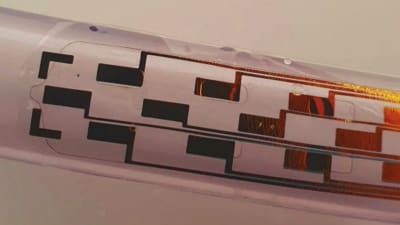
The device uses soft robotics, ultra-thin electronics, and microfluidics.
Briefs: Wearables
The smart bandage can dispense antibiotic, monitor wound-healing biomarkers, and report important data directly to doctors.
INSIDER: Electronics & Computers
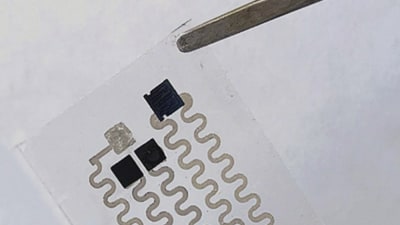
True to Moore’s Law, the number of transistors on a microchip has doubled every year since the 1960s. But this trajectory is predicted to soon plateau because silicon — the backbone...

INSIDER: Research Lab
Georgia Institute of Technology researchers have developed a new nanoelectronics platform based on graphene — a single sheet of carbon atoms.

INSIDER: Energy
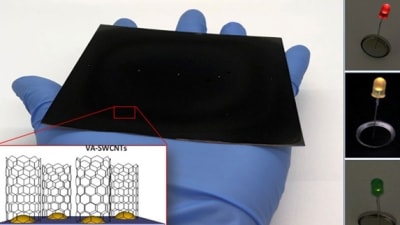
Lawrence Livermore National Laboratory (LLNL) scientists have created vertically aligned single-walled carbon nanotubes on metal foils that could be a boon for energy storage and the electronics industry.
Briefs: Imaging
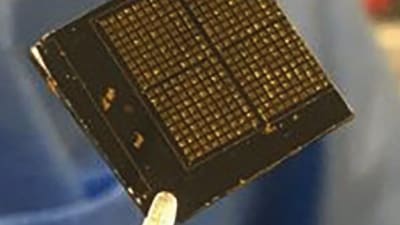
Researchers at University of Central Florida have developed an artificial intelligence device that mimics the retina of the eye.
Briefs: AR/AI
The new method could slash the energy cost of AI.

Articles: Test & Measurement
This column presents technologies that have applications in commercial areas, possibly creating the products of tomorrow.

INSIDER: Sensors/Data Acquisition
At 200 times stronger than steel, graphene has been hailed as a super material of the future since its discovery in 2004. The ultrathin carbon material is an incredibly strong...
INSIDER: Sensors/Data Acquisition
The challenge of fabricating nanowires directly on silicon substrates for the creation of the next generation of electronics has finally been solved by...

INSIDER: Mechanical & Fluid Systems
Professor of Chemical and Biomolecular Engineering Elisa Riedo and her team have discovered a fundamental friction law that is leading to a deeper understanding of energy dissipation...

INSIDER: Imaging
Until recently, it was widely believed among physicists that it was impossible to compress light below the so-called diffraction limit, except when using metal nanoparticles, which...

Briefs: Mechanical & Fluid Systems
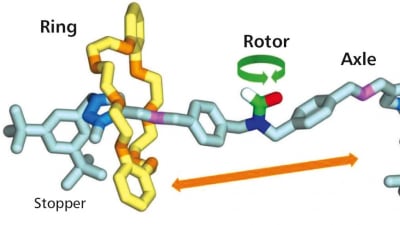
Oscillatory and rotational motions of different parts are combined to pave the way to developing super-miniaturized mechanical devices.
Briefs: Nanotechnology
Since it is a chemical sensor instead of being enzyme-based, the new technology is robust, has a long shelf-life and can be tuned to detect lower glucose concentrations than current systems.

Quiz: Design
How well do you know nanotechnology? Find out with this quiz?

INSIDER: Design
Scientists have developed a new technique for fabricating metamaterials from sheets of paper, using a computer to guide the movement of conductive ink pens and mechanical...

INSIDER: Semiconductors & ICs
The silicon-based computer chips that power our modern devices require vast amounts of energy to operate. Despite ever-improving computing efficiency, information technology...

INSIDER: Sensors/Data Acquisition
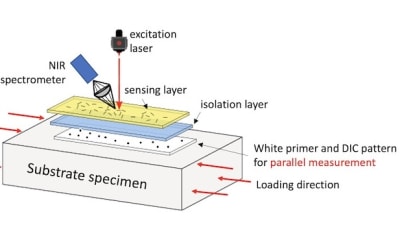
A strain-sensing smart skin developed at Rice University uses very small carbon nanotube structures to monitor and detect damage in large structures. The “strain paint” uses the fluorescent...
Briefs: Test & Measurement
A group of scientists led by the U.S. Department of Energy’s Argonne National Laboratory has created a new method for improving the resolution of hard X-ray nanotomography.

INSIDER: Sensors/Data Acquisition
A collaborative effort has installed electronic “brains” on solar-powered robots that are 100 to 250 micrometers in size — smaller than an ant’s head — so that they can walk autonomously without...

Briefs: Nanotechnology
Since it is a chemical sensor instead of being enzyme-based, the new technology is robust, has a long shelf-life and can be tuned to detect lower glucose concentrations than current systems.

Briefs: Manufacturing & Prototyping
Researchers from the Cockrell School of Engineering at The University of Texas at Austin recently created the first ever solid-state optical nanomotor.

Briefs: Lighting
Tests showed the metalens they made could focus its 197-nanometer output onto a spot measuring 1.7 microns in diameter, increasing the power density of the light output by 21 times.

INSIDER: Sensors/Data Acquisition
A new material holds promise for the next generation of organic electronics.

INSIDER: Electronics & Computers
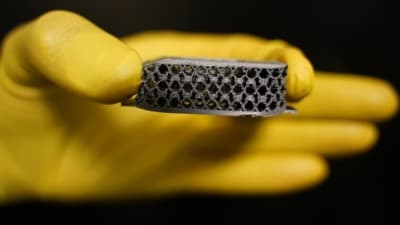
Researchers at the University of Pittsburgh Swanson School of Engineering are creating patient-specific 3D-printed smart metamaterial implants that double as sensors to monitor spinal healing.
Top Stories
 Blog: Robotics, Automation & Control

Aerial Microrobots That Can Match a Bumblebee's Speed
 Blog: Electronics & Computers

Turning Edible Fungi into Organic Memristors
 Blog: Manufacturing & Prototyping

Revolutionizing the Production of Semiconductor Chips
 News: Energy

 INSIDER: Electronics & Computers

World’s Smallest Programmable, Autonomous Robots
 INSIDER: Manufacturing & Prototyping

Webcasts
 Upcoming Webinars: Software

E/E Architecture Redefined: Building Smarter, Safer, and Scalable...
 Upcoming Webinars: Automotive

Hydrogen Engines Are Heating Up for Heavy Duty
 Upcoming Webinars: Electronics & Computers

Advantages of Smart Power Distribution Unit Design for Automotive...
 Upcoming Webinars: Transportation

Quiet, Please: NVH Improvement Opportunities in the Early Design...
 Upcoming Webinars: AR/AI

A FREE Two-Day Event Dedicated to Connected Mobility
 Podcasts: Manufacturing & Prototyping

How Sift's Unified Observability Platform Accelerates Drone Innovation