Stories
0
1170
30
5 Ws: Software
EgoTouch, a new tool developed by researchers in CMU’s Human-Computer Interaction Institute, could put control for AR/VR environments in the palm of your hand.

Blog: Energy
Watch this video to learn more about three new energy technologies. One is from Rice University; one is from Université Grenoble Alpes, Grenoble, France and University of San Diego, CA; and the last one is from Swiss Federal Laboratories for Materials Science and Technology (Empa).
Products: Software
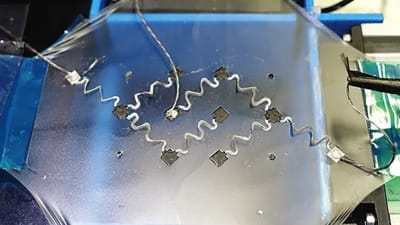
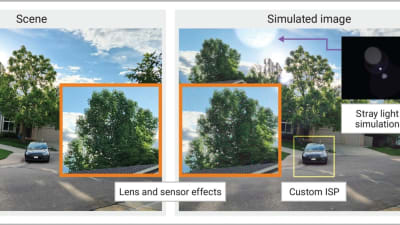
Read about the product of the month, Synopsys' ImSym — Imaging System Simulator, a virtual prototyping platform for imaging systems, encompassing lenses, sensors, and image signal processors (ISPs).
Articles: Electronics & Computers
Weight is among the most critical factors behind component choice when it comes to aerospace applications. Being among the bulkiest of components, connectors and cables need to embrace the latest scientific advances in order to reduce weight and enhance performance, fuel efficiency, and overall system reliability. This article outlines the recent advances enabling lighter connectors for aircraft, satellites, and drones.

Videos of the Month: Energy
See the videos of the month, including one on Michigan Engineering racing its 17th solar car, Astrum, across the Australian Outback; one on how NASA’s Europa Clipper — a 7,000-pound spacecraft — was packed and shipped from the agency’s Jet Propulsion Laboratory in Southern California to Kennedy Space Center in Florida; one on the MIT Media Lab’s Space Exploration Initiative; and one on leveraging precision growth to convert plants into biodegradable electronic devices.
Articles: AR/AI
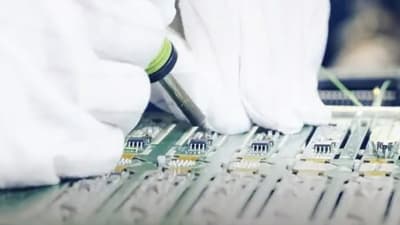
See the products of tomorrow, including a 3D microwave antenna, smart CCTV systems trained to spot blockages in urban waterways, and a full-scale prototype for six telescopes that will enable, in the next decade, the space-based detection of gravitational waves.

Products: Software
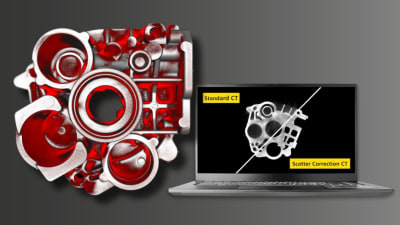
See what's new on the market, including Nikon Metrology NV's Scatter Correction CT; Emerson's next-generation Rosemount™ 3490 Controller; Fischer Connectors' USB 3.2 connectors and cable assembly solutions; Renesas Electronics' R-Car Family of system-on-chips for entry-level Advanced Driver Assistance Systems (ADAS); and much more.
Application Briefs: Manufacturing & Prototyping
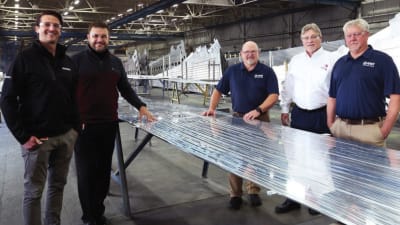
The aerospace industry is in an era of profound innovation. Airplanes and air travel are transforming in response to the needs of the global economy, necessitating the building of aircraft at an accelerated pace. Enter NWI. With over 50 years of long-bed machining expertise, NWI is a contract manufacturer of complex structural components, sub-assemblies, and complete major assemblies of wing structures. Read on to learn more.
Briefs: Materials
Potential Solvents for Building on Moon and Mars
Researchers have taken the first steps toward finding liquid solvents that may someday help extract critical building materials from lunar and Martian rock dust, an important piece in making long-term space travel possible. Read on to learn more.
Briefs: Wearables
Purdue University engineers have developed a method to transform existing cloth items into battery-free wearables resistant to laundering. These smart clothes are powered wirelessly through a flexible, silk-based coil sewn on the textile. Read on to learn more.

Briefs: Wearables
A silicone membrane for wearable devices is more comfortable and breathable thanks to better-sized pores made with the help of citric acid crystals. The new preparation technique fabricates thin, silicone-based patches that rapidly wick water away from the skin. The technique could reduce the redness and itching caused by wearable biosensors that trap sweat beneath them. Read on to learn more.

Briefs: Photonics/Optics
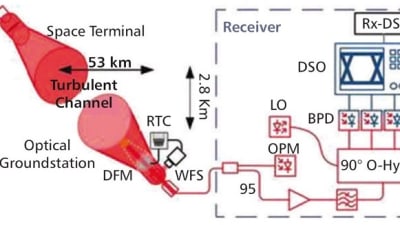
Researchers have achieved data rates as high as 424Gbit/s across a 53-km turbulent free-space optical link using plasmonic modulators — devices that uses special light waves called surface plasmon polaritons to control and change optical signals. The new research lays the groundwork for high-speed optical communication links that transmit data over open air or space. Read on to learn more.
Briefs: Connectivity
Researchers have developed a new method for predicting what data wireless computing users will need before they need it, making wireless networks faster and more reliable. The new method makes use of a technique called a “digital twin,” which effectively clones the network it is supporting. Read on to learn more.

Briefs: Information Technology
A group of University of Arizona researchers has developed a wearable monitoring device system that can send health data up to 15 miles without any significant infrastructure. Their device, they hope, will help make digital health access more equitable. Read on to learn more.

Briefs: Photonics/Optics
In a paper published in the journal Nature Nanotechnology, a team of Caltech engineers reports building a metasurface patterned with miniscule tunable antennas capable of reflecting an incoming beam of optical light to create many sidebands, or channels, of different optical frequencies. Read on to learn more.

Briefs: Communications
A research team led by Rice University’s Edward Knightly has uncovered an eavesdropping security vulnerability in high-frequency and high-speed wireless backhaul links, widely employed in critical applications such as 5G wireless cell phone signals and low-latency financial trading on Wall Street. Read on to learn more.

Briefs: Aerospace
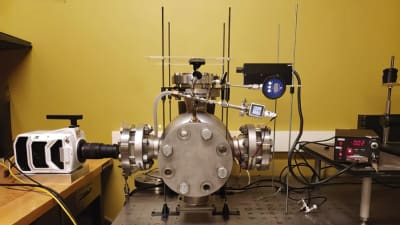
A research team from the University of Waterloo’s Laboratory for Emerging Energy Research is looking into processing lunar regolith, the Moon’s top layer of soil and dust, into usable materials for life support, energy generation, and construction. This includes investigating the use of defunct satellite material as a fuel source when mixed with lunar regolith. Read on to learn more.
Briefs: Aerospace
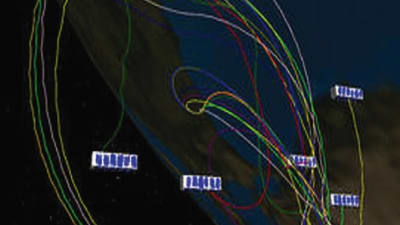
To address scalable control of orbital dynamics, NASA Ames Research Center has patented Swarm Orbital Dynamics Advisor (SODA) — a solution that accepts high-level configuration commands and provides the orbital maneuvers needed to achieve the desired type of swarm relative motion. Read on to learn more.
Briefs: Mechanical & Fluid Systems
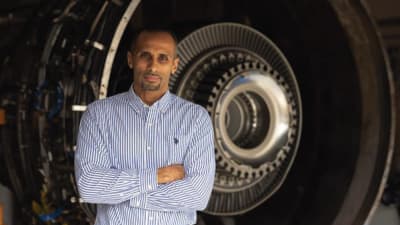
Over the past year, the DoD has awarded funding to hypersonics research led by University of Central Florida Mechanical and Aerospace Engineering Professor Kareem Ahmed to support the advancements he’s making in the technology. The support is a testament to the progress UCF has made in the field. Read on to learn more about these advances.
Briefs: Power
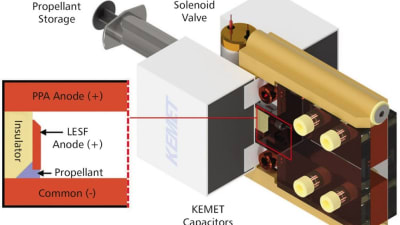
A novel micropropulsion system was developed for nanosatellite applications using a liquid-fed pulsed-plasma thruster. It uses a liquid propellant for a Lorentz-force pulsed-plasma accelerator and an extended lifetime ignition system driven by nanosecond-long pulses. Read on to learn more.
Briefs: Software
Incorporating a vision-based navigation method, NASA Ames has developed a novel Alternative Position, Navigation, and Timing (APNT) solution for AAM aircraft in environments where GPS is not available. Read on to learn more about it.

Briefs: Energy
In recent years, engineers at ETH Zurich have developed the technology to produce liquid fuels from sunlight and air. In 2019, they demonstrated the entire thermochemical process chain under real conditions for the first time, in the middle of Zurich, on the roof of ETH Machine Laboratory. Two ETH spin-offs, Climeworks and Synhelion, are further developing and commercializing the technologies. Read on to learn more.
Briefs: Software
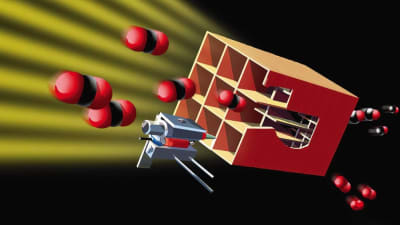
A new approach uses commercial chip fab materials and techniques to fabricate specialized transistors to serve as the building block of the timing device. Read on to learn more.
Briefs: Manufacturing & Prototyping
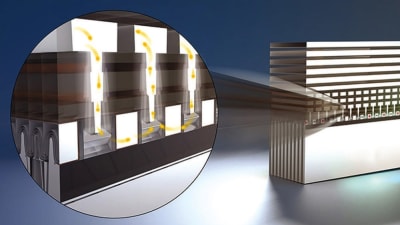
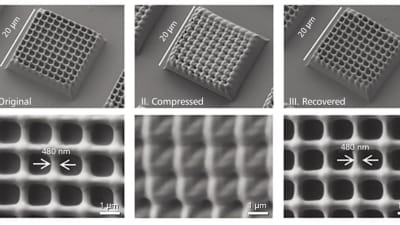
Researchers have successfully demonstrated the 4D printing of shape memory polymers in submicron dimensions that are comparable to the wavelength of visible light. Read on to learn more.
Briefs: Aerospace
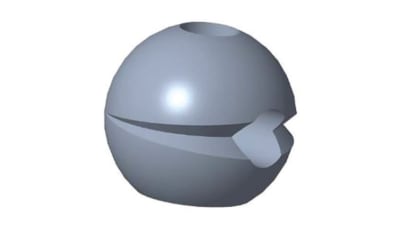
Innovators at NASA Johnson Space Center have developed an adjustable thermal control ball valve assembly which utilizes a unique geometric ball valve design to facilitate precise thermal control within a spacesuit. The technology meters the coolant flow going to the cooling and ventilation garment, worn by an astronaut in the next generation space suit. Read on to learn more.
Briefs: Materials
Biomedical engineers have developed a “bio-ink” for 3D-printed materials that could serve as scaffolds for growing human tissues to repair or replace damaged ones in the body. Read on to learn more.

Articles: Materials
Over the past decade, NASA’s Space Technology Mission Directorate and its team of development partners have developed several unique thermal protection system (TPS) technologies designed to protect spacecraft from the extreme heat conditions and entry environments that space missions face. Read on to learn more about it.

Top Stories
 Blog: Sensors/Data Acquisition

Going for Gold in Winter Olympic Curling
 Blog: Energy

Batteries that Can Withstand the Cold
 Blog: Lighting

A Stretchable OLED that Can Maintain Most of Its Luminescence
 INSIDER: Design

Advancing All-Solid-State Batteries
 Blog: Data Acquisition

 Blog: Materials

Webcasts
 On-Demand Webinars: Defense

Cooling a New Generation of Aerospace and Defense Embedded Computing...
 Upcoming Webinars: Software

Beyond AI-Copy-Paste Engineering: Advanced AI-Integration Success...
 Upcoming Webinars: Automotive

Battery Abuse Testing: Pushing to Failure
 Upcoming Webinars: Power

A FREE Two-Day Event Dedicated to Connected Mobility
 Upcoming Webinars: RF & Microwave Electronics

Choosing the Right N-Port Strategy: Multiport VNAs vs. Switch...
 Upcoming Webinars: AR/AI