Stories
0
990
30
INSIDER: Sensors/Data Acquisition
From mountain goats that run up near-vertical rock faces to armadillos that roll into a protective ball, animals have evolved to adapt effortlessly to changes in their environment....

INSIDER: Mechanical & Fluid Systems
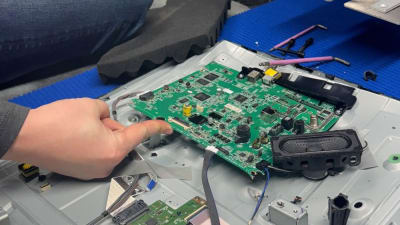
A researcher from Carnegie Mellon University’s School of Computer Science is using robotics to improve e-waste recycling.
INSIDER: Unmanned Systems
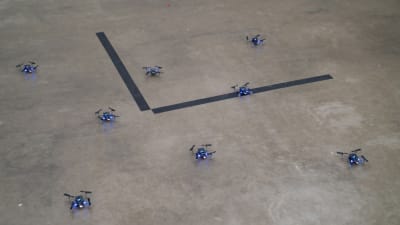
Drone shows are an increasingly popular form of large-scale light display. These shows incorporate hundreds to thousands of airborne bots, each programmed to fly in paths that...
Quiz: Information Technology
Test your knowledge of cloud computing with this quiz.

White Papers: Manufacturing & Prototyping
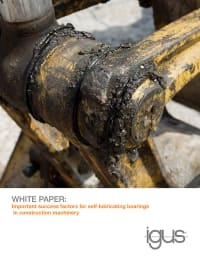
Important Success Factors for Dry-running Bearings in Construction Machinery
Choosing between plastic and metal bearings for construction machinery is a decision many manufacturers have to make. However, it’s a deceptively simple choice, as...Blog: Design
Researchers have developed a new AI algorithm, called Torque Clustering, that is much closer to natural intelligence than current methods. It significantly improves how AI systems learn and uncover patterns in data independently, without human guidance.

NASA Spinoff: Aerospace
Recent successes in cultivating human heart tissue, knee cartilage, and pharmaceutical crystals in space have relied on technology that was initially developed decades ago with support from NASA.

Blog: Design
Paying attention to what successful researchers have to say about their process is a good way to get ideas about what it takes to be successful in research and development.

Podcasts: Connectivity
Overcoming IoMT connectivity barriers with ultra-low-power wireless technologies.

5 Ws: Robotics, Automation & Control
With the goal to democratize space research, MIT engineers have demonstrated the first fully 3D-printed, droplet-emitting electrospray engine which can be produced rapidly and for a fraction of the cost of traditional thruster.

INSIDER: Energy
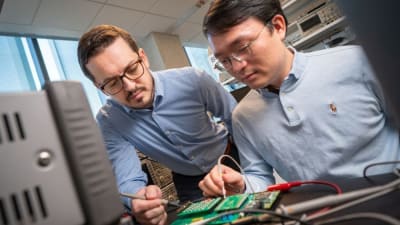
An innovative circuit design could enable miniature devices, such as microdrones and other microrobotics, to be powered for longer periods of time while staying...
INSIDER: Energy
Oxide-ion conductors enable oxide ions (O2-) to be transported in solid oxide fuel cells (SOFCs), which can run on diverse fuels beyond hydrogen, including natural gas,...

INSIDER: Energy
As population growth and extreme temperatures strain the United States power grid, utilities and equipment manufacturers are looking for ways to increase the amount of...

INSIDER: Power
Researchers at the University of Minnesota have achieved a new material that will be pivotal in making the next generation of high-power electronics...
Special Reports: Photonics/Optics

Medical Manufacturing & Outsourcing - March 2025
Researchers achieve near‐void‐free 3D printing…how new laser joining technology is improving implantable device reliability…tips and techniques for adhesive bonding of plastics. Read...Products: Electronics & Computers
Last December, Tech Briefs readers were asked to select one product from our 2024 Products of the Month to be named Readers’ Choice Product of the Year. Thanks to all of our readers who cast their votes. Read on to learn the 2024 winners.

Products: Software
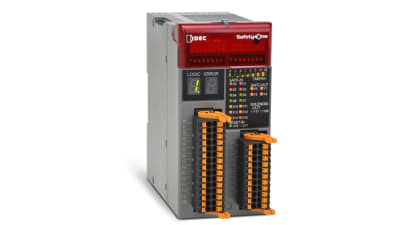
See the product of the month: IDEC Corporation's FS1B Safety Controller, an upgrade of the popular FS1A.
Articles: Electronics & Computers
See the products of tomorrow, including paper-thin optical lenses simple enough to mass produce like microchips; a compact cooling technology that can pump away heat continuously using layers of flexing thin films; and a multilayered chip design that doesn’t require any silicon wafer substrates and works at temperatures low enough to preserve the underlying layer’s circuitry.

Products: Semiconductors & ICs
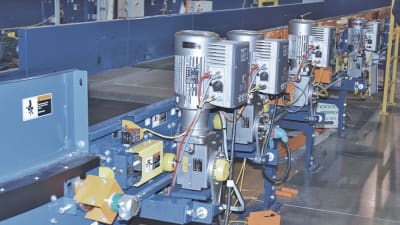
See what's new on the market, including electronic control products from NORD DRIVESYSTEMS; the new F-141 photonics alignment system from PI; InnoPhase IoT's expansion of its Talaria platform; Aerotech, Inc.'s HexGen® HEX150-125HL Miniature Hexapod; and more.
Briefs: Energy
NASA Ames Research Center presents a novel, patent-pending adjustable-autonomous intelligent systems approach for developing sustainable, small-scale reproductions of subsets of the Earths biosphere that can be distributed both on and beyond Earth, for improving the quality of life for all life, expanding the diversity of life, studying and protecting life, as well as enabling life to permanently extend beyond Earth. Read on to learn more.

Briefs: Semiconductors & ICs
Researchers have developed a strategy to design luminescent polymers with high light-emitting efficiencies from the start that are both biodegradable and recyclable. Read on to learn more.

Briefs: Materials
A PNNL research team used a simple mixed-salt water-based solution and their knowledge of metal properties to separate valuable minerals in continuously flowing reaction chambers. Read on to learn more.

Briefs: Robotics, Automation & Control
A new study led by Flinders University and French researchers has used a novel bio-inspired computing artificial intelligence solution to improve the potential of UUVs and other adaptive control systems to operate more reliability in rough seas and other unpredictable conditions. Read on to learn more.

Briefs: Robotics, Automation & Control
In creating a pair of new robots, Cornell researchers cultivated an unlikely component: fungal mycelia. By harnessing mycelia’s innate electrical signals, the researchers discovered a new way of controlling “biohybrid” robots that can potentially react to their environment better than their purely synthetic counterparts. Read on to learn more.
Briefs: Propulsion
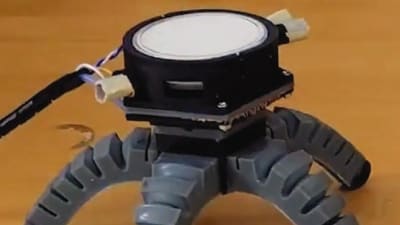
In a recent study published in the journal eLife, an international research group has studied the relationship between electrical stimulation in stick insects’ leg muscles and the resultant torque (the twisting force that makes the leg move). Read on to learn what they found.

Briefs: RF & Microwave Electronics
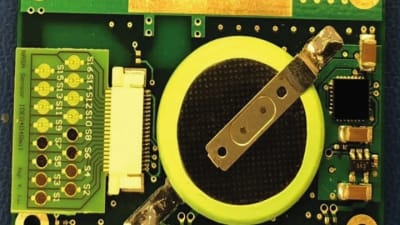
Innovators at NASA Johnson Space Center have developed an adaptable RFID system that optimizes transmission for priority data as targets move in and out of passive coverage areas. The method extends the range, and reduces data latency, of ultra-low power battery-assisted passive RFID sensor tags. Read on to learn more.
Briefs: Physical Sciences
Jamie Paik and colleagues in the Reconfigurable Robotics Lab in EPFL’s School of Engineering have developed a sensor that can perceive combinations of bending, stretching, compression, and temperature changes, all using a robust system that boils down to a simple concept: color. Read on to learn more about it.

Briefs: Connectivity
The Brown University research team created a novel approach for a wireless communication network that can efficiently transmit, receive, and decode data from thousands of microelectronic chips that are each no larger than a grain of salt. Read on to learn more about it.
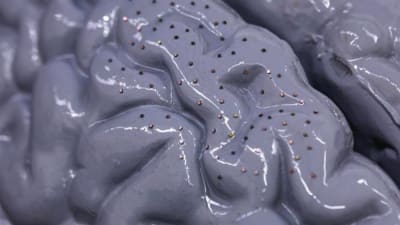
Top Stories
 Blog: Sensors/Data Acquisition

Going for Gold in Winter Olympic Curling
 Blog: Energy

Batteries that Can Withstand the Cold
 Blog: Lighting

A Stretchable OLED that Can Maintain Most of Its Luminescence
 INSIDER: Design

Advancing All-Solid-State Batteries
 Blog: Data Acquisition

 Blog: Materials

Webcasts
 On-Demand Webinars: Defense

Cooling a New Generation of Aerospace and Defense Embedded Computing...
 Upcoming Webinars: Software

Beyond AI-Copy-Paste Engineering: Advanced AI-Integration Success...
 Upcoming Webinars: Automotive

Battery Abuse Testing: Pushing to Failure
 Upcoming Webinars: Power

A FREE Two-Day Event Dedicated to Connected Mobility
 Upcoming Webinars: RF & Microwave Electronics

Choosing the Right N-Port Strategy: Multiport VNAs vs. Switch...
 Upcoming Webinars: AR/AI