Stories
0
10620
30
Question of the Week
Will Hyperloops replace trains?
According to the Navigant Research firm, Hyperloop Transportation Technologies has made a deal with central California landowners to build the world's first Hyperloop. The 5-mile test track will be built along California's Interstate 5. The Hyperloop, brought up in 2014 by Tesla Motors CEO Elon Musk, would...
INSIDER: Sensors/Data Acquisition
Visual Microphone Identifies Structural Defects
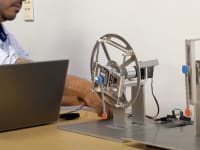
A new technique from Massachusetts Institute of Technology researchers estimates material properties of physical objects, such as stiffness and weight, from video.
INSIDER: Materials
Researchers Create Shape-Shifting Plastic
Researchers from Washington State University and the Department of Energy's Oak Ridge Laboratory have created a tunable shape-memory polymer. The shape-shifting plastic can “remember” its original shape and return to it after being deformed with heat or other forces.
Question of the Week: Lighting
Will iris detection become a mainstream smartphone feature?
This week's Question: The Fujitsu Arrows NX F-04G, a new smartphone set for release in Japan, comes with a built-in retinal scanner that can be used for a variety of different functions, including unlocking the device, accessing apps, and making mobile payments. A front-facing infrared...
INSIDER: Mechanical & Fluid Systems
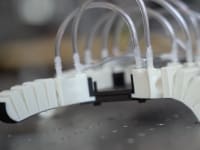
Micro actuators are needed for numerous applications, ranging from mobile and wearable devices, to minimally invasive medical devices. However, the limitations associated with their fabrication...

INSIDER: Software
To the naked eye, buildings and bridges appear fixed in place, unmoved by forces like wind and rain. But in fact, these large structures do experience imperceptibly small vibrations that,...

News: Medical
Researchers at the University of Houston have created an optical lens that can be placed on an inexpensive smartphone to amplify images by a magnitude of 120, all for just 3 cents a lens. The lens can...
News: Photonics/Optics
An ultrafast camera can acquire two-dimensional images at 100 billion frames per second, a speed capable of revealing light pulses and other phenomena previously too fast to be observed....

News: Sensors/Data Acquisition
Researchers at the Fraunhofer Institute for Factory Operation and Automation IFF have developed the Dermascanner full-body dermatological scanner to help doctors diagnose skin conditions. When the...

INSIDER: Materials
New Nanomaterials Mimic Bird Feathers
Inspired by the way iridescent bird feathers play with light, UC San Diego scientists have created thin-film materials in a wide range of pure colors: red, orange, yellow, and green. The hues are determined by physical structure rather than pigments.
Question of the Week
Will robo-pets catch on?
This week's Question: In a study in Frontiers in Veterinary Science, Australian researcher Jean-Loup Raul predicts that robotic and virtual-reality pets will grow in popularity as urban populations expand. “It might sound surreal for us to have robotic or virtual pets, but it could be totally normal for the next...
INSIDER: Sensors/Data Acquisition
Researchers Create Acoustic 'Image' of Thunder
Southwest Research Institute (SwRI) researchers have imaged the first acoustic signature of thunder, visually capturing the sound waves created by artificially triggered lightning.
INSIDER: Electronics & Computers
A patented passive cooling system for computer processors from the University of Alabama could save U.S. consumers more than $6.3 billion per year in energy costs...

INSIDER: Energy
The Sun is a huge source of energy. In just one hour, planet Earth is hit by so much sunshine that humankind could cover its energy needs for an entire year if only we knew how to harvest and...
INSIDER: Electronics & Computers
Engineering researchers at the University of Arkansas have invented a novel electrical power converter system that simultaneously accepts power from a variety of energy sources and...

INSIDER: Sensors/Data Acquisition
Researchers Create 'Cognitive' Underwater Robots
A new programming approach developed by MIT engineers gives underwater robots more “cognitive” capabilities.
INSIDER: Medical
More than 100 drugs have been approved to treat cancer, but predicting which ones will help a particular patient is an inexact science. A new implantable device, about the size of a...

INSIDER: Test & Measurement
NASA researchers, working with the Air Force Research Laboratory and FlexSys of Ann Arbor, MI, successfully completed initial flight tests of a new morphing wing technology that has...

Question of the Week: Lighting
Will "smart city" lighting efforts pay off?
This week's Question: At this year's Mobile World Congress in Spain, Sierra Wireless and Philips CityTouch demonstrated "smart city" lighting capabilities. The companies' systems connect a city's individual street lights to the Internet via 2G, 3G, and 4G networks. The "smart" technology allows...
News: Test & Measurement
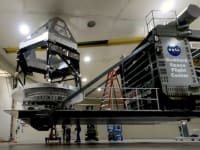
The first full joint testing between NASA and the U.S. Navy of the Orion spacecraft recovery procedures off the coast of California was suspended after the team experienced issues...

News: Electronics & Computers
Smartphones and other personal electronic devices could, in regions where they are in widespread use, function as early warning systems for large earthquakes. This technology could serve...

News: Energy
Scientists are discovering new ways to decrease costs and increase efficiency of solar panels and coming up with creative ways to generate power. According to TechRepublic, a photovoltaic...

News: Sensors/Data Acquisition
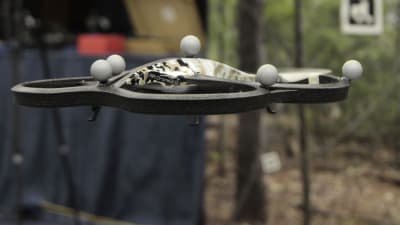
Search-and-rescue operations, package delivery, and underwater exploration could all be performed soon by intelligent machines. The Autonomy Incubator group at NASA Langley is...
INSIDER: Imaging
Trillion-Frame-Per-Second Camera Captures Ultrafast Phenomena
Researchers from Japan have developed a new high-speed camera that can record events at a rate of more than 1-trillion-frames-per-second. The STAMP (Sequentially Timed All-optical Mapping Photography) technology holds promise for the study of complex, ultrafast phenomena.
Question of the Week
Will NASA achieve “warp drive?”
This week’s Question: According to a NASASpaceflight.com forum, NASA has successfully tested its electromagnetic (EM) drive in a vacuum. The form of space flight could eventually enable trips at speeds approaching that of light. The drive works by propelling objects through space by using magnets to create...
Briefs: Medical
High-Density, Homogenous Bacterial Spore Distributions on Test Surfaces
Thus far, spore transfer had been successful from the polycarbonate membrane onto stainless steel, aluminum, and to some extent, glass. In order to image the endospores under an ESEM (environmental scanning electron microscope), the spores were transferred onto a 4-mm-diameter,...
Briefs: Medical
Team Game and Simulation Control
This technology is an offshoot of LaRC-developed technologies using physiological measures for assessing pilot stress, sustained attention, engagement, and awareness in a laboratory flight simulation environment. The technology allows modulation of player inputs to a video game or simulation from a user interface...
Briefs: Medical
CRP Aptamers to Bone-Specific Alkaline Phosphatase (BAP)
In order to detect and quantify bone-specific alkaline phosphatase (BAP) in a human biological sample, a binding agent (molecule) that specifically recognizes BAP in a sample is typically required. This binding agent can then be used in numerous assays/instruments to enable the detection and...
Briefs: Communications
VCSEL Laser Array for Communications
Optical communications in terrestrial and space environments require transmitted signals on the order of 40 GHz and higher, because of the uncertain and changing transmission environments. A robust communications system is needed that will provide these frequencies and substantial discrimination between...
Top Stories
 Blog: Power

My Opinion: We Need More Power Soon — Is Nuclear the Answer?
 Blog: AR/AI
Aerial Microrobots That Can Match a Bumblebee's Speed
 News: Energy

 Blog: Electronics & Computers

Turning Edible Fungi into Organic Memristors
 Blog: Robotics, Automation & Control

Microscopic Swimming Machines that Can Sense, Respond to Surroundings
 INSIDER: Sensors/Data Acquisition
Webcasts
 Upcoming Webinars: Power

Hydrogen Engines Are Heating Up for Heavy Duty
 Upcoming Webinars: Automotive

Advantages of Smart Power Distribution Unit Design for Automotive...
 Upcoming Webinars: Automotive

Quiet, Please: NVH Improvement Opportunities in the Early Design...
 Upcoming Webinars: Test & Measurement

From Spreadsheets to Insights: Fast Data Analysis Without Complex...
 Upcoming Webinars: Automotive

Battery Abuse Testing: Pushing to Failure
 Upcoming Webinars: Connectivity