Stories
0
1890
30
Products: Design
See the product of the month: Advanced Energy Industries' new configurable power supply that delivers optimized, application-specific power conversion in a small form factor with up to four times higher power density than conventional solutions.

Articles: Sensors/Data Acquisition
See the products of tomorrow, including the University of Maryland's "cooling glass"; the Reconfigurable Robotics Lab's sensor that can perceive combinations of bending, stretching, compression, and temperature changes using color; Tufts' tiny biological robots; and more.

Products: Manufacturing & Prototyping
See what's new on the market, including a new feature for RJG's CoPilot process control system, Renishaw's expanded RenAM 500, AIRMAR's three medium ultra-wide transducers, Coilcraft's molded power inductors, VP810 vapor phase soldering systems from ASSCON, and more.

Briefs: Design
MIT researchers have engineered both the nanoparticles used to deliver the COVID-19 antigen and the antigen itself, to boost the immune response, without the need for a separate adjuvant. If further developed for use in humans, this type of RNA vaccine could help to reduce costs, the dosage needed, and potentially lead to longer-lasting immunity.

Briefs: Design
The ventilators are simpler and cheaper to make than those currently available.

Briefs: Energy
A stretchable system that can harvest energy from human breathing and motion for use in wearable health-monitoring devices may be possible, according to an international team of researchers.

Briefs: Medical
Using 3D Bioprinting to Create Eye Tissue
The research team from the National Eye Institute printed a combination of cells that form the outer blood-retina barrier — eye tissue that supports the retina’s light-sensing photoreceptors. The technique provides a theoretically unlimited supply of patient-derived tissue to study degenerative retinal diseases such as age-related macular degeneration.
Briefs: Energy
Scientists at the U.S. Department of Energy’s (DOE) Argonne National Laboratory are researching solutions to these Li-ion battery issues by testing new materials in battery construction. One such material is sulfur.

Briefs: Energy
Wireless power transfer was recently demonstrated by MAPLE — Microwave Array for Power-transfer Low-orbit Experiment — one of three key technologies being tested by the Space Solar Power Demonstrator (SSPD-1), the first space-borne prototype from Caltech’s Space Solar Power Project (SSPP), which aims to harvest solar power in space and transmit it to the Earth’s surface.

Briefs: Physical Sciences
A team from Chalmers University of Technology has succeeded in observing how the lithium metal in the cell behaves as it charges and discharges. The new method may contribute to batteries with higher capacity and increased safety in our future cars and devices.

Briefs: Energy
A research team from the Department of Energy’s Pacific Northwest National Laboratory reports that the flow battery, a design optimized for electrical grid energy storage, maintained its capacity to store and release energy for more than a year of continuous charge and discharge.
Briefs: Materials
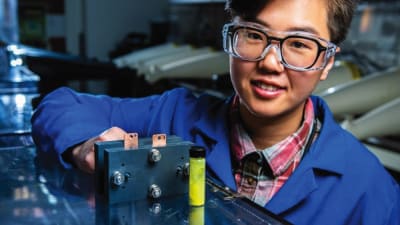
Researchers at the U.S. Department of Energy’s (DOE) Argonne National Laboratory have developed an autonomous, or self-driving, microscopy technique. It uses AI to selectively target points of interest for scanning. Read on to learn more.

Briefs: Lighting
Researchers at SEAS have uncovered hidden potential in metasurfaces and demonstrated optical devices that manipulate light’s polarization state with an unprecedented degree of control. Read on to learn more.

Briefs: Semiconductors & ICs
Researchers have created a device that enables them to electronically steer and focus a beam of terahertz electromagnetic energy with extreme precision. This opens the door to high-resolution, real-time imaging devices that are hundredths the size of other radar systems and more robust than other optical systems.

Briefs: Photonics/Optics
An international team of researchers reports on a compact high-brightness mid-IR-driven source combining a gas-filled anti-resonant-ring photonic crystal fiber with a novel nonlinear-crystal. The tabletop source provides a seven-octave coherent spectrum from 340 nm–40,000 nm with spectral brightness 2–5 orders of magnitude higher than one of the brightest synchrotron facilities.

Briefs: Manufacturing & Prototyping
The NIST camera is made up of grids of ultrathin electrical wires, cooled to near absolute zero, in which current moves with no resistance until a wire is struck by a photon. In these superconducting-nanowire cameras, the energy imparted by even a single photon can be detected because it shuts down the superconductivity at a particular location (pixel) on the grid. Combining all the locations and intensities of all the photons makes up an image.

Briefs: Semiconductors & ICs
Researchers have unveiled a remarkable new material with potential to impact the world of material science: amorphous silicon carbide (a-SiC). Beyond its exceptional strength, this material demonstrates mechanical properties crucial for vibration isolation on a microchip. It is therefore particularly suitable for making ultra-sensitive microchip sensors.

Briefs: Materials
Developed by a team led by Lawrence Berkeley National Laboratory, a self-assembling nanosheet could significantly extend the shelf life of consumer products. And because the new material is recyclable, it could also enable a sustainable manufacturing approach that keeps single-use packaging and electronics out of landfills.
Briefs: Materials
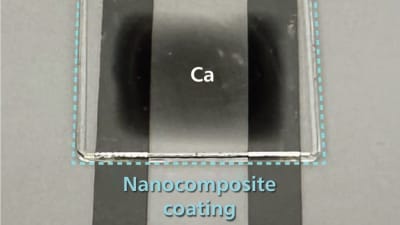
A series of buzzing “loop-currents” could explain a recently discovered, never-before-seen phenomenon in a type of quantum material. The quantum material is known by the chemical formula Mn 3Si2Te6, but it’s safe to call it “honeycomb.” Read on to learn more.

Briefs: Materials
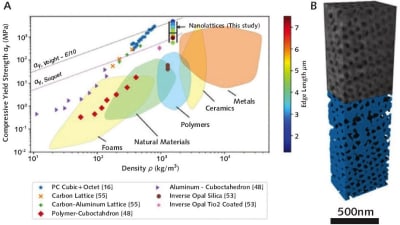
Scientists at the Columbia University, University of Connecticut, and the U.S. Department of Energy’s (DOE) Brookhaven National Laboratory were able to fabricate a pure form of glass and coat specialized pieces of DNA with it to create a material that was not only stronger than steel, but incredibly lightweight.
Briefs: Materials
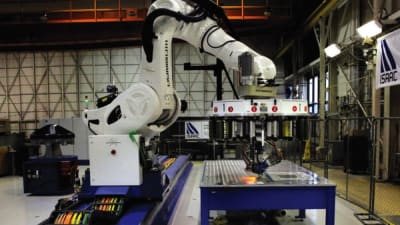
NASA’s Langley Research Center has developed a simplified, tool-less automated tow/tape placement (ATP) system. This invention enables several benefits that mitigate limitations associated with conventional ATP systems. Read on to learn more.
Briefs: Manufacturing & Prototyping
Harvard researchers have realized a key milestone in the quest for stable, scalable quantum computing, an ultra-high-speed technology that will enable game-changing advances in a variety of fields, including medicine, science, and finance.

Briefs: Materials
A new method for metal 3D printing aims to make more efficient use of resources by allowing structural modifications to be “programmed” into metal alloys during 3D printing, fine-tuning their properties without the “heating and beating” process that’s been in use for thousands of years.

Briefs: Manned Systems
Recent experiments by a team from the West Virginia University focused on how a weightless microgravity environment affects 3D printing using titania foam, a material with potential applications ranging from UV blocking to water purification. ACS Applied Materials and Interfaces published their findings.
Briefs: Materials
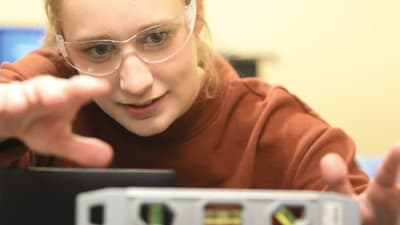
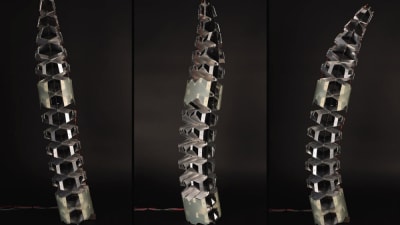
Using kirigami, the ancient Japanese art of folding and cutting paper, MIT researchers have now manufactured a type of high-performance architected material known as a plate lattice, on a much larger scale than scientists have previously been able to achieve by additive fabrication.
Articles: Test & Measurement
NASA’s Artemis program consists of a series of missions designed to land humans on the Moon and establish a sustainable, continuing presence. A long-term foothold on the Moon’s surface enables invaluable research and testing opportunities that will set the stage for future groundbreaking missions, including the first human mission to Mars.

Articles: Electronics & Computers
What are the opportunities and risks AI offers in manufacturing? How can manufacturers successfully implement AI and prepare their workforce to integrate it into their processes? What’s its future outlook? Tech Briefs asked four industry experts in this roundtable.

Videos of the Month: Robotics, Automation & Control
See the videos of the month, including one on Purdue University researchers teaching robots how to navigate the swaying deck of a boat, one on a Carnegie Mellon-led team developing a soft robot to better understand an organism — the pleurocystitid — that existed 450 million years ago, and more.

INSIDER: Design
An international research group has engineered a novel high-strength flexible device by combining piezoelectric composites with unidirectional carbon fiber (UDCF), an anisotropic...

Top Stories
 Blog: Power

My Opinion: We Need More Power Soon — Is Nuclear the Answer?
 Blog: AR/AI

Aerial Microrobots That Can Match a Bumblebee's Speed
 News: Energy

 Blog: Electronics & Computers

Turning Edible Fungi into Organic Memristors
 Blog: Robotics, Automation & Control

Microscopic Swimming Machines that Can Sense, Respond to Surroundings
 INSIDER: Sensors/Data Acquisition

Webcasts
 Upcoming Webinars: Power

Hydrogen Engines Are Heating Up for Heavy Duty
 Upcoming Webinars: Automotive

Advantages of Smart Power Distribution Unit Design for Automotive...
 Upcoming Webinars: Automotive

Quiet, Please: NVH Improvement Opportunities in the Early Design...
 Upcoming Webinars: Test & Measurement

From Spreadsheets to Insights: Fast Data Analysis Without Complex...
 Upcoming Webinars: Automotive

Battery Abuse Testing: Pushing to Failure
 Upcoming Webinars: Connectivity