Stories
0
4440
30
Articles: Transportation
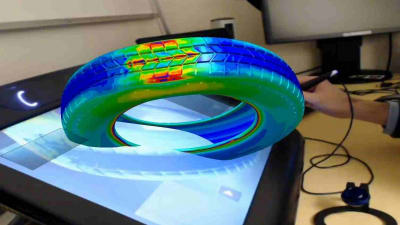
The more complex the vehicle, the greater the need for comprehensive design solutions.
Briefs: Electronics & Computers
These robust supercapacitors still work when stretched to eight times their original size.

Briefs: Medical
Ultra-Miniaturized Microendoscope
The lens-free scope produces higher-quality images at a fraction of the size.
Briefs: Materials
This invention holds potential for a range of biomedical applications, from controlled-release drug delivery to tissue engineering.

Briefs: Test & Measurement
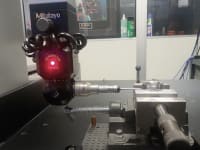
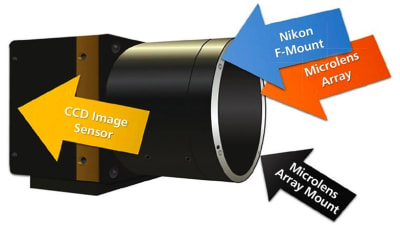
This camera enables multi-spectral imaging for metrology.
Briefs: Electronics & Computers
This composite can be used in lithium metal batteries.
Briefs: Communications
Assembling tiny chips into unique programmable surfaces dramatically increases the amount of data wireless systems can transmit.

Briefs: Materials
These glass substrates can be used for displays on smartphones and tablets and for other durable, impact-resistant applications.

Briefs: Medical
A chip-based technology generates sound profiles with high resolution and intensity to make ultrasound therapy more effective and easier.

Briefs: Tubing & Extrusion
The stent monitors even subtle changes in the flow of blood through the artery.
Products: Imaging
The GVC1001 computer features dual 10-GigE ports for gigabit Ethernet camera or other sensor inputs.

Question of the Week: Sensors/Data Acquisition
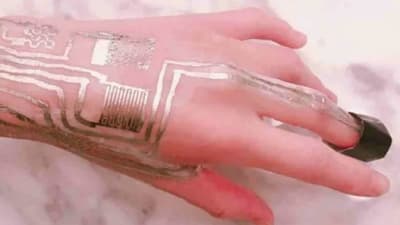
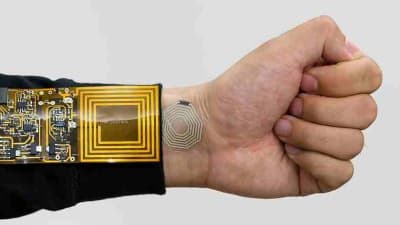
This month’s Here’s an Idea episode highlighted a number of on-body sensors. Penn State professor Larry Cheng, for example, found a way to 3D-print a sensor directly on the skin (shown in the above image),...
Blog: Test & Measurement
This year's winners included industrial-automation software, simulation tech, and digital storage oscilloscopes.

INSIDER: Robotics, Automation & Control
Army-funded researchers created nanosized robots that could enable locomotion, novel metamaterial design, and high-fidelity sensors. Cornell University researchers created micron-sized shape memory actuators that...

INSIDER: Motion Control
There are some tasks that traditional rigid robots aren’t cut out for. Soft-bodied robots, on the other hand, may be able to interact with people more safely or slip into tight spaces with ease. But...

Blog: AR/AI
Robotics researchers are developing exoskeleton legs capable of thinking and making control decisions on their own using sophisticated artificial intelligence (AI) technology.
Podcasts: Manufacturing & Prototyping
In this episode of our Here's an Idea podcast, we speak to engineers who are building a variety of wearables. And some sensors blend in more than others.
Question of the Week: Aerospace
Will Turboelectric Aircraft Take Off?
A recent video on Tech Briefs TV highlighted NASA’s new idea for aircraft: the STARC-ABL. The concept under development aims to bridge the gap between current jet fuel-powered aircraft and future all-electric vehicles.
Blog: RF & Microwave Electronics
Long-range radar is used in air-traffic control. Short-range radar supports automotive applications like collision avoidance. How do you know what range you need for your application?

Blog: Energy
You have the power. That's the idea behind a "wearable microgrid" from the University of California San Diego that harvest and stores energy from your body to power electronics.

INSIDER: Electronics & Computers
Rice University engineers have suggested a colorful solution to next-generation energy collection: Luminescent solar concentrators (LSCs) in your windows. The team designed and built...

INSIDER: Electronics & Computers
Researchers at CU Boulder have developed a new, low-cost, wearable device that transforms the human body into a biological battery. The device is stretchy enough that you can wear it like a...

INSIDER: Power
Scientists at University of California, Davis, have proposed a solution to dendrite growth in rechargeable lithium metal batteries using microfluidics. The group proved that flowing ions near...

INSIDER: Materials
Range anxiety, the fear of running out of power before being able to recharge an electric vehicle, may be a thing of the past, according to a team of Penn State engineers who are...

Question of the Week: Manufacturing & Prototyping
Will Technology Increasingly Integrate with Nature?
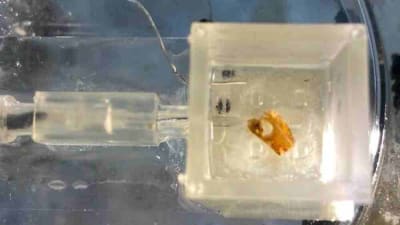
“Nature is much more advanced than we are, so we should use it,” said Dr. Ben Maoz, one of a team of Tel Aviv University researchers who created a robot that uses a dead locust’s ear to “hear” electrical signals and respond to them with movement. (Read our lead story to learn more.)
Blog: Manufacturing & Prototyping
The 2021 “Create the Future” Design Contest is open, and we want to hear your big ideas.

Blog: Sensors/Data Acquisition
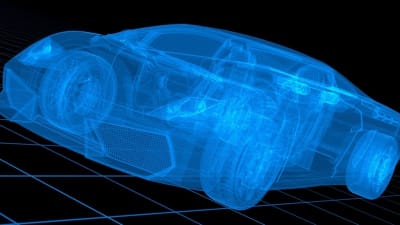
Software and electrical engineering is converging in today’s vehicles. A reader asks our expert: “How do you decide which items to test first?”
Blog: Sensors/Data Acquisition
A robot being developed at Tel Aviv University "hears" electrical signals, thanks to a natural sensor: the ear of a dead locust.
Top Stories
 Blog: Power

My Opinion: We Need More Power Soon — Is Nuclear the Answer?
 Blog: AR/AI

Aerial Microrobots That Can Match a Bumblebee's Speed
 News: Energy

 Blog: Electronics & Computers

Turning Edible Fungi into Organic Memristors
 Blog: Robotics, Automation & Control

Microscopic Swimming Machines that Can Sense, Respond to Surroundings
 INSIDER: Sensors/Data Acquisition
Webcasts
 Upcoming Webinars: Power

Hydrogen Engines Are Heating Up for Heavy Duty
 Upcoming Webinars: Automotive

Advantages of Smart Power Distribution Unit Design for Automotive...
 Upcoming Webinars: Automotive

Quiet, Please: NVH Improvement Opportunities in the Early Design...
 Upcoming Webinars: Test & Measurement

From Spreadsheets to Insights: Fast Data Analysis Without Complex...
 Upcoming Webinars: Automotive

Battery Abuse Testing: Pushing to Failure
 Upcoming Webinars: Connectivity