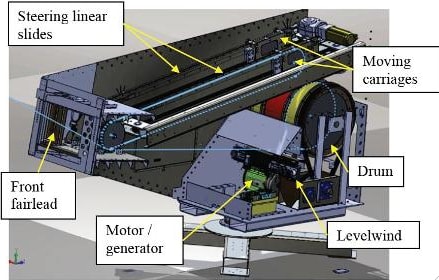
The AWE technology uses a flexible airfoil to capture power from the wind. The airfoil is tethered to a base station and the tethers are spooled onto a large drum. The system, which is mounted to a trailer, operates as a long-stroke reciprocating engine. During the generate phase of the cycle, the airfoil is actively flown in a cross-wind manner downwind of the base station, which maximizes the tension in the tethers. As the airfoil moves away from the ground station, the tethers unspool from the drum and drive it to turn a motor/generator. Electrical power from the generator is transmitted to a battery bank that is also mounted to the trailer. When the maximum tether length is reached, the airfoil is oriented into the wind to minimize tether tension and retracted. The net energy gain per cycle is the energy generated during the outgoing stroke minus the energy consumed during the retract stroke.
During development, Windlift used an National Instruments (NI) Green Engineering Grant award for a seat of the NI Developer Suite, which included DIAdem data management and analysis software, LabVIEW Real-Time, LabVIEW FPGA, LabVIEW SoftMotion, LabVIEW Control Design and Simulation modules, and the LabVIEW PID and Fuzzy Logic Toolkit, among others. Windlift used the shared variable engine feature of the CompactRIO to port data over a TCP/IP connection to a remote laptop for data logging.
Below, you can view a video of Windlift testing with a 12m2 commercial kitesurfing wing. Instantaneous power output and total energy are shown for reference. The average windspeed during the test was 10 m/s at 10m height.
Transcript
No transcript is available for this video.