

An apparatus that generates four signals at a frequency of 7.1 GHz having precisely controlled relative phases and equal amplitudes has been designed and built. This apparatus is intended mainly for use in computer-controlled automated calibration and testing of a phase-comparison digital tracker (PCDT) that measures the relative phases of replicas of the same Xband signal received by four antenna elements in an array. (The relative direction of incidence of the signal on the array is then computed from the relative phases.) The present apparatus can also be used to generate precisely phased signals for steering a beam transmitted from a phased antenna array.
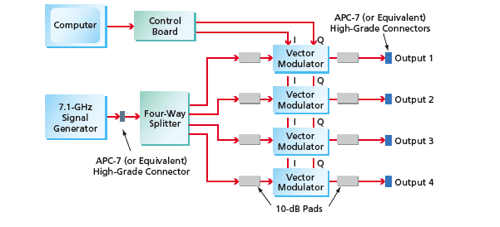
The apparatus (see figure) includes a 7.1-GHz signal generator, the output of which is fed to a four-way splitter. Each of the four splitter outputs is attenuated by 10 dB and fed as input to a vector modulator, wherein DC bias voltages are used to control the in-phase (I) and quadrature (Q) signal components. The bias voltages are generated by digital-to-analog- converter circuits on a control board that receives its digital control input from a computer running a LabVIEW program. The outputs of the vector modulators are further attenuated by 10 dB, then presented at high-grade radio-frequency connectors. The attenuation reduces the effects of changing mismatch and reflections.
The apparatus was calibrated in a process in which the bias voltages were first stepped through all possible IQ settings. Then in a reverse interpolation performed by use of MATLAB software, a lookup table containing 3,600 IQ settings, representing equal amplitude and phase increments of 0.1°, was created for each vector modulator. During operation of the apparatus, these lookup tables are used in calibrating the PCDT.
This work was done by Amy Boas, Samuel Li, and Robert McMaster of Caltech for NASA's Jet Propulsion Laboratory. For further information, access the Technical Support Package (TSP) free on-line at www.techbriefs.com/tsp under the Electronics/Computers category.
NPO-42813
This Brief includes a Technical Support Package (TSP).
Calibration Test Set for a Phase-Comparison Digital Tracker
(reference NPO-42813) is currently available for download from the TSP library.
Don't have an account?
Overview
The document outlines the development and capabilities of the PCDT Calibration Test Set, designated as NTR Number 42813, created by NASA's Jet Propulsion Laboratory (JPL). This innovative technology is designed to produce four 7.1 GHz signals with precisely controlled amplitude and relative phase, facilitating automated testing under computer control. The primary motivation for this development stems from the need for accurate calibration and verification of the Phase Comparison Digital Tracker (PCDT), which is essential for tracking the angle of arrival of X-band signals in deep-space missions.
The PCDT is utilized as a precision pointing reference for high-gain antennas that require high data rates. The calibration test set addresses a significant challenge: the PCDT must measure the relative phases of four incoming signals with an uncertainty of less than one degree. Existing laboratory microwave signal generators lack the capability to provide multiple outputs with the necessary precision and speed. The solution involves a computer-controlled array of vector modulators, which allows for rapid production of precisely calibrated signals that can change every 10 to 100 milliseconds.
The test set consists of a 4-way splitter and four vector modulators, controlled by eight DC bias voltages managed through a LabVIEW program and a digital-to-analog converter board. The outputs are delivered via precision RF connectors. Calibration is achieved by systematically adjusting the IQ settings of the modulators, creating a lookup table with 3600 settings that allow for 0-360 degree phase control in 0.1 degree increments.
This technology not only enhances the performance verification of flight hardware but also has broader applications in systems requiring precise measurement of coherent microwave signals, such as millimeter wave antenna measurements and interferometers. Additionally, it can be used for generating precisely phased signals for steering beams from transmitting phased arrays.
The document emphasizes the importance of this technology in supporting NASA's aeronautical and space activities, highlighting its potential for commercial applications and its contribution to advancements in aerospace-related developments. For further information, the document provides contact details for the Innovative Technology Assets Management team at JPL.











