

Vector modulators are used to impose baseband modulation on RF signals, but non- ideal behavior limits the overall performance. The non-ideal behavior of the vector modulator is compensated using data collected with the use of an automated test system driven by a LabVIEW® program that systematically applies thousands of control-signal values to the device under test and collects RF measurement data.
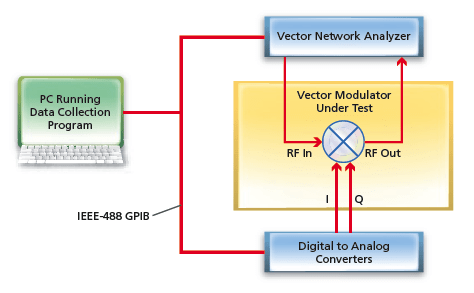
The second step is to post-process the file to determine the correction functions as needed. The result of the entire process is a tabular representation, which allows translation of a desired I/Q value to the required analog control signals to produce a particular RF behavior. In some applications, “corrected” performance is needed only for a limited range. If the vector modulator is being used as a phase shifter, there is only a need to correct I and Q values that represent points on a circle, not the entire plane.
This innovation has been used to calibrate 2-GHz MMIC (monolithic microwave integrated circuit) vector modulators in the High EIRP Cluster Array project (EIRP is high effective isotropic radiated power). These calibrations were then used to create correction tables to allow the commanding of the phase shift in each of four channels used as a phased array for beam steering of a Ka-band (32-GHz) signal.
The system also was the basis of a breadboard electronic beam steering system. In this breadboard, the goal was not to make systematic measurements of the properties of a vector modulator, but to drive the breadboard with a series of test patterns varying in phase and amplitude. This is essentially the same calibration process, but with the difference that the data collection process is oriented toward collecting breadboard performance, rather than the measurement of output from a network analyzer.
This work was done by James Lux, Amy Boas, and Samuel Li of Caltech for NASA’s Jet Propulsion Laboratory.
The software used in this innovation is available for commercial licensing. Please contact Karina Edmonds of the California Institute of Technology at (626) 395-2322. Refer to NPO-44518.
This Brief includes a Technical Support Package (TSP).
System for Automated Calibration of Vector Modulators
(reference NPO-44518) is currently available for download from the TSP library.
Don't have an account?
Overview
The document titled "System for Automated Calibration of Vector Modulators" details advancements in the calibration and performance characterization of vector modulators, which are essential components in modern communication systems. Vector modulators manipulate RF signals by multiplying them with complex numbers represented as I (in-phase) and Q (quadrature) signals. However, these devices often exhibit non-ideal behaviors that deviate from theoretical models, necessitating calibration to ensure accurate signal processing.
The calibration process described involves an automated system that utilizes LabView software to control test equipment, collect data, and generate output files containing both control signals and measured data. The system can accept user inputs for systematic variations or predefined test values, allowing for efficient data collection and analysis. The output is processed to derive correction functions, enabling the translation of desired I/Q values into the necessary analog control signals for specific RF behaviors.
The document outlines two primary applications of the calibration system: one for general vector modulator performance and another for a breadboard electronic beam steering system. In the latter, the focus shifts from systematic measurements to driving the system with varying phase and amplitude test patterns, demonstrating the versatility of the calibration system.
Additionally, the document discusses the evolution of calibration techniques, highlighting the shift from traditional analog correction methods to modern digital approaches. In contemporary systems, digital signal processing (DSP) techniques allow for the embedding of inverse correction functions directly within the DSP framework, streamlining the calibration process. This is particularly beneficial for encoding multiple I/Q states in modulation schemes like QPSK.
The automated test system described in the document employs computer-controlled digital-to-analog converters (DACs) and vector network analyzers (VNAs) to systematically apply different I and Q signals to the vector modulator under test (VMUT). This automation significantly reduces the time and effort required to gather extensive data points necessary for accurate modeling of the modulator's performance.
Overall, the document emphasizes the importance of automated calibration systems in enhancing the performance and reliability of vector modulators, which are critical for applications in both space and ground communications. The advancements presented are poised to facilitate the integration of high-performance vector modulators in future communication technologies.











