Theoretical and experimental investigations have demonstrated the feasibility of compact white-light sensor optics consisting of unitary combinations of (1) low-profile whispering-gallery-mode (WGM) resonators and (2) tapered rod optical waveguides. These sensors are highly wavelength-dispersive and are expected to be especially useful in biochemical applications for measuring absorption spectra of liquids.
These sensor optics exploit the properties of a special class of non-diffracting light beams that are denoted Bessel beams because their amplitudes are proportional to Bessel functions of the radii from their central axes. High-order Bessel beams can have large values of angular momentum. In a sensor optic of this type, a low-profile WGM resonator that supports modes having large angular momenta is used to generate high-order Bessel beams. As used here, “low-profile” signifies that the WGM resonator is an integral part of the rod optical waveguide but has a radius slightly different from that of the adjacent part(s).
An important difference between such an optic and an ordinary WGM resonator is that its modes decay primarily into Bessel modes of the optical waveguide, rather than to the outside. By changing the dimensions and shape of the WGM resonator and/or the radius of the adjacent part(s) of waveguide, it is possible to change the resonator loading and thereby tailor the degree to which light propagates from the resonator along the waveguide.
The feasibility of applications that involve exploitation of optical waves that have angular momentum depends on the propagation distances of such waves in free space. A high-order Bessel beam that propagates from a WGM resonator along a cylindrical waveguide with evanescent-field coupling cannot leave the waveguide; it propagates to an end of the waveguide, where it is totally internally reflected back along the waveguide toward the other end. However, if the waveguide is tapered, as in an optic of the present type, then the optic acts as radiator horn that preserves the angular momentum of the axially propagating Bessel beams while changing their axial momentum. A notable result of propagation along the taper is that upon reaching the wide end, the Bessel beams can be released into the space outside the waveguide and their shapes are preserved.
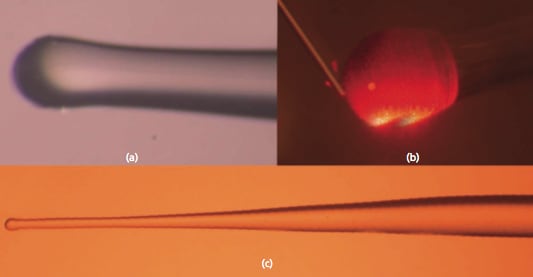
An optic of the present type can be made by cutting and polishing a bump/dip toroidal pattern on the side of a rod of transparent material or partly melting the tip of the rod. For example, the figure depicts such an optic made from a fused-silica rod of 30-mm length that tapers from 0.45-mm diameter at the narrow end to 3 mm at the wide end. The WGM resonator is a 500-μm axisymmetric bulge at the narrow end, formed by using a hydrogen torch to partly melt the narrow end. In operation, light is coupled into the WGM resonator via the cleaved tip of an optical fiber.
In use of such an optic as a sensor, the rod is dipped into liquid, the absorption spectrum of which one seeks to measure. Interference among the Bessel beams in the far-field region of the waveguide forms a helix-shaped light field. A charge-coupled-device camera is installed at a distance between 2 and 30 mm from the wide end of the optical fiber to observe this field. The dependence of the brightness of this field on the azimuth angle contains information on absorption as a function of wavelength.
This work was done by Dmitry Strekalov, Lute Maleki, Andrey Matsko, Anatoliy Savchenkov, and Vladimir Iltchenko of Caltech for NASA’s Jet Propulsion Laboratory. NPO-43363
This Brief includes a Technical Support Package (TSP).
WGM-Resonator/Tapered-Waveguide White-Light Sensor Optics
(reference NPO-43363) is currently available for download from the TSP library.
Don't have an account?
Overview
The document outlines a technical disclosure regarding a novel biochemical sensor developed by NASA's Jet Propulsion Laboratory (JPL), identified as NPO-43363. This sensor employs a Bessel beam technique to achieve high sensitivity in measuring absorption in various media, addressing limitations associated with traditional whispering-gallery-mode resonators (WGMR).
The core innovation lies in the use of a thin, highly transparent taper made from materials like fused silica, calcium fluoride, or diamond. This taper acts as a dispersive element, with diameters ranging from 1 micrometer to 1 millimeter, allowing for adjustable sensitivity based on the filament's thickness. The taper features a horn-shaped end that preserves the orbital momentum of Bessel beams while altering their axial momentum, facilitating effective light coupling through a tapered fiber.
The sensor operates by dipping the filament into the medium of interest, where the interference of Bessel beams in the far field generates a helix-shaped optical field. A CCD camera positioned approximately 2-30 mm from the horn tip captures this field, with the brightness dependence on the azimuth angle providing critical information about absorption at specific wavelengths.
One of the significant advantages of this sensor is its ability to measure in real-time, detecting deviations at specific frequencies immediately. The sensor's compact design, with a length of about 20 mm and a diameter of 1 mm, enhances its applicability in various settings. The method boasts a high optical evanescent field, with sensitivity limits defined by the absorption of the medium divided by a factor (K) that can exceed 10%.
The document emphasizes that this approach eliminates the need for resonators, allowing for continuous frequency changes without the constraints of fixed optical coupling or stable narrowband lasers. This flexibility, combined with the ability to tolerate noise in the light source and optical coupling system, marks a significant advancement over prior art.
In summary, the JPL's biochemical sensor represents a breakthrough in high-sensitivity measurement technology, leveraging the unique properties of Bessel beams and a compact design to facilitate real-time absorption analysis in various media, with potential applications in scientific and commercial fields.