The variable terrain tilt platform (VTTP) is a means of providing simulated terrain for mobility testing of engineering models of the Mars Exploration Rovers. The VTTP could also be used for testing the ability of other robotic land vehicles (and small vehicles in general) to move across terrain under diverse conditions of slope and surface texture, and in the presence of obstacles of various sizes and shapes.
The VTTP consists mostly of a 16-ft- (4.88-m)-square tilt table. The tilt can be adjusted to any angle between 0° (horizontal) and 25°. The test surface of the table can be left bare; can be covered with hard, high-friction material; or can be covered with sand, gravel, and/or other ground-simulating material or combination of materials to a thickness of as much as 6 in. (≈15 cm). Models of rocks, trenches, and other obstacles can be placed on the simulated terrain.
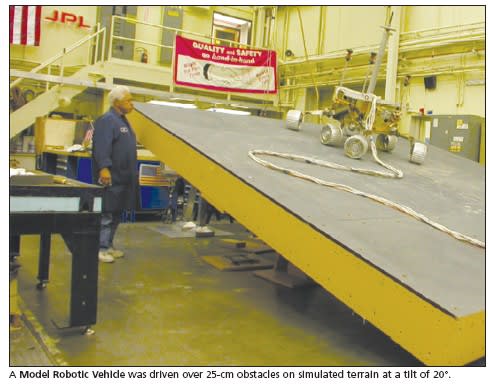 For example, for one of the Mars- Rover tests, a high-friction mat was attached to the platform, then a 6-in.- (≈15 cm) deep layer of dry, loose beach sand was deposited on the mat. The choice of these two driving surface materials was meant to bound the range of variability of terrain that the rover was expected to encounter on the Martian surface. At each of the different angles at which tests were performed, for some of the tests, rock-like concrete obstacles ranging in height from 10 to 25 cm were placed in the path of the rover (see figure).
The development of the VTTP was accompanied by development of a methodology of testing to characterize the performance and modes of failure of a vehicle under test. In addition to variations in slope, ground material, and obstacles, testing typically includes driving up-slope, down-slope, cross-slope, and at intermediate angles relative to slope. Testing includes recording of drive-motor currents, wheel speeds, articulation of suspension mechanisms, and the actual path of the vehicle over the simulated terrain. The collected data can be used to compute curves that summarize torque, speed, power demand, and slip characteristics of wheels during the traverse.
This work was done by Randel Lindemann of Caltech for NASA's Jet Propulsion Laboratory. For further information, access the Technical Support Package (TSP) free online at www.techbriefs.com/tsp under the Mechanics category. NPO-42522
This Brief includes a Technical Support Package (TSP).
Platform for Testing Robotic Vehicles on Simulated Terrain
(reference NPO-42522) is currently available for download from the TSP library.
Don't have an account?
Overview
The document discusses the development, testing, and performance of the Mars Exploration Rovers (MER), specifically Spirit and Opportunity, which were designed to explore the Martian surface. It highlights the importance of understanding the rover's mobility capabilities, including its ability to traverse diverse terrains such as rocks, craters, soft soils, and hills. The rovers were built to meet specific mission requirements, including the ability to overcome obstacles of at least 25 cm in height and navigate slopes of up to 20 degrees.
The mobility assembly of the rovers employs a rocker-bogie suspension system, which connects the six wheels to the rover body, allowing for independent wheel movement and enhanced stability on uneven surfaces. Each wheel is driven by its own motor, and the front and rear wheels can also be steered, providing the rovers with significant maneuverability. The design and testing of this mobility system were crucial, as they ensured that the rovers could effectively navigate the challenging Martian terrain.
The document emphasizes the results of extensive Earth-based testing, which closely mirrored the performance of the Opportunity rover on Mars, particularly at Meridiani Planum. The testing program revealed the rover's hard-failure limits, such as being overturned or stuck, as well as soft-failure scenarios where mission goals were not fully achieved. The findings underscored the importance of system validation for future rover missions.
The MER rovers have successfully accumulated over 10 km of travel on Mars, demonstrating their ability to climb rocks, traverse various soil types, and negotiate hills and craters. This performance validated the design and construction of the mobility assembly and showcased the effectiveness of autonomous rover missions for NASA.
Overall, the document serves as a comprehensive overview of the MER project, detailing the engineering challenges, design solutions, and the successful execution of the rovers' missions on Mars. It highlights the significance of the rover's mobility capabilities in achieving scientific objectives and advancing our understanding of the Martian environment.