

Microvalves containing silicone-rubber seals actuated by heating and cooling of paraffin have been proposed for development as integral components of microfluidic systems. In comparison with other microvalves actuated by various means (electrostatic, electro-magnetic, piezoelectric, pneumatic, and others), the proposed valves (1) would contain simpler structures that could be fabricated at lower cost and (2) could be actuated by simpler (and thus less expensive) control systems.
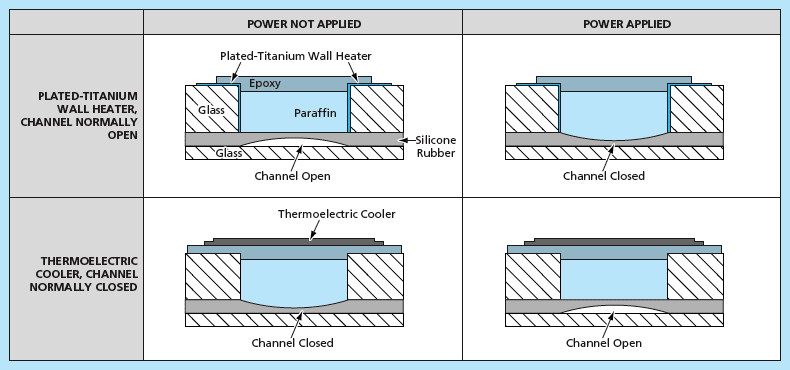
Each valve according to the proposal would include a flow channel bounded on one side by a flat surface and on the other side by a curved surface defined by an arched-cross-section, elastic seal made of silicone rubber [polydimethylsilane (PDMS)]. The seal would be sized and shaped so that the elasticity of the PDMS would hold the channel open except when the seal was pressed down onto the flat surface to close the channel.
The principle of actuation would exploit the fact that upon melting or freezing, the volume of a typical paraffin increases or decreases, respectively, by about 15 percent. In a valve according to the proposal, the seal face opposite that of the channel would be in contact with a pistonlike plug of paraffin. In the case of a valve designed to be normally open at ambient temperature, one would use a paraffin having a melting temperature above ambient. The seal would be pushed against the flat surface to close the channel by heating the paraffin above its melting temperature. In the case of a valve designed to be normally closed at ambient temperature, one would use a paraffin having a melting temperature below ambient. The seal would be allowed to spring away from the flat surface to open the channel by cooling the paraffin below its melting temperature. The availability of paraffins that have melting temperatures from -70 to +80 °C should make it possible to develop a variety of normally closed and normally open valves.
The figure depicts examples of prototype normally open and normally closed valves according to the proposal. In each valve, an arch cross section defining a channel having dimensions of the order of tens of micrometers would be formed in a silicone-rubber sheet about 40 µm thick. The silicone-rubber sheet would be hermetically sealed to a lower glass plate that would define the sealing surface and to an upper glass plate containing a well. The well would be filled with paraffin and capped with a rigid restraining layer of epoxy. In the normally open valve, the paraffin would have a melting temperature above ambient (e.g., 40 °C) and the wall of the well would be coated with a layer of titanium that would serve as an electric heater. In the normally closed valve, the paraffin would have a melting temperature below ambient (e.g., -5 °C). Instead of a heater in the well, the normally closed valve would include a thermoelectric cooler on top of the epoxy cap.
This work was done by Danielle Svelha, Sabrina Feldman, and David Barsic of Caltech for NASA's Jet Propulsion Laboratory. In accordance with Public Law 96-517, the contractor has elected to retain title to this invention. Inquiries concerning rights for its commercial use should be addressed to:
Innovative Technology Assets Management JPL Mail Stop 202-233 4800 Oak Grove Drive Pasadena, CA 91109-8099 (818)354-2240 E-mail:
This Brief includes a Technical Support Package (TSP).
Silicone-Rubber Microvalves Actuated by Paraffin
(reference NPO30519) is currently available for download from the TSP library.
Don't have an account?
Overview
The document is a Technical Support Package from NASA's Jet Propulsion Laboratory (JPL) detailing Silicone-Rubber Microvalves that are actuated by paraffin. It is part of NASA Tech Briefs (NPO-30519) and aims to disseminate aerospace-related technological advancements with broader applications in various fields.
The microvalves utilize paraffin, a low melting point material, to control fluid flow in microchannels. The document describes three types of valve designs: Normally Closed Thermoelectric (Peltier) Cooling, Normally Open Titanium-Plated Wall Heating, and Normally Open Coiled Copper Wire Heating. Each design employs different mechanisms to achieve actuation and control.
-
Normally Closed Thermoelectric (Peltier) Cooling Valve: This valve uses a thermoelectric cooler to maintain a closed state until activated. The design includes components such as epoxy, glass slides, and PDMS (polydimethylsiloxane), which are essential for the microvalve's functionality.
-
Normally Open Titanium-Plated Wall Heating Valve: This valve remains open under normal conditions and utilizes titanium plating for wall heating. The heating mechanism allows for the control of fluid flow by changing the state of the paraffin.
-
Normally Open Coiled Copper Wire Heating Valve: Similar to the titanium-plated valve, this design employs insulated copper wire coiled around tubing to generate heat, thus controlling the valve's state.
The document includes cross-sectional drawings of each valve type, illustrating their construction and the materials used. These designs are not to scale but provide a clear understanding of the microvalve architecture.
Additionally, the Technical Support Package emphasizes the potential applications of these microvalves in various industries, including biomedical devices, chemical processing, and environmental monitoring. The document also provides contact information for further assistance and resources available through NASA's Scientific and Technical Information (STI) Program Office.
Overall, this Technical Support Package serves as a comprehensive overview of innovative microvalve technology, showcasing NASA's commitment to advancing engineering solutions that can benefit multiple sectors beyond aerospace.











