

The European Organization for Nuclear Research (CERN) requires new magnets that are smaller than their predecessors to accommodate new instrumentation. Because of their size, these magnets need to generate a 24 percent stronger magnetic field and the structure must provide for near-zero deformation of the conductor. Even a small deformation could increase the electrical resistance and raise the temperature enough to cause the conductor to lose its superconducting state. Engineers addressed this challenge using ANSYS electromagnetic, thermal, and structural simulation tools. Coupling the multiphysics domains in the ANSYS® Workbench® environment allowed the team to optimize the design by simultaneously considering all of the physics.
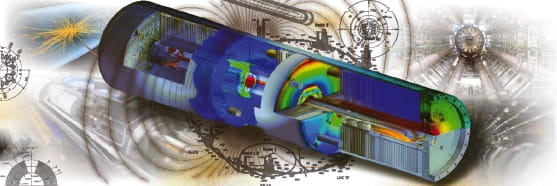
The magnets must be extremely rigid, because even minute shifts of the conductor could initiate quenches (transition of the conductor from the superconducting to the resistive state). These new magnets generate axial forces that are almost double the existing main dipoles on the LHC. The old methodology for designing magnets was so time-consuming that only a few design alternatives could be considered, and it was not possible to simultaneously optimize the design based on its performance in multiple domains. Engineers introduced a new methodology for designing this next generation of superconducting magnets by combining advanced computer-aided design tools with coupled multiphysics simulation in an integrated design environment.
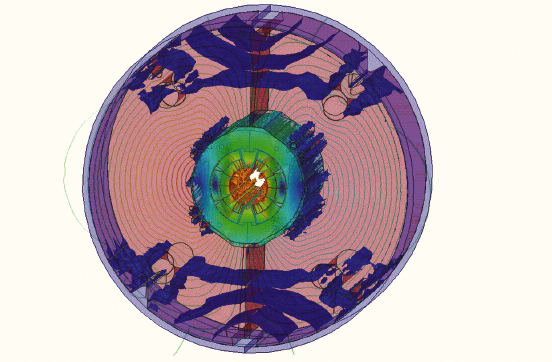
Some subassemblies of the proposed optimized design have already been built and tested, and their performance matches the simulation predictions. The LHC is scheduled to re-open in 2015.
This article was written by Charilaos Kokkinos, Mechanical & Aeronautics Engineer, FEAC Engineering. Kokkinos left CERN in 2013 to found FEAC Engineering, a startup engineering company in Ioannina, Greece specializing in simulation-driven product development. FEAC warmly thanks Mikko Karppinen, the project leader of the 11T dipole magnet. For more information, visit www.feacomp.com and www.ansys.com .











