

A technique for suppressing sublimation of key elements from skutterudite compounds in advanced thermoelectric devices has been demonstrated. The essence of the technique is to cover what would otherwise be the exposed skutterudite surface of such a device with a thin, continuous film of a chemically and physically compatible metal. Although similar to other sublimation- suppression techniques, this technique has been specifically tailored for application to skutterudite antimonides.
The primary cause of deterioration of most thermoelectric materials is thermal decomposition or sublimation—one or more elements sublime from the hot side of a thermoelectric couple, changing the stoichiometry of the device. Examples of elements that sublime from their respective thermoelectric materials are Ge from SiGe, Te from Pb/Te, and now Sb from skutterudite antimonides. The skutterudite antimonides of primary interest are CoSb3 [electron-donor (n) type] and CeFe3–xCoxSb12 [electron-acceptor (p) type]. When these compounds are subjected to typical operating conditions [temperature of 700 °C and pressure <10–5 torr (0.0013 Pa)], Sb sublimes from their surfaces, with the result that Sb depletion layers form and advance toward their interiors. As the depletion layer advances in a given device, the change in stoichiometry diminishes the thermal-to-electric conversion efficiency of the device.
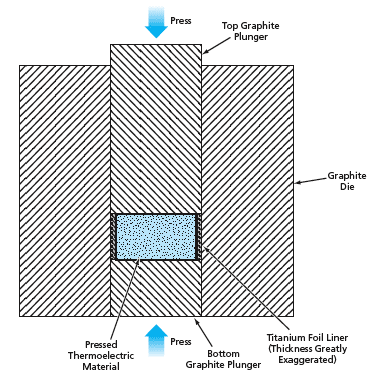
Guided by the aforementioned experiments, a powder-metallurgy process for fabricating skutterudite was modified to provide for covering the outer surfaces of the segments with titanium foils. In the unmodified process, the thermoelectric material, in powder form, is hot-pressed in a graphite die, then removed, then further processed. The combination of high temperature and pressure in the die acts to promote bonding between particles, and as such, is ideal as a means of adding an adherent sublimation- suppressing outer layer. Hence, the process is modified by simply lining the inner wall of the die with a foil of the barrier material before filling the die with the thermoelectric powder (see figure).
In preparation for further experiments, the modified process was used to fabricate specimens of n- and p-type skutterudites covered with adherent 25- μm-thick foils of titanium. In the experiments, these specimens were heated in a vacuum under the same conditions as in the experiments described above, then sectioned and examined. Like the niobium foils in those experiments, the titanium foil outer layers in these experiments were found to have suppressed sublimation of Sb.
This work was done by Jeffrey Sakamoto, Thierry Caillat, Jean-Pierre Fleurial, and G. Jeffrey Snyder of Caltech for NASA's Jet Propulsion Laboratory.
This invention is owned by NASA, and a patent application has been filed. Inquiries concerning nonexclusive or exclusive license for its commercial development should be addressed to the Patent Counsel, NASA Management Office–JPL. Refer to NPO-40040.
This Brief includes a Technical Support Package (TSP).
Coating Thermoelectric Devices to Suppress Sublimation
(reference NPO-40040) is currently available for download from the TSP library.
Don't have an account?
Overview
The document is a Technical Support Package from NASA’s Jet Propulsion Laboratory (JPL) concerning a new technology aimed at suppressing sublimation in advanced thermoelectric devices. Identified by the NTR Number 40040, this innovation is part of NASA Tech Briefs, which disseminates aerospace-related developments with potential wider technological, scientific, or commercial applications.
Sublimation, the process where a solid transitions directly to a gas without passing through a liquid phase, can adversely affect the performance and longevity of thermoelectric devices. These devices are crucial in various applications, including power generation and cooling systems, particularly in space exploration where environmental conditions can be extreme.
The document emphasizes the importance of this technology in enhancing the reliability and efficiency of thermoelectric devices, which are essential for various missions and applications. By addressing the issue of sublimation, the innovation aims to improve the operational lifespan and effectiveness of these devices, making them more suitable for long-term use in challenging environments.
The Technical Support Package is part of NASA's Commercial Technology Program, which seeks to share the results of its research and development efforts with the broader community. This initiative is designed to foster innovation and collaboration between NASA and commercial entities, thereby promoting the application of advanced technologies in various sectors.
For further inquiries or detailed information regarding this technology, the document provides contact details for the Innovative Technology Assets Management team at JPL. They can offer additional insights and support related to the research and technology discussed in the package.
Overall, this document serves as a valuable resource for understanding the advancements in thermoelectric device technology and highlights NASA's commitment to sharing its innovations for broader applications beyond aerospace. It underscores the potential impact of these developments on various industries, paving the way for enhanced technological solutions in the future.











