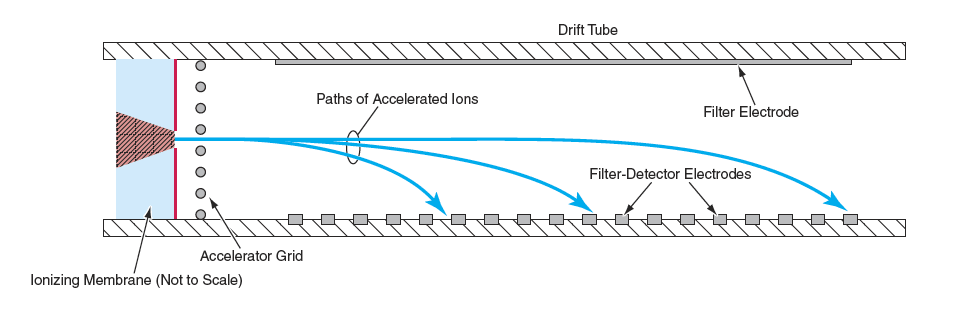
The figure depicts a proposed miniature ion-mobility spectrometer that would share many features of design and operation of the instrument described in the immediately preceding article. The main differences between that instrument and this one would lie in the configuration and mode of operation of the filter and detector electrodes. A filter electrode and detector electrodes would be located along the sides of a drift tube downstream from the accelerator electrode. These electrodes would apply a combination of (1) a transverse AC electric field that would effect differential transverse dispersal of ions and (2) a transverse DC electric field that would drive the dispersed ions toward the detector electrodes at different distances along the drift tube. The electric current collected by each detector electrode would be a measure of the current, and thus of the abundance of the species of ions impinging on that electrode. The currents collected by all the detector electrodes could be measured simultaneously to obtain continuous readings of abundances of species. The downstream momentum of accelerated ions would be maintained through neutralization on the electrodes; the momentum of the resulting neutral atoms would serve to expel gases from spectrometer, without need for a pump.
This work was done by Frank T. Hartley of Caltech for NASA's Jet Propulsion Laboratory.
This Brief includes a Technical Support Package (TSP).
Miniature Ion-Array Spectrometer
(reference NPO-21193) is currently available for download from the TSP library.
Don't have an account?
Overview
The document is a Technical Support Package for the Miniature Ion-Array Spectrometer, identified by NASA Tech Briefs NPO-21193, produced by NASA's Jet Propulsion Laboratory (JPL) in Pasadena, California. It is part of NASA's Commercial Technology Program, which aims to disseminate the results of aerospace-related developments that have broader technological, scientific, or commercial applications.
The Miniature Ion-Array Spectrometer represents a significant advancement in spectrometry technology, which is crucial for various applications, including environmental monitoring, planetary exploration, and materials analysis. The document outlines the capabilities and potential uses of this spectrometer, emphasizing its compact design and efficiency, which make it suitable for deployment in diverse settings, including space missions.
The Technical Support Package includes references to additional resources and assistance available through NASA's Innovative Partnerships Program, which fosters collaboration between NASA and private industry to promote the commercialization of NASA technologies. It encourages interested parties to explore further information available from the NASA Scientific and Technical Information (STI) Program Office, which can be accessed online or through direct contact via phone or email.
The document also includes a notice regarding the liability and rights associated with the information provided. It clarifies that the United States Government, nor any individual acting on its behalf, assumes liability for the use of the information contained within the document. Additionally, it states that any mention of trade names or manufacturers is for identification purposes only and does not imply official endorsement by NASA.
Overall, this Technical Support Package serves as a resource for understanding the Miniature Ion-Array Spectrometer's technology and its potential applications, while also providing pathways for further inquiry and collaboration in the field of aerospace technology. It highlights NASA's commitment to sharing innovative developments that can benefit a wide range of industries and scientific research.