A proposed instrument for measuring a static electric field would be based partly on a conventional rotating- split-cylinder or rotating-split-sphere electric-field mill. However, the design of the proposed instrument would overcome the difficulty, encountered in conventional rotational field mills, of transferring measurement signals and power via either electrical or fiber-optic rotary couplings that must be aligned and installed in conjunction with rotary bearings. Instead of being made to rotate in one direction at a steady speed as in a conventional rotational field mill, a split-cylinder or split-sphere electrode assembly in the proposed instrument would be set into rotational vibration like that of a metronome. The rotational vibration, synchronized with appropriate rapid electronic switching of electrical connections between electric-current-measuring circuitry and the split-cylinder or split-sphere electrodes, would result in an electrical measurement effect equivalent to that of a conventional rotational field mill.
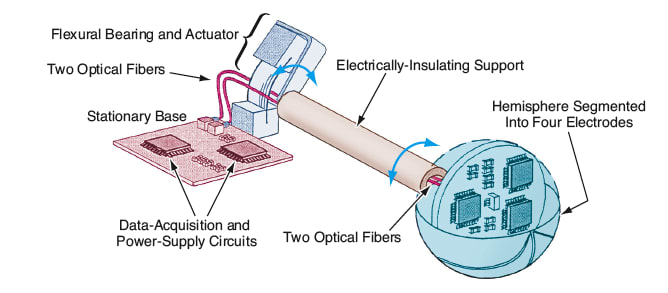
The flexural bearing and actuator would be anchored to a stationary base, on which data-acquisition and power-supply electronic circuits would be mounted. In addition to the electrodes, the electrode assembly would contain electronic circuits for switching the electrical connections to the electrodes, measuring the electric currents that flow between connected electrodes as the assembly rotates in the ambient electric field, digitizing the current measurements, and transmitting the digitized measurement signals to the data-acquisition circuitry via one of the optical fibers. Power would be transmitted from a light-emitting diode on the stationary base, via another optical fiber, to photovoltaic circuitry in the electrode assembly.
Because the flexural bearing, its actuator, and the electrode assembly taken together would constitute a resonant mechanical system like a metronome, little power would be needed to maintain the large angular excursions needed to produce sufficiently large measurement signals. The precise nature of the actuator has not yet been determined; it seems likely that a magnetic drive could easily be implemented. The actuator could be equipped with a rotary position encoder, which could provide feedback for adjusting the excitation of the actuator to correct for small deviations of the rotational vibration from constant frequency and amplitude.
This work was done by Harold Kirkham of Caltech for NASA's Jet Propulsion Laboratory.
NPO-30572
This Brief includes a Technical Support Package (TSP).
Rotationally Vibrating Electric-Field Mill
(reference NPO-30572) is currently available for download from the TSP library.
Don't have an account?
Overview
The document discusses the development and functionality of the Rotationally Vibrating Electric-Field Mill, a device designed to measure direct current (dc) electric fields. It outlines the basic components of field meters, which consist of a sensing probe and a base station for signal processing. Three primary methods for measuring dc electric fields are described: measuring short-circuit current, open-circuit voltage, and using optical crystals. Each method has its advantages and disadvantages, with the optical crystal method being ruled out due to calibration challenges.
The document emphasizes the need for motion in traditional field meters, particularly the rotating split-electrode field mill, which is favored for its isolation from self-charge and atmospheric ions. However, this design faces challenges in manufacturing and requires careful alignment and power management. The rotating mechanism complicates data and power transfer, prompting the exploration of alternatives to physical rotation.
One proposed solution is the use of virtual motion, where electrodes are switched electronically rather than physically rotated. The document illustrates this concept with a four-electrode mill design, which can simulate rotation through electronic reconnections. This approach aims to simplify the mechanics while maintaining measurement accuracy.
The vibrating version of the rotating split-electrode field mill is highlighted as a promising alternative. It utilizes a metronome-type bearing, allowing for resonant operation with minimal energy expenditure. This design can accommodate fiber optics for data and power transfer, enhancing reliability and reducing maintenance needs. The document suggests that a digital signal processing system could be integrated into the probe, powered by light from an LED in the base station.
In summary, the document presents a comprehensive overview of the challenges and innovations in electric field measurement technology. The Rotationally Vibrating Electric-Field Mill represents a significant advancement, combining the benefits of isolation and closed structure with reduced complexity in operation and maintenance. Future development efforts will focus on refining this technology for practical applications, particularly in long-term, unattended operations.