

These units would offer long life and high energy-conversion efficiency.
A family of proposed miniature sources of power would exploit the direct conversion of the kinetic energy of a particles into electricity in diamond semiconductor diodes. These power sources would function over a wide range of temperatures encountered in terrestrial and outer-space environments. These sources are expected to have operational lifetimes of 10 to 20 years and energy conversion efficiencies >35 percent.
A power source according to the proposal would include a pair of devices like that shown in the figure. Each device would contain Schottky and p/n diode devices made from high-band-gap, radiation-hard diamond substrates. The n and p layers in the diode portion would be doped sparsely (<1014 cm-3) in order to maximize the volume of the depletion region and thereby maximize efficiency. The diode layers would be supported by an undoped diamond substrate.
The source of a particles would be a thin film of 244Cm (half-life 18 years) sandwiched between the two paired devices. The sandwich arrangement would force almost every a particle to go through the active volume of at least one of the devices. Typical a particle track lengths in the devices would range from 20 to 30 microns. The a particles would be made to stop only in the undoped substrates to prevent damage to the crystalline structures of the diode portions.
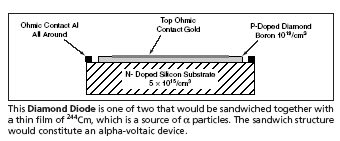
The overall dimensions of a typical source are expected to be about 2 by 2 by 1 mm. Assuming an initial 244Cm mass of 20 mg, the estimated initial output of is 20 mW (a current of 20 mA at a potential of 1 V).
This work was done by Jagdish U. Patel, Jean-Pierre Fleurial, and Elizabeth Kolawa of Caltech for NASA’s Jet Propulsion Laboratory. For further information, access the Technical Support Package (TSP) free on-line at www.techbriefs.com/tsp under the Physical Sciences category.
This invention is owned by NASA, and a patent application has been filed. Inquiries concerning nonexclusive or exclusive license for its commercial development should be addressed to
the Patent Counsel
NASA Management Office–JPL at (818) 354-7770.
Refer to NPO-30323.
This Brief includes a Technical Support Package (TSP).
Alpha-Voltaic Sources Using Diamond as Conversion Medium
(reference NPO-30323) is currently available for download from the TSP library.
Don't have an account?
Overview
The document discusses the development of a highly efficient, miniaturized alpha-voltaic power source utilizing diamond as a conversion medium, specifically designed for extreme space environments. This innovative technology, developed by researchers at NASA's Jet Propulsion Laboratory, aims to create a power source capable of continuous operation for over 15 years, making it ideal for deep space missions, underwater and underground probes, and high-temperature environments.
The proposed power source features a unique design that incorporates Schottky and P-N diode devices fabricated from high band-gap, radiation-hard diamond substrates. These devices are engineered with very low doping levels to maximize the depletion region volume, enhancing efficiency. A thin film of Curium-244 (Cm-244) is sandwiched between two diamond devices, allowing alpha particles emitted from the radioisotope to pass through the active device volume without causing damage to the crystal structure. The expected dimensions of the device are 2mm x 2mm x 1mm, with a power output of 20.0 mWatts and a current of 20.0 mA at 1 Volt.
The document emphasizes the significant advantages of this new technology over previous attempts using silicon carbide (SiC) and gallium arsenide (GaAs) photodiodes, which suffered from limited efficiency and rapid degradation. The diamond-based power source is expected to achieve a conversion efficiency greater than 35%, providing a high power density and long operational life, which is crucial for missions that require compact and lightweight power solutions.
The potential applications of this technology are vast, including its use in micro-explorers and MEMS (Micro-Electro-Mechanical Systems) devices, where distributed low-power electronics are essential. The ability to function effectively in sun-obscured deep space, high-temperature conditions, and other extreme environments positions this alpha-voltaic power source as a transformative solution for future interstellar exploration missions.
In summary, the document outlines a pioneering approach to power generation in space, leveraging the unique properties of diamond materials to create a reliable, long-lasting, and efficient energy source that could significantly enhance the capabilities of future space exploration endeavors.







