

A mathematical model has been developed for describing the thermofluid dynamics of a dense, chemically reacting mixture of solid particles and gases. As used here, "dense" signifies having a large volume fraction of particles, as for example in a bubbling fluidized bed. The model is intended especially for application to fluidized beds that contain mixtures of carrier gases, biomass undergoing pyrolysis, and sand. So far, the design of fluidized beds and other gas/solid industrial processing equipment has been based on empirical correlations derived from laboratory- and pilot-scale units. The present mathematical model is a product of continuing efforts to develop a computational capability for optimizing the designs of fluidized beds and related equipment on the basis of first principles. Such a capability could eliminate the need for expensive, time-consuming predesign testing.
The present model includes components in common with models described in several previous NASA Tech Briefs articles, including, most notably, "Model of Pyrolysis of Biomass in a Fluidized-Bed Reactor" (NPO-20708), NASA Tech Briefs, Vol. 25, No. 6 (June 2001), page 59; "Multiphase-Flow Model of Fluidized-Bed Pyrolysis of Biomass" (NPO-20789), NASA Tech Briefs, Vol. 26, No. 2 (February 2002), page 56; and "Model of a Fluidized Bed Containing a Mixture of Particles" (NPO-20937), NASA Tech Briefs, Vol. 26, No. 4 (April 2002), page 56. The model distinguishes among multiple particle classes on the basis of physical properties (e.g., diameter or density) and/or through thermochemical properties (e.g., chemical reactivity or nonreactivity). The formulation of the model follows a multifluid approach in which macroscopic equations for the solid phase are derived from a kinetic-like theory considering inelastic-rigid-sphere submodels in accounting for collisional transfer in high-density regions. The gas phase equations are derived using ensemble averaging.
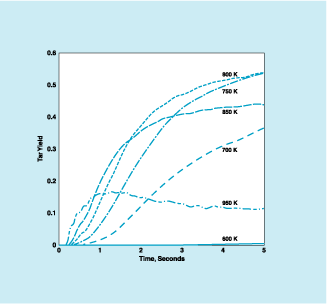
In one of several test cases, the model was applied to the pyrolysis of biomass particles in a laboratory fluidized bed reactor and used to compute yields of reaction products (especially tar). The results indicate that at fixed initial particle size, the temperature of the fluidizing gas is the foremost parameter that influences the tar yield and can be chosen to maximize the tar yield (see figure). The temperature of the biomass feed, the nature of the feedstock, and the fluidization velocity were all found to exert only minor effects on the tar yield.
This work was done by Josette Bellan and Danny Lathouwers of Caltech for NASA's Jet Propulsion Laboratory. For further information, access the Technical Support Package (TSP) free on-line at www.techbriefs.com/tsp under the Physical Sciences category. NPO-30163.
This Brief includes a Technical Support Package (TSP).
Model of Fluidized Bed Containing Reacting Solids and Gases
(reference NPO-30163) is currently available for download from the TSP library.
Don't have an account?
Overview
The document is a technical support package from NASA's Jet Propulsion Laboratory (JPL), detailing a model for fluidized beds containing reacting solids and gases. It is part of a broader effort to enhance the understanding and efficiency of industrial processes, particularly those involving biomass pyrolysis. The work is attributed to inventors Josette Bellan and Danny Lathouwers and is presented under NASA Contract No. NAS 7-918.
The primary focus of the document is on the development of a novel binary class model that simulates the flow and interaction of two distinct classes of particles—specifically, sand and biomass. This model is grounded in kinetic theory and addresses the unique properties and behaviors of each particle class, which have different velocities and thermal characteristics. Each class is assigned its own "granular temperature," constitutive relations, and transport properties, allowing for a more accurate representation of their dynamics within the fluidized bed.
The motivation behind this research stems from the need to effectively simulate fluidized bed reactors that handle mixtures of particles with varying properties. Traditional models often fall short in accurately capturing the complexities of such systems, leading to inefficiencies in design and operation. The proposed model aims to overcome these limitations by providing a detailed framework for understanding the hydrodynamics and heat transfer processes specific to each particle class.
The document emphasizes the significance of this model in reducing the reliance on costly predesign testing, thereby streamlining the design process for industrial applications. By offering a theoretical basis for predicting the behavior of mixed particle systems, the model can facilitate better design choices and operational strategies in fluidized bed reactors.
In summary, this technical support package presents a comprehensive approach to modeling fluidized beds with reacting solids and gases, highlighting the innovative contributions of the authors. It serves as a valuable resource for researchers and engineers seeking to improve the efficiency and effectiveness of processes involving complex particle interactions in fluidized systems. The work is positioned as a significant advancement in the field, with potential implications for various industrial applications.











