

A proposed brushless shaft-angle sensor for use in extreme cold would offer significant advantages over prior such sensors:
- It would be capable of operating in extreme cold; and
- Its electronic circuitry would be simpler than that of a permanent- magnet/multiple- Hall-probe shaft-angle sensor that would otherwise ordinarily be used to obtain comparable angular resolution.
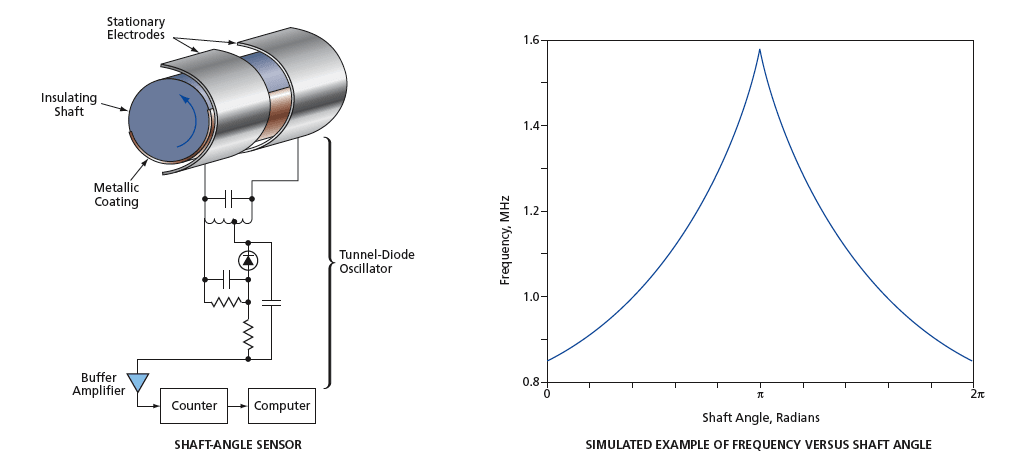
The principle of operation of the proposed shaft-angle sensor requires that the shaft (or at least the portion of the shaft at the sensor location) be electrically insulating. The affected portion of the shaft would be coated with metal around half of its circumference. Two half-circular-cylinder electrodes having a radius slightly larger than that of the shaft would be mounted on the stator, concentric with the shaft, so that there would be a small radial gap between them and the outer surface of the shaft. Hence, there would be a capacitance between each stationary electrode and the metal coat on the shaft.
The stationary electrodes would be connected into a tunnel-diode oscillator circuit, so that the series combination of the two capacitances would be part of the capacitance that determines the oscillation frequency. As the shaft is rotated, the stationary-electrode/metal-coat overlap area would change, causing the series capacitance and the oscillation frequency to change. The frequency would be measured and used to infer the shaft angle from the known relationships among shaft angle, capacitance, and frequency.
It should be noted that a given frequency could signify either of two distinct shaft angles. If necessary, one could resolve the shaft-angle ambiguity by use of two sensors at different angular positions.
This work was done by Talso Chui of Caltech for NASA's Jet Propulsion Laboratory.
NPO-43328
This Brief includes a Technical Support Package (TSP).
Shaft-Angle Sensor Based on Tunnel- Diode Oscillator
(reference NPO-43328) is currently available for download from the TSP library.
Don't have an account?
Overview
The document discusses a novel brushless motor position sensor based on a tunnel-diode oscillator, as detailed in NASA Tech Brief NPO-43328. This technology represents an advancement over traditional magnetic measurement methods, which typically rely on multiple Hall probes to detect angular positions. The proposed sensor utilizes a capacitive measurement approach, significantly simplifying the design and enhancing resolution.
The sensor consists of an insulating shaft coated with a metallic strip positioned at 180 degrees of its angular range. Two metallic pads create a pair of capacitors with this strip, and these capacitors are connected in series. As the shaft rotates, the series capacitance changes in accordance with the angular position. The tunnel-diode oscillator generates a sinusoidal signal whose frequency correlates with the angular position of the motor. Notably, the design allows for a single frequency to correspond to two different angular positions, which can lead to ambiguity. However, the implementation of an additional oscillator can resolve this issue, ensuring accurate position detection.
The document highlights the potential for achieving a resolution better than 0.01%, which is a significant improvement over existing technologies. Traditional systems that use Hall probes require a large number of sensors and associated circuitry, making them complex and costly. For instance, achieving an angular resolution of just 1.5 degrees would necessitate 240 Hall probes and corresponding voltage detection circuits. In contrast, the proposed capacitive sensor simplifies the design by relying on a single tunnel-diode oscillator, reducing both complexity and cost.
The document is part of NASA's Commercial Technology Program, aimed at disseminating aerospace-related developments with broader technological, scientific, or commercial applications. It emphasizes the innovative nature of the sensor and its potential impact on various industries that require precise angular position sensing.
For further inquiries or assistance regarding this technology, the document provides contact information for the Innovative Technology Assets Management at JPL. Overall, this brushless motor position sensor represents a significant step forward in sensor technology, promising enhanced performance and reduced complexity for applications in aerospace and beyond.











