A proposed torque sensor would be capable of operating over the temperature range from 1 to 400 K, whereas a typical commercially available torque sensor is limited to the narrower temperature range of 244 to 338 K. The design of this sensor would exploit the wide temperature range and other desirable attributes of differential transducers based on tunnel-diode oscillators as described in "Multiplexing Transducers Based on Tunnel- Diode Oscillators" (NPO-43079), NASA Tech Briefs, Vol. 30, No. 9 (September 2006), page 42.
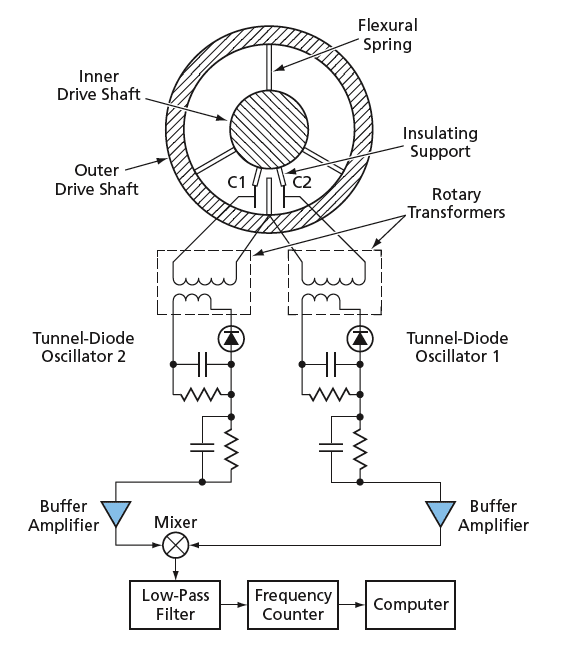
The sensory principle would be mostly the same as that described in the cited prior article. At zero torque, the flexural springs would cause the common middle electrode to lie midway between the C1 and C2 electrodes. The two capacitances, and thus the frequencies of the two oscillators, would vary in opposite directions as torque caused the middle electrode to move away from the midpoint. The outputs of the tunnel- diode oscillators would be mixed and low-pass filtered to obtain a signal at the difference between the frequencies of the two oscillators. The difference frequency would be measured by a frequency counter and converted to torque by a computer.
This work was done by Talso Chui and Joseph Young of Caltech for NASA's Jet Propulsion Laboratory.
NPO-43325
This Brief includes a Technical Support Package (TSP).
Torque Sensor Based on Tunnel-Diode Oscillator
(reference NPO-43325) is currently available for download from the TSP library.
Don't have an account?
Overview
The document presents a technical overview of a torque sensor developed by NASA's Jet Propulsion Laboratory (JPL), based on a tunnel-diode oscillator, as detailed in NASA Tech Brief NPO-43325. This innovative sensor addresses the challenge of measuring torque in rotating shafts without the need for physical wiring, which is particularly advantageous in environments where traditional wiring may be impractical, such as in space applications.
The core of the technology combines a rotary transformer with a tunnel-diode oscillator, enabling the sensor to operate effectively across a wide temperature range, from 1 Kelvin to 400 Kelvin. This capability is crucial for applications that may experience extreme temperature variations, such as those encountered in space exploration or other harsh environments.
The design features a hollow external drive shaft that transmits torque to an internal drive shaft through a system of torsional springs made from three flexure springs. The deflection of these springs is measured by monitoring changes in capacitance across two capacitors, which detect the relative rotation between the external and internal shafts. This method allows for precise torque measurement without the complications associated with wired connections.
The document emphasizes the novelty of this torque sensor, highlighting its potential applications not only in aerospace but also in various technological, scientific, and commercial fields. The sensor's design and operational principles are illustrated in a conceptual diagram, which aids in understanding the mechanics involved.
Additionally, the document serves as a technical support package, providing contact information for further inquiries and assistance related to the technology. It is part of NASA's Commercial Technology Program, aimed at disseminating aerospace-related developments that have broader applications beyond their original context.
In summary, the torque sensor based on a tunnel-diode oscillator represents a significant advancement in torque measurement technology, offering a reliable and efficient solution for a variety of applications, particularly in environments where traditional methods may fall short. The document encapsulates the technical details and potential implications of this innovative sensor, inviting further exploration and collaboration in the field.