

Multiplexing and differential transducers based on tunnel-diode oscillators (TDOs) would be developed, according to a proposal, for operation at very low and/or widely varying temperatures in applications that involve requirements to minimize the power and mass of transducer electronic circuitry. It has been known since 1975 that TDOs are useful for making high-resolution (of the order of 10–9) measurements at low temperatures. Since that time, TDO transducers have been found to offer the following additional advantages, which the present proposal is intended to exploit:
- TDO transducers can operate at temperatures ranging from 1 K to about 400 K. Most electronic components other than tunnel diodes do not operate over such a wide temperature range.
- TDO transducers can be made to operate at very low power —typically, <1 mW.
- Inasmuch as the response of a TDO transducer is a small change in an arbitrarily set oscillation frequency, the outputs of many TDOs operating at sufficiently different set frequencies can be multiplexed through a single wire.
- Inasmuch as frequencies can be easily subtracted by means of mixing circuitry, one can easily use two TDOs to make differential measurements. Differential measurements are generally more precise and less susceptible to environmental variations than are absolute measurements.
- TDO transducers are tolerant to ionizing radiation.
- Ultimately, the response of a TDO transducer is measured by use of a frequency counter. Because frequency counting can be easily implemented by use of clock signals available from most microprocessors, it is not necessary to incorporate additional readout circuitry that would, if included, add to the mass and power consumption of the transducer circuitry .
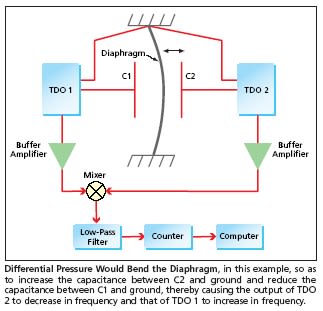 In one example of many potential variations on the basic theme of the proposal, the figure schematically depicts a conceptual differential-pressure transducer containing a symmetrical pair of TDOs. The differential pressure would be exerted on an electrically conductive and grounded diaphragm, which, at zero differential pressure, would nominally be sprung to a middle position between two capacitor plates that would be parts of the two TDOs. The frequencies of the two TDOs would vary in opposite directions as variations in differencan be multiplexed through a single wire.
- Inasmuch as frequencies can be easily subtracted by means of mixing circuitry, one can easily use two TDOs to make differential measurements. Differential measurements are generally more precise and less susceptible to environmental variations than are absolute measurements.
- TDO transducers are tolerant to ionizing radiation.
- Ultimately, the response of a TDO transducer is measured by use of a frequency counter. Because frequency counting can be easily implemented by use of clock signals available from most microprocessors, it is not necessary to incorporate additional readout circuitry that would, if included, add to the mass and power consumption of the transducer circuitry .
In one example of many potential variations on the basic theme of the proposal, the figure schematically depicts a conceptual differential-pressure transducer containing a symmetrical pair of TDOs. The differential pressure would be exerted on an electrically conductive and grounded diaphragm, which, at zero differential pressure, would nominally be sprung to a middle position between two capacitor plates that would be parts of the two TDOs. The frequencies of the two TDOs would vary in opposite directions as variations in differential pressure bent the diaphragm away from one capacitor plate and toward the other. The outputs of the TDOs would be mixed and low-pass filtered to obtain a signal at the difference between the frequencies of the two TDOs. The difference frequency would be measured by a frequency counter and converted to differential pressure by a computer.
This work was done by Talso Chui, Konstantin Penanen, and Joseph Young of Caltech for NASA's Jet Propulsion Laboratory. For further information, access the Technical Support Package (TSP) free online at www.techbriefs.com/tsp under the Semiconductors & ICs category. NPO-43079
This Brief includes a Technical Support Package (TSP).
Multiplexing Transducers Based on Tunnel-Diode Oscillators
(reference NPO-43079) is currently available for download from the TSP library.
Don't have an account?
Overview
The document titled "Multiplexing Transducers Based on Tunnel-Diode Oscillators" is a technical support package from NASA's Jet Propulsion Laboratory, detailing advancements in sensor technology that leverage tunnel-diode oscillators for various aerospace applications.
Key features of the technology include a wide operating temperature range, from 400 K to 1 K, making it suitable for extreme environments encountered in space exploration. The system is designed for low power consumption, approximately 1 mW, which is critical for long-duration missions where energy efficiency is paramount.
The document emphasizes the high precision of the tunnel-diode oscillator technology, with a frequency jitter of ∆f/f ~ 0.001 ppm. This level of precision is essential for accurate measurements in scientific instruments. The use of differential measurement techniques further enhances the accuracy of the readings, making these transducers ideal for applications such as pressure gauges and propellant gauges in crewed exploration vehicles (CEVs) and lunar or planetary surface instruments like seismometers and microbalances.
Multiplexing capabilities are a significant advantage of this technology. The ability to transmit output signals from multiple oscillators over the same line simplifies the design and reduces the complexity of wiring in instruments. This feature is particularly beneficial in space missions where weight and space are at a premium.
The document also includes figures illustrating the design of a microbalance for lunar regolith and a sensitive lunar seismometer, showcasing practical applications of the technology. These instruments are crucial for conducting scientific research on the Moon and other celestial bodies, providing valuable data about their composition and geological activity.
Overall, the technical support package serves as a resource for understanding the capabilities and applications of multiplexing transducers based on tunnel-diode oscillators. It highlights the potential for these advancements to contribute to future aerospace missions, enhancing our ability to explore and understand the universe. The document is part of NASA's efforts to disseminate aerospace-related developments that have broader technological, scientific, or commercial implications, encouraging innovation and collaboration in the field.









