

A proposed method of suppressing the effect of background noise in an optical communication system would exploit the transmission and reception of correlated photons at the receiver. The method would not afford any advantage in a system in which performance is limited by shot noise. However, if the performance of the system is limited by background noise (e.g., sunlight in the case of a free-space optical communication system or incoherently scattered in-band photons in the case of a fiber-optic communication system), then the proposed method could offer an advantage: the proposed method would make it possible to achieve a signal-to-noise ratio (S/N) significantly greater than that of an otherwise equivalent background-noise-limited optical communication system based on the classical transmission and reception of uncorrelated photons.
The figure schematically depicts a classical optical-communication system and a system according to the proposed method. In the classical system, a modulated laser beam is transmitted along an optical path to a receiver, the optics of which include a narrow-band-pass filter that suppresses some of the background noise. A photodetector in the receiver detects the laser-beam and background photons, most or all of which are uncorrelated.
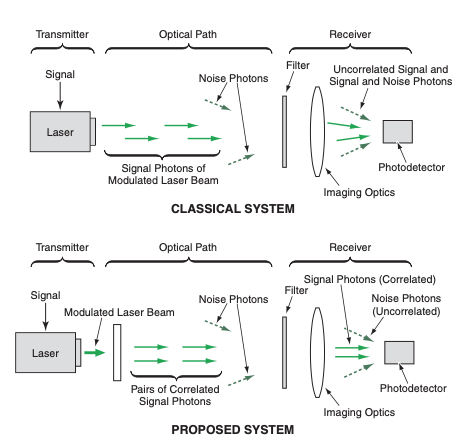
In the proposed system, correlated photons would be generated at the transmitter by making a modulated laser beam pass through a nonlinear parametric down-conversion crystal. The sum of frequencies of the correlated photons in each pair would equal the frequency of the incident photon from which they were generated. As in the classical system, the correlated photons would travel along an optical path to a receiver, where they would be band-pass filtered and detected. Unlike in the classical system, the photodetector in the receiver in this system would be one that intrinsically favors the detection of pairs of correlated photons over the detection of uncorrelated photons. Even though there would be no way of knowing the precise location and time of creation of a given pair of correlated signal photons in the nonlinear down-conversion crystal, the fact that the photons are necessarily created at the same time and place makes it possible to utilize conventional geometrical imaging optics to reunite the photons in coincidence in the receiving photodetector.
Because most or all of the signal photons would be correlated while most or all of the noise photons would be uncorrelated, the S/N would be correspondingly enhanced in the photodetector output. An additional advantage to be gained by use of a correlated-photon detector is that it could be capable of recovering the signal even in the presence of background light so bright that a classical uncorrelated-photon detector would be saturated.
A blocked-impurity-band (BIB) photodetector that preferentially detects pairs of correlated photons over uncorrelated ones and that operates at a quantum efficiency of 88 percent is commercially available. This detector must be cooled to the temperature of liquid helium to obtain the desired low-noise performance. It is planned to use this detector in a proof-of-principle demonstration. In addition, it may be possible to develop GaN-based photodetectors that could offer the desired low-noise performance at room temperature.
This work was done by Deborah Jackson, George Hockney, and Jonathan Dowling of Caltech for NASA's Jet Propulsion Laboratory.
NPO-30633
This Brief includes a Technical Support Package (TSP).
Using Correalted Photons To Suppress Background Noise
(reference NPO30633) is currently available for download from the TSP library.
Don't have an account?
Overview
The document is a NASA Technical Support Package detailing a novel approach to noise rejection in optical communication systems using correlated photons. Authored by Jonathan P. Dowling, George M. Hockney, and Deborah J. Jackson, the report addresses the challenges posed by background noise in optical communications, particularly in scenarios where the signal is overwhelmed by intense background light, such as sunlight or scattered photons in fiber networks.
The primary motivation for this research stems from the limitations of traditional single photon detectors, which can become saturated in high-background environments, making it difficult to establish reliable communication links. The proposed solution involves generating pairs of correlated photons at the transmitter, which are then used to encode the signal information. This method leverages the unique properties of quantum entanglement, allowing for enhanced detection capabilities.
The document outlines the technical aspects of the approach, including the use of a detector designed to have low efficiency for single photon detection but significantly higher efficiency for detecting pairs of photons. This design enables the recovery of the signal even when the background noise is substantial, effectively improving the signal-to-noise ratio. The report highlights that, under optimal conditions, the background noise can be reduced by a factor of 10^-6, which is a significant improvement over conventional methods.
Additionally, the document discusses the implications of this technology for various applications, including free-space optical communications and fiber-optic networks. By employing correlated photons, the system can maintain effective communication links in challenging environments, thus expanding the potential for high-bandwidth data transmission.
The report also includes references to previous works and studies that support the findings and methodologies presented. It emphasizes the novelty of the approach and its potential to transform optical communication systems by providing a robust solution to the pervasive issue of background noise.
In summary, this NASA Technical Support Package presents a cutting-edge technique for noise rejection in optical communications, utilizing the principles of quantum mechanics to enhance signal detection in the presence of overwhelming background noise, thereby paving the way for more reliable and efficient communication technologies.









