An acquisition, tracking, and pointing (ATP) system, under development at the time of reporting the information for this article, is intended to enable a terminal in a free-space optical communication system to continue to aim its transmitting laser beam toward a receiver at a remote terminal when the laser beacon signal from the remote terminal temporarily fades or drops out of sight altogether. Such fades and dropouts can be caused by adverse atmospheric conditions (e.g., rain or clouds). They can also occur when intervening objects block the line of sight between terminals as a result of motions of those objects or of either or both terminals.
A typical prior ATP system in an optical-communication terminal, shown in the upper part of the figure, includes a retroreflector, a beam splitter, and a charge-coupled-device (CCD) image detector mounted on the same platform that holds the transmitting laser. With help of the beam splitter and the retroreflector, the direction of aim of the laser beam, relative to the direction to the beacon, is measured in terms of the relative positions of the beacon and a sample of the laser beam on the CCD. Hence, the CCD output constitutes an indication of the instantaneous aim of the transmitted laser beam and can be used as a feedback control signal for a steering mirror to point the transmitted laser beam toward the beacon. The CCD output is sampled at a high update rate to provide feedback compensation for any motion (including microscopic vibration) of the platform. If the intensity of the beacon signal reaching the CCD is reduced, the beam-pointing performance is reduced. If the reduction is severe or prolonged, the transmitted laser beam may cease to track the beacon, with consequent loss of the communication link.
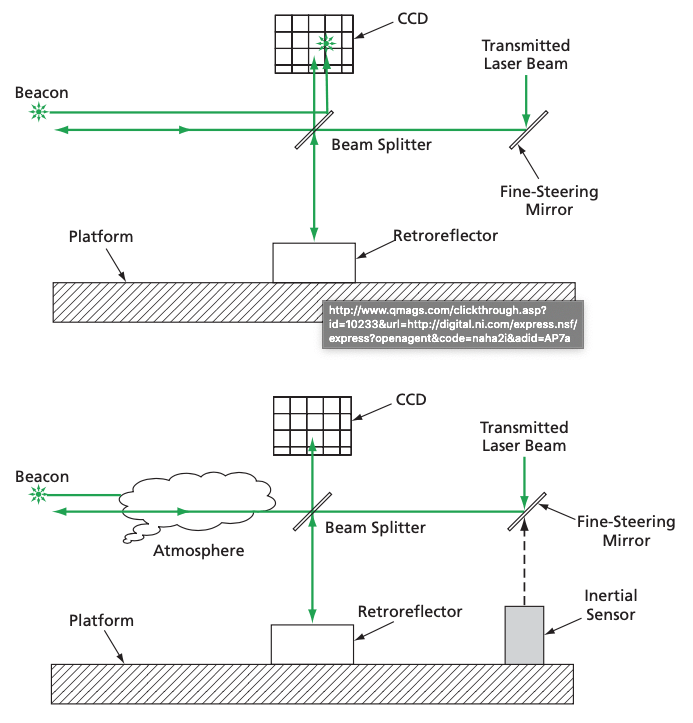
The developmental ATP system, shown in the lower part of the figure, includes all the components of the prior system, plus an inertial sensor, which measures the vibrations and other motions of the platform. The feedback control subsystem utilizes the inertial-sensor output, in addition to the CCD output, as a source of feedback for control of the steering mirror: The inertial signal serves as an approximate indication of the instantaneous orientation of the dimmed (or missing) beacon, making it possible to continue to compensate for vibrations and other motions when the system is partially or totally blind to the beacon.
The time during which compensation can be maintained is limited by the accumulation of integration error since the last observation of the beacon at adequate intensity. Typical atmospheric fades last about 1 ms. It has been estimated that compensation could be maintained for times ranging from tens of milliseconds to tens of seconds, depending on the amount of pointing error that can be tolerated.
This work was done by Gerardo Ortiz and Shinhak Lee of Caltech for NASA's Jet Propulsion Laboratory.
NPO-40061
This Brief includes a Technical Support Package (TSP).
Atmospheric-Fade-Tolerant Tracking and Pointing in Wireless Optical Communication
(reference NPO40061) is currently available for download from the TSP library.
Don't have an account?
Overview
The document presents an innovative Atmospheric Fade Tolerant Acquisition, Tracking, and Pointing (ATP) system developed by Gerardo Ortiz and Shinhak Lee at NASA's Jet Propulsion Laboratory. This technology addresses the challenges faced in optical communications, particularly during atmospheric fades caused by conditions such as clouds, rain, or obstructions that can dim or block the reference beacon signal. Traditional systems struggle under these conditions, often resulting in lost communication links.
The ATP system incorporates high-bandwidth inertial sensors into the tracking loop, which measure platform vibrations—one of the primary disturbances affecting beacon motion. By utilizing the output from these inertial sensors alongside standard beacon tracking algorithms, the system can maintain accurate pointing of the transmit laser towards the receiver, even when the beacon signal is weak or absent. This capability allows for uninterrupted data transmission, which is crucial for high data rate optical communication systems that can lose significant amounts of information during short fades.
The document outlines the operational mechanics of the ATP system, emphasizing that it can maintain accurate pointing for durations ranging from tens of milliseconds to over 10 seconds, depending on the conditions and the acceptable pointing error. This extended tracking capability is particularly beneficial in maintaining communication during adverse weather conditions, increasing data transmission rates, and extending communication ranges while requiring lower beacon power.
The advantages of this new technology include improved communication reliability in challenging atmospheric conditions, enhanced data throughput, and reduced power requirements for the beacon. However, the system does come with some disadvantages, such as increased mass due to the added inertial sensors and greater complexity in the tracking algorithms.
Overall, the ATP system represents a significant advancement in optical communication technology, providing a robust solution to the problem of atmospheric fades and ensuring stable communication links for both moving and stationary platforms. The work is a testament to the ongoing efforts in aerospace technology to enhance communication capabilities in various environments.