

An advanced technique of deep reactive-ion etching (DRIE) has been developed for fabricating smooth vertical walls in silicon wafers. These walls are suitable for use as bounding surfaces of optical waveguides in photonic and optoelectronic devices. The roughness of a typical 8-µm-high vertical wall surface of a waveguide made by this technique is <20 nm; by keeping the roughness at such a low level, one helps to ensure that the waveguide is capable of low-loss optical transmission.
The specific DRIE technique, denoted the "Bosch" technique, involves repeated exposure of a photoresist-masked silicon wafer to (1) an etchant (SF6 + C4F8 ) plasma in alternation with a passivant (C4F8) plasma. To ensure vertical, smooth walls, it is necessary to investigate, in detail, the effects of variations in all photoresist and DRIE process parameters and then to exert tight control over these parameters. Among other things, this means that the photoresist process parameters must be chosen to obtain perpendicular photoresist side walls. The power levels of the plasma apparatus in the etching and passivating steps, the durations of these steps, the total number of etching-and-passivating cycles, and the pressures and rates of flow of the SF6 and C4F8 gases must also be investigated in detail and then controlled to obtain vertical walls with low roughness.
Ranges of parameters that have been investigated in a DRIE apparatus at NASA's Jet Propulsion Laboratory are the following:
- Total process time - 10 to 30 minutes;
- Pressure - 5 to 40 millitorr (0.7 to 5 Pa)
- Durations of etching and passivating steps - 4 to 10 seconds;
- Rate of flow of SF6 gas during etching step - 100 to 180 standard cubic centimeters per minute (sccm);
- Rate of flow of C4F8 gas during etching step - 30 to 70 sccm;
- Platen power during etching step - 12 to 16 W;
- Coil power during etching step - 575 to 650 W;
- Rate of flow of C4F8 during passivating step - 90 to 140 sccm;
- Platen power during passivating step -0 to 2 W;
- Coil power during passivating step - 575 to 650 W.
This work was done by Chi Wu, Stephen Vargo, and Tasha Turner of Caltech for NASA's Jet Propulsion Laboratory.
In accordance with Public Law 96-517, the contractor has elected to retain title to this invention. Inquiries concerning rights for its commercial use should be addressed to
Technology Reporting Office
JPL
Mail Stop 122-116
4800 Oak Grove Drive
Pasadena, CA 91109
(818) 354-2240
Refer to NPO-20756
This Brief includes a Technical Support Package (TSP).
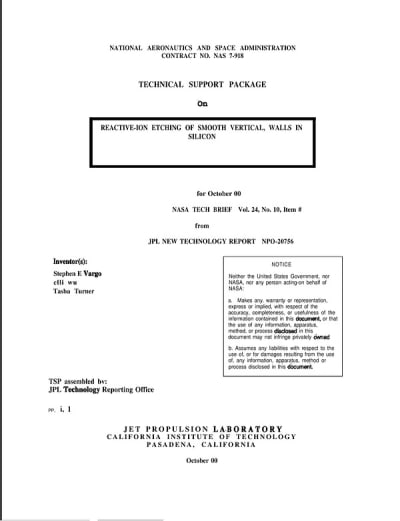
Reactive-Ion Etching of Smooth Vertical Walls in Silicon
(reference NPO20756) is currently available for download from the TSP library.
Don't have an account?
Overview
The document presents a technical overview of an advanced deep reactive-ion etching (DRIE) technique developed for fabricating smooth vertical walls in silicon wafers, which are essential for optical waveguides in photonic and optoelectronic devices. This technique, referred to as the "Bosch" process, involves alternating exposure of a photoresist-masked silicon wafer to etchant and passivant plasmas, specifically using SF6 and C4F8 gases.
Key highlights of the process include the need for precise control over various parameters to achieve vertical walls with low roughness. The document outlines the critical parameters investigated during the DRIE process at NASA’s Jet Propulsion Laboratory (JPL), including:
- Total Process Time: 10 to 30 minutes
- Pressure: 5 to 40 millitorr (0.7 to 5 Pa)
- Etching and Passivating Step Durations: 4 to 10 seconds
- Flow Rates: SF6 gas (100 to 180 standard cubic centimeters per minute) and C4F8 gas (30 to 70 sccm during etching; 90 to 140 sccm during passivation)
- Platen Power: 12 to 16 W during etching and 0 to 2 W during passivation
- Coil Power: 575 to 650 W for both etching and passivation steps
The document emphasizes that achieving smooth vertical walls with a roughness of less than 20 nm is crucial for ensuring low-loss optical transmission in waveguides. The authors, Chi Wu, Stephen Vargo, and Tasha Turner, conducted this research for NASA at JPL, highlighting the importance of detailed investigation and control of the DRIE process parameters.
Additionally, the document includes a disclaimer stating that references to specific commercial products or processes do not imply endorsement by the U.S. Government or JPL. It also notes that the work was carried out under contract with NASA, emphasizing the collaborative nature of the research.
In summary, this document serves as a technical brief on the Bosch technique for DRIE, detailing the process parameters necessary for fabricating high-quality silicon waveguides, which are vital for advancements in optical technologies.











