

A proposed method of FQPSK modulation and demodulation of a radio signal would incorporate any of a number of relatively simple (short-constraintlength) outer codes. By affording significant coding gains even when using a reduced-complexity (and thus suboptimal) FQPSK receiver, this method would offer the concomitant potential to enhance efficiency in power and spectral width of an FQPSK communication system.
is a bandwidth-efficient phasemodulation scheme named after its inventor. Among the notable features of FQPSK is shaping of what would otherwise be square in-phase (I) and quadrature (Q) pulse waveforms, such that the signal envelope (in effect, the power of the transmitted signal) remains nearly constant. The shaping involves, among other things, a cross-correlation between the I and Q channels. The nature of the cross-correlation is such as to effectively incorporate a trellis coding scheme into FQPSK.
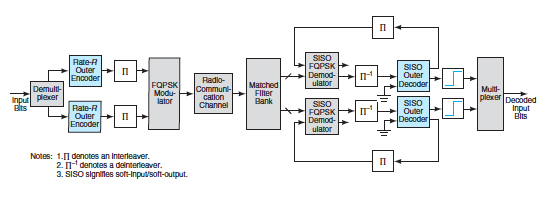
According to the proposed method, a short-constraint-length code (in effect, an outer code) would be introduced into a data stream via an interleaver prior to modulation of the carrier signal in an FQPSK transmitter. The combination of this outer code with the trellis or convolutional code inherent in FQPSK (in effect, an inner code) would form a concatenated coding arrangement which allows for iterative decoding. At the receiver, the iterative decoding would be part of the demodulation process.
The figure depicts one of a number of generic coding/decoding schemes, admitted by this method, that includes the use of a reduced-complexity receiver. Computational simulations for this scheme with various outer codes, interleaver block sizes, and numbers of decoding iterations demonstrated the potential to obtain coding gains (in terms of signal-to-noise ratio needed to keep the bit-error rate below a specified value) ranging from 3.75 to 7.7 dB.
This work was done by Marvin Simon and Dariush Divsalar of Caltech for NASA’s Jet Propulsion Laboratory.
In accordance with Public Law 96-517, the contractor has elected to retain title to this invention. Inquiries concerning rights for its commercial use should be addressed to
Intellectual Property group
JPL
Mail Stop 202-233
4800 Oak Grove Drive
Pasadena, CA 91109
(818) 354-2240
Refer to NPO-30135, volume and number of this NASA Tech Briefs issue, and the page number.
This Brief includes a Technical Support Package (TSP).
FQPSK With an Outer Code for Greater Efficiency
(reference NPO-30135) is currently available for download from the TSP library.
Don't have an account?
Overview
The document presents a technical report on a novel approach to Feher-patented Quadrature Phase-Shift Keying (FQPSK) modulation and demodulation, developed by Marvin K. Simon and Dariush Divsalar at NASA's Jet Propulsion Laboratory. The focus is on enhancing power and bandwidth efficiency through the use of outer coding in conjunction with the inherent trellis coding of FQPSK.
FQPSK is a bandwidth-efficient phase modulation technique characterized by its ability to maintain a nearly constant signal envelope, which is crucial for effective communication. The proposed method introduces relatively simple outer codes with short constraint lengths into the data stream before modulation. This is achieved through an interleaver, which prepares the data for transmission. The combination of these outer codes with the inner trellis or convolutional codes of FQPSK forms a concatenated coding arrangement that allows for iterative decoding at the receiver.
The document details computational simulations that demonstrate significant coding gains, quantified in terms of signal-to-noise ratio improvements ranging from 3.75 to 7.7 dB. These gains are particularly notable even when utilizing a reduced-complexity FQPSK receiver, which is designed to be less computationally intensive while still achieving effective performance.
The report outlines various configurations for the concatenation of coding schemes and presents specific numerical results to illustrate the potential benefits of this approach. The iterative decoding process is integrated into the demodulation phase, enhancing the overall efficiency of the communication system.
In summary, the work emphasizes the importance of coding strategies in improving the performance of FQPSK systems, particularly in scenarios where power and bandwidth efficiency are critical. The findings suggest that the proposed method could lead to advancements in communication technologies, making them more effective for various applications, including those in space exploration and other demanding environments.
The document serves as a valuable resource for researchers and engineers interested in coding theory, modulation techniques, and the development of efficient communication systems, highlighting the innovative contributions of the Jet Propulsion Laboratory in this field.











