

A method of processing data acquired by ultra-wide-band (UWB) syntheticaperture radar (SAR) provides for suppression of those errors that are caused by the undesired relative motion of the radar platform and the targets. This method involves, among other things, processing of data in the wave-number or frequency domain and the application of motion compensation as a function of the positions of a target relative to the radar platform.
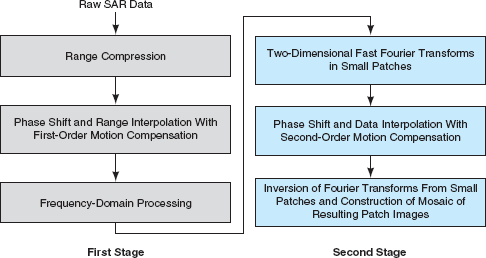
In a wide-beam SAR system, the key dilemma in properly compensating for motion is that one needs to track the location of each target on an SAR strip map, but the locations of the targets are not known from the outset. The present method addresses this dilemma. The method involves two stages of processing (see figure).
In the first stage, a strip parallel to the flight track is processed and targets are motion compensated, assuming that they are located in the antenna fan beam plane. Following the first-order motion compensation, a frequency-domain SAR processing algorithm is applied. The motion compensation for targets in off-boresight directions is not correct, but the motion compensation for the target(s) in the nominal center of the beam is correct. This stage of processing ensures that target impulse responses are located correctly geometrically, albeit insufficiently focused.
In the second stage of processing, the data strip is divided into overlapping small patches and it is pretended that the target(s) in each small patch lie at the center of the patch. The data processed in stage 1 are reprocessed within each small patch to refine the motion compensation. This reprocessing includes second-order motion compensation that takes the form of frequency and phase shifts applied to the partially motion-compensated UWB SAR data. Inasmuch as the motion compensation is perfect only at the center of each small patch, the smaller the patches, the better the motion-compensation performance. For the sake of computational efficiency, the two-stage processing algorithm has been formulated such that the reprocessing in small patches is much less computationally demanding than is the processing of the wide area patch, such that it is computationally affordable to reprocess many small patches.
This work was done by Soren Madsen of Caltech for NASA’s Jet Propulsion Laboratory. For further information, access the Technical Support Package (TSP) free on-line at www.nasatech.com/tsp under the Information Sciences category. NPO-21096
This Brief includes a Technical Support Package (TSP).
Compensating for Motion Errors in UWB SAR Data
(reference NPO-21096) is currently available for download from the TSP library.
Don't have an account?
Overview
The document discusses a novel method for compensating for motion errors in ultra-wide-band (UWB) synthetic-aperture radar (SAR) data, developed by Soren Madsen at NASA's Jet Propulsion Laboratory. UWB SAR presents unique challenges compared to traditional narrow-band SAR due to its wide radar beam and the lack of a well-defined radar signal frequency. These factors complicate the motion compensation process, which is crucial for accurately locating targets on an SAR strip map.
The proposed method involves a two-stage processing algorithm designed to enhance motion compensation. In the first stage, a data strip parallel to the flight track is processed, assuming that targets are located within the antenna fan beam plane. This initial processing applies first-order motion compensation, which is effective for targets at the center of the beam but less accurate for off-boresight targets.
The second stage refines this initial compensation by dividing the data strip into overlapping small patches. Each patch is treated as if the target is at its center, allowing for more precise second-order motion compensation through frequency and phase shifts. This approach improves the accuracy of motion compensation, particularly for targets located away from the center of the beam. The smaller the patches, the better the motion compensation performance, while still maintaining computational efficiency.
The document emphasizes that the two-stage processing algorithm is computationally efficient, enabling the reprocessing of many small patches without excessive computational demands. This efficiency is crucial for practical applications, as it allows for the handling of large datasets typical in UWB SAR operations.
Overall, the method addresses the key dilemma of tracking target locations in a wide-beam SAR system, where targets are not known in advance. By applying motion compensation as a function of target range and azimuth angle, the proposed algorithm significantly enhances the accuracy of UWB SAR data processing. The work is documented in a technical support package and is intended for researchers and practitioners in the field of remote sensing and radar technology.











