

A method of sequence detection has been proposed to mitigate the effects of inter-slot interference and inter-symbol interference (both denoted "ISI") in the reception of M-ary pulse-position modulation (PPM) optical signals. The method would make it possible to reduce the error rate for a given slot duration, to use a shorter slot duration (and, hence, to communicate at a higher rate) without exceeding a given error rate, or to use a lower-bandwidth (and, hence, less-expensive) receiver to receive a signal of a given slot width without exceeding a given error rate.
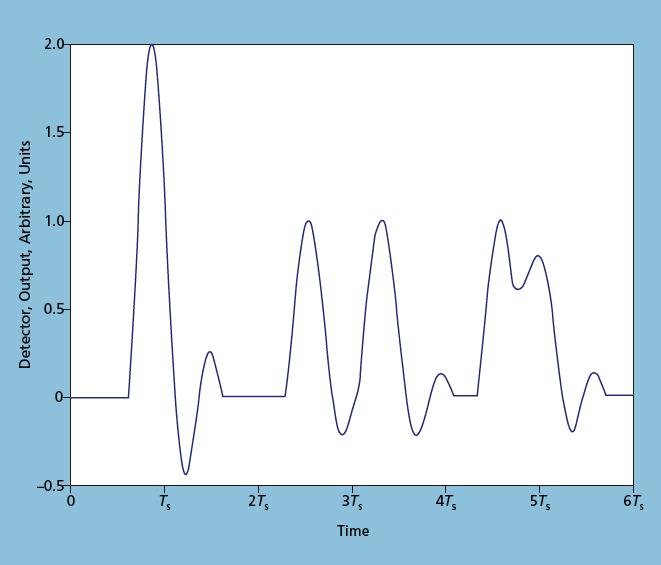
The photodetector in a PPM receiver produces a pulse in response to each incident photon, so that, in effect, the receiver counts arriving signal photons. Because the duration of each pulse is finite, the response of the detector during a given time slot can include or consist of one or more tails of pulses from photons belonging to the preceding time slot (see figure). As a result, depending on the bit-to-symbol mapping of the PPM code in use, the receiver could interpret the current received symbol as other than the intended symbol. ISI is the tendency toward erroneous interpretation of this kind. The severity of ISI increases as Ts decreases. Hence, the pulse duration imposes a lower limit on the range of useable Ts values.
The present method of reducing ISI involves mathematical modeling of ISI, a novel bit-to-symbol mapping (that is, a novel PPM code), and an iterative demodulation-and-decoding scheme. The method can be implemented in a receiver of relatively low complexity.
In the mathematical model, photons are assumed to arrive at randomly distributed instants during each time slot. The number of photons arriving during a time slot is assumed to be Poisson-distributed, with mean nb in a noise-only ("0") slot or mean ns(1 – β/2) + nb during a signal-plus-noise ("1") slot, where β is the average detector-output energy that appears in the adjacent time slots. The fraction β depends on the shape of the detector output pulse. The method includes dividing each Ts into a number (typically, 64) of sampling periods and summing the digitized detector-output samples from these periods to estimate the integral of the detector-output waveform. The sums thus computed are used, in conjunction with the mathematical model, to form likelihoods for the iterative demodulation-and-decoding scheme.
The novel bit-symbol mapping, denoted anti-Gray, stands in contrast with two prior mappings, denoted natural and Gray, respectively. In a natural mapping, an input a (where a is an integer between 0 and M – 1) is mapped to a pulse in position a. In a Gray mapping, pairs of PPM symbols characterized by pulses in adjacent slots are mapped to input pairs with minimal Hamming distance (1). In an anti-Gray mapping, pairs of PPM symbols with pulses in adjacent slots are mapped to input pairs with maximal Hamming distance [log2(M) or log2(M) – 1]. By means of computational simulations, it has been shown that an anti-Gray mapping reduces bit and word error rates, relative to those of a natural mapping, by amounts that correspond to a 0.25 dB increase in signal strength.
This work was done by Bruce Moision, Meera Srinivasan, and Clement Lee of Caltech for NASA's Jet Propulsion Laboratory.
NPO-41271
This Brief includes a Technical Support Package (TSP).
Sequence Detection for PPM Optical Communication With ISI
(reference NPO-41271) is currently available for download from the TSP library.
Don't have an account?
Overview
The document titled "Sequence Detection for PPM Optical Communication With ISI" (NPO-41271) is a technical support package from NASA's Jet Propulsion Laboratory (JPL) that discusses advancements in optical communication technology, particularly in the context of pulse position modulation (PPM) and inter-symbol interference (ISI).
The primary focus of this document is on the development of sequence detection methods that improve the reliability and efficiency of optical communication systems, which are crucial for various aerospace applications. The presence of inter-symbol interference can significantly degrade the performance of communication systems by causing errors in signal interpretation. This document outlines innovative techniques designed to mitigate these effects, thereby enhancing the overall performance of optical communication channels.
The technical support package is part of NASA's Commercial Technology Program, which aims to disseminate aerospace-related developments that have broader technological, scientific, or commercial implications. The document serves as a resource for researchers, engineers, and industry professionals interested in the latest advancements in optical communication technologies.
In addition to the technical details, the document provides information on how to access further resources and assistance through NASA's Scientific and Technical Information (STI) Program Office. It emphasizes the importance of compliance with U.S. export regulations and the proprietary nature of the information contained within the document.
Overall, this technical support package represents a significant contribution to the field of optical communication, offering insights into advanced detection techniques that can be applied in various high-tech environments, including space exploration and satellite communications. The findings and methodologies discussed in this document are expected to have a lasting impact on the development of more robust and efficient communication systems in the aerospace sector and beyond.
For those interested in exploring this topic further, the document encourages engagement with NASA's STI Help Desk and provides contact information for additional inquiries. This reflects NASA's commitment to fostering innovation and collaboration in technology development.











