

Non-polymeric N,N´-di-N-hydrocarbyl- 2,5-diamino-1,4-benzoquinones (where the hydrocarbyl substituents are alkyl or aryl) have been found to be useful as corrosion-inhibiting additives for paints and other conventional coating materials that are applied to steel and other metals. Prior coating additives made from reactions of benzoquinones with diamines are polymeric. Such polymers are expensive and difficult to make. Moreover, being polymers, they cannot diffuse much and hence are believed not to protect uncoated areas of metal against corrosion. In contrast, when used in proper concentrations, the present non-polymeric diaminobenzoquinones provide enhanced protection that extends somewhat from the edges of coats into uncoated areas — an important advantage in situations in which there are imperfections (e.g., gaps, scratches, and blisters) in coats of paint.
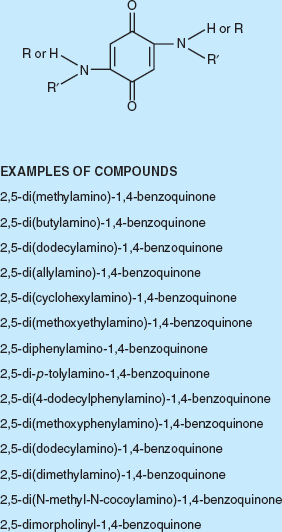
The figure depicts the generic molecular structure and lists examples of the present corrosion-inhibiting compounds. Each of these compounds is synthesized from 1,4-benzoquinone and the corresponding amine. In those listed compounds that contain NH groups, the reactivity of the NH groups is attenuated by the attached electron-poor quinone structures; consequently, those compounds are practically unreactive under normal conditions for curing coating materials, so that the compounds behave as additives, not reactives.
Unlike prior functionally substituted or polymeric diaminobenzoquinones, the present corrosion inhibitors are not limited to use in coating materials based on a particular family of polymers. Examples of types of coating materials to which the present compounds can be added for effective protection against corrosion include acrylics, polyesters, alkyds, polyamides, epoxies, phenolics, aminoplastics, polyimides, urethanes, silicones, and coating materials based on unsaturated drying oils.
The preferred amounts of these compounds lie in the range from 2 to 15 weight percent of coating solids. In each case, the chosen additive of this type is dissolved in the coating material (insofar as it is soluble) before the coating material is applied to steel. Alternatively or in addition, insofar as the additive is insoluble, it is dispersed into the coating material in finely powdered form. The standard paint-making techniques and materials can all be used in conjunction with the present corrosion-inhibiting compounds. In addition, the present corrosion-inhibiting compounds can be included in paints and other coating materials together with other corrosion-inhibiting compounds, such as chromates, molybdates, borates, and carbonates.
This work was done by Edward D. Weil of Polytechnic University for Kennedy Space Center. For further information, access the Technical Support Package (TSP) free on-line at www.nasatech.com/tsp under the Materials category.
This invention is owned by NASA, and a patent application has been filed. Inquiries concerning nonexclusive or exclusive license for its commercial development should be addressed to
the Technology Programs and Commercialization Office,
Kennedy Space Center,
(321) 867-6373.
Refer to KSC-11979.







