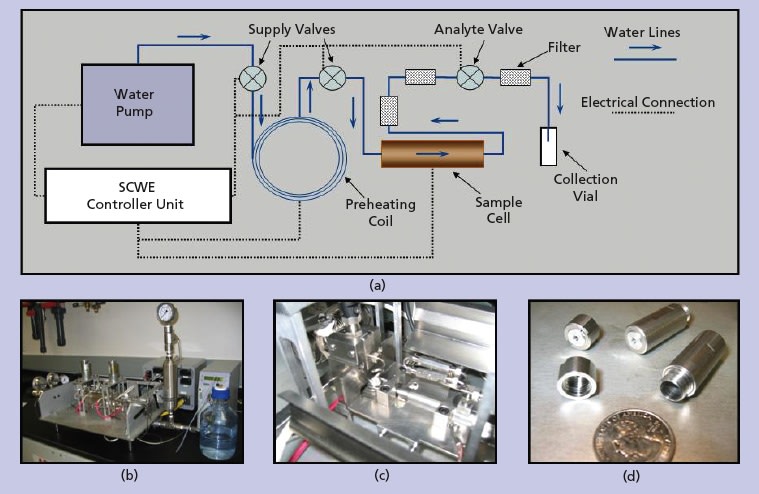
An apparatus for extracting organic compounds from soils, sands, and other solid matrix materials utilizes water at subcritical temperature and pressure as a solvent. The apparatus, called subcritical water extractor (SCWE), is a prototype of subsystems of future instrumentation systems to be used in searching for organic compounds as signs of past or present life on Mars. An aqueous solution generated by an apparatus like this one can be analyzed by any of a variety of established chromatographic or spectroscopic means to detect the dissolved organic compound(s). The apparatus can be used on Earth: indeed, in proof-of-concept experiments, SCWE was used to extract amino acids from soils of the Atacama Desert (Chile), which was chosen because the dryness and other relevant soil conditions there approximate those on Mars.
Heretofore, laboratory extractions of organic compounds have involved the use, variously, of toxic organic solvents in Soxhlet extraction, strong acids in amino acid vapor-phase hydrolysis, or carbon dioxide as a solvent at supercritical temperature and pressure. Supercritical CO2 is effective as a solvent for extracting lipids and other very nonpolar organic compounds because its relative permittivity is 1.4 and does not vary significantly with pressure in the range of 7 to 21 MPa or with temperature in the range of 25 to 200 °C. However, supercritical CO2 is often inadequate as a solvent for extraction of other nonpolar and polar organics. Frequently, it is necessary to mix supercritical CO2 with methanol or other more-polar organic solvents to obtain an extraction solvent having a greater relative permittivity.
The apparatus (see figure) includes a sample cell, into which a solid sample is placed. During a typical extraction, water is pumped to the required high pressure through supply valves, a preheating coil, the sample cell, and an analyte valve into a collection vial. The filters, at various positions downstream of the sample cell, prevent contamination of analytical instruments by particles of the sample solid matrix.
Relative to prior methods and apparatuses used to extract organic compounds, the present apparatus and the method of its operation offer several advantages:
- The solvent (water) is environmentally benign;
- The relative permittivity of the solvent can be adjusted to the values needed to selectively extract, with high efficiency, organic compounds that have different physical and chemical properties;
- The basic principle of operation is simple;
- The apparatus can be highly automated;
- Whereas Soxhlet and hydrolysis extractions often take many hours, an extraction by use of this apparatus takes only minutes.
This work was done by Xenia Amashukeli, Frank Grunthaner, Steven Patrick, James Kirby, Donald Bickler, Peter Willis, Christine Pelletier, and Charles Bryson of Caltech for NASA’s Jet Propulsion Laboratory. NPO-44144
This Brief includes a Technical Support Package (TSP).
Subcritical-Water Extraction of Organics From Solid Matrices
(reference NPO-44144) is currently available for download from the TSP library.
Don't have an account?
Overview
The document discusses the development and application of a subcritical water extractor (SCWE) designed for the extraction of organic compounds from solid matrices, such as soils. The SCWE leverages the unique properties of water, particularly its dielectric constant, which varies with temperature and pressure. At lower temperatures, water has a high dielectric constant, making it effective for extracting polar compounds. However, as temperature increases, the dielectric constant decreases, allowing water to behave similarly to nonpolar organic solvents at higher temperatures and pressures.
The SCWE presents several advantages over traditional extraction methods, which often rely on toxic organic solvents like toluene and hexane or supercritical carbon dioxide (CO2). These advantages include the use of environmentally benign water as a solvent, the ability to adjust the dielectric constant for selective extraction, operational simplicity, high extraction efficiency, and rapid processing times. The SCWE can effectively extract a range of organic compounds with varying physical and chemical properties, making it a versatile tool for scientific research.
The document emphasizes the importance of effective extraction methods for the detection and analysis of biomarker compounds, particularly in the context of NASA's search for organic molecules indicative of life on Mars. The SCWE has been successfully used to extract amino acids from soils, including those resembling Martian conditions, demonstrating its potential for in situ applications on Mars. The extraction protocols developed for amino acids focus on a temperature range of 30°C to 250°C to optimize solubility while minimizing decomposition.
Additionally, the document outlines the design of a portable SCWE system, which is capable of performing extractions in field studies. This system includes features such as a sample cell chamber, a water heating coil, and precise temperature and pressure controls to ensure efficient extraction without sample loss.
In summary, the SCWE represents a significant advancement in the extraction of organic compounds from solid matrices, with promising applications in astrobiology and planetary exploration. Its environmentally friendly approach and operational efficiency make it a valuable tool for future missions aimed at detecting signs of life beyond Earth.