A mathematical model has been developed to predict the behavior of mutually interacting drops of a first fluid surrounded by a second fluid, under quiescent conditions at supercritical temperature. The model has been specialized to represent the behavior of drops of liquid oxygen surrounded by hydrogen under supercritical conditions like those encountered in a rocket-engine combustion chamber.
The drops of liquid oxygen are formed by atomization from jets of liquid oxygen. There is considerable experimental evidence that the atomization process forms the drops in clusters, and that the drops interact within each cluster. The interaction among drops affects the stability of combustion process. Therefore, a model like the present one is needed for designing combustors, and for analyzing and controlling their operation.

The situation represented by the present interacting-drop model is that of a cluster of a finite number of drops of one fluid (which could be liquid oxygen) immersed in another fluid (a dense gas that could be hydrogen). All the drops are assumed to be spheres of same radius, and each drop is assumed to reside in a fictitious sphere of influence with a radius equal to half the distance to the nearest neighbor drop in the cluster. The interstitial region between the spheres of influence is assumed to be uniform and quiescent with respect to the cluster. Each sphere of influence contains one drop and its surrounding fluid, and has fixed mass; this means that the sphere of influence expands or contracts in response to variations in temperature.
The behavior of a drop within its sphere of influence is represented by the isolated-drop model described in the first of the two preceding articles – "Model of a Drop of O2 Surrounded by H2 at High Pressure" (NPO-20220). The interactions among drops and the resulting collective behavior of the drops are represented by using equations for the conservation of total mass, conservation of the mass of each fluid, and conservation of energy in the interstitial region to establish boundary conditions for the spheres of influence. Transfers of heat and mass to the cluster are modeled via a Nusselt-number formulation.
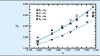
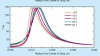
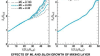
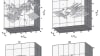
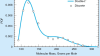
Numerical results from calculations for the liquid-oxygen/hydrogen system (see figure) show that the behavior of a cluster is insensitive to variations of the Nusselt number over 3 orders of magnitude. The results also show that at fixed pressure, the accumulation of oxygen in the interstitial region increases with decreasing distance between drops. At fixed initial distance between drops, the gradients of dependent variables become increasingly smeared as pressure increases; this behavior is qualitatively the opposite of that observed for isolated drops. From these observations it is inferred that clusters of drops might be desirable in supercritical combustion because they aid mixing of reactants.
This work was done by Josette Bellan and Kenneth Harstad of Caltech forNASA's Jet Propulsion Laboratory. NPO-20257
This Brief includes a Technical Support Package (TSP).
Model of interacting O2 drops surrounded by H2 at a high pressure
(reference NPO20257) is currently available for download from the TSP library.
Don't have an account?
Overview
The document is a technical support package from NASA, detailing a study on the modeling of interacting oxygen (O₂) drops surrounded by hydrogen (H₂) at high pressure, authored by Josette Bellan and Kenneth G. Harstad. This research is significant for the development of liquid rocket motors, where the atomization of liquid oxygen is critical for efficient combustion.
The study highlights two primary methods of atomization: coaxial jets of liquid oxygen surrounded by hydrogen streams and impinging jets, which can be either liquid oxygen interacting with itself or with a fuel. Experimental observations indicate that the initial formation of ligaments occurs during atomization, which subsequently disintegrate into clusters of drops. This process is essential for achieving effective mixing of reactants, which is crucial for combustion stability and efficiency.
The document references various studies that have documented the breakup process of liquid jets, emphasizing that drops created during atomization do not behave as isolated entities. Instead, they exhibit collective behavior, which is vital for controlling high-frequency combustion instabilities. The interactions among fluid drops at high pressure have been modeled, although existing models may not fully capture the complexities of high-pressure transport processes, particularly in supercritical regimes.
The research underscores the importance of understanding fluid drop interactions to improve the design and operation of rocket engines. The findings suggest that the response function in combustion systems must account for these interactions to enhance performance and stability.
Additionally, the document includes disclaimers regarding the information presented, clarifying that references to specific commercial products or processes do not imply endorsement by the U.S. Government or NASA. The work was conducted at the Jet Propulsion Laboratory (JPL) under a contract with NASA, emphasizing the collaborative nature of aerospace research.
Overall, this technical support package provides valuable insights into the atomization processes in liquid rocket motors, highlighting the significance of drop interactions in high-pressure environments and their implications for combustion stability and efficiency in aerospace applications.